
You can also listen to this podcast on iono.fm here.
JIMMY MOYAHA: Standard Bank Group limited released their full-year results for the year ended 31st December 2025. For those who somehow do not know The Standard Bank Group, it is the largest bank on the African continent, with assets under management closer to the $200 billion mark.
Read: Standard Bank profit rises to record on fee growth, client gains
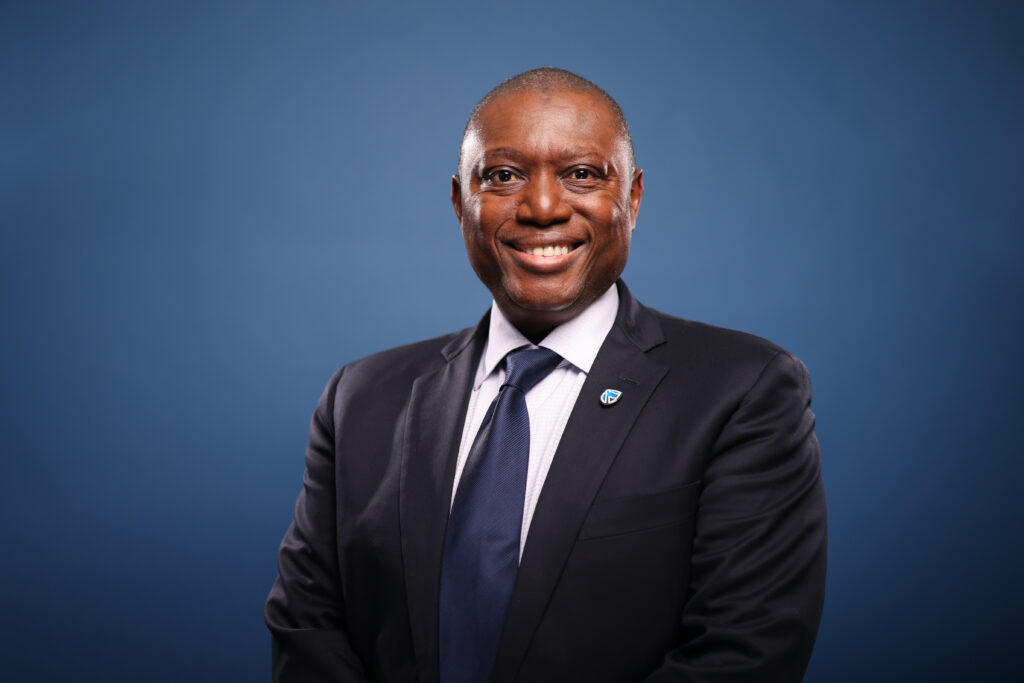
To reflect on these numbers, I’m joined on the line by the company’s group chief executive, Sim Tshabalala, to look at the numbers and see if we can make sense of them.
Malume Sim, always lovely having you on the show. Always a pleasure catching up on the company’s performance. A strong performance at that. All metrics really in double digits. Very, very little to complain about from a business perspective.
But in your words and from the words of your team, how did you find the year?
SIM TSHABALALA: Jimmy, we found the year exhilarating, hard, but it was gratifying to end the year having met all the promises that you’d made to shareholders.
It was a real privilege and a real pleasure to be able to say that you promised an ROE [return on investment] in the target range and then you get to the top of the target range.
[And] to promise a cost-income ratio approaching 50%, and you get to 50.3%, and so forth is just an absolute privilege.
And then, of course, we employ 50 000 people who are earnest, good people. They love this institution; they love their clients. And every single day they’ve added value to those clients and these numbers show it.
So it’s been a wonderful, wonderful year.
JIMMY MOYAHA: Malume Sim, let’s take a look at the numbers in a bit more detail. The business is divided into smaller business units almost, but still each of these business units is a giant in its own right. Take me through just the performance of the different business units that sit within the Standard Bank Group portfolio, and how they fared both locally and abroad.
SIM TSHABALALA: You are alluding to something fundamental to the Standard Bank competitive advantage, which is just the sheer might and diversity of this institution.
ADVERTISEMENT
CONTINUE READING BELOW
And the business units are an illustration thereof:
Insurance and asset management – they were up 26% at R4.1 billion.
Personal and Business Banking – a giant, R11.4 billion. This entity could be a listed entity in its own right and it would be a behemoth on the JSE. They were up 3%.
Business and Commercial Banking was down 4%. They made R9.2 billion, but with an ROE of 38% – 38%, just picture that!
And then Corporate and Investment Banking was a dominant business. It’s half the size of our group. That was up 18%, R24 billion. So there you go – a juggernaut.
Each of those subcomponents is a juggernaut in its own right, demonstrating this portfolio that I’m referring to.
I might just add, then, you have South Africa – if you look at it from a geographic point of view – making us close to R20 billion, up 7%.
And then you have Africa regions – East, South, Central and West Africa making us also close to just shy of R19.6 billion. They were up 9%.
A proper portfolio.
JIMMY MOYAHA: Malume Sim, let’s look at the business from an operational level, the ability to operate across the African continent, serving different groups, different geographies, different regulatory restrictions – all the while growing the business in each of the markets.
How does the business do that? What is the secret to being able to expand but also maintain the strategy? We’re in the middle of Vision 2028, and I know you’re going to want to see as much of that through as possible. How does the business continue the momentum year after year?
SIM TSHABALALA: Quite simply by recognising that we are executing a strategy that has been in place since the 1980s – in 1988, when the three leaders of the business decided, after [Standard Chartered] sold, that they would grow the business outside South Africa.
They started in Swaziland in 1988, then Botswana.
Then they bought the Grindlays [Bank] in 1994, represented in eight countries, and over time building this business by way of greenfields in Angola.
The Angolan business is now one of the top banks in Angola.
ADVERTISEMENT:
CONTINUE READING BELOW
Partnering with [inaudible] in Mozambique, we are now the top bank in Mozambique, having bought the business from [Banco Standard Totta de Mozambique].
In Nigeria we have the best corporate and investment bank. It’s a partnership, an old relationship between ourselves and Stanbic IBTC.
My point is it’s a long-lived strategy that the current management team is executing with just plain discipline.
Having said that, we also have a risk management framework built over the years. And, as I said off the podium this morning, that risk management framework is a deep, deep understanding of credit risk, market risk, strategic risk, understanding what happens in Angola as being very, very different to what happens in Uganda, and making sure that you understand this portfolio and have active portfolio management – and then having a board that is on the ball that understands these risks.
And then, of course, you need to understand the fact that 21 jurisdictions have 21 [sets of] laws and regulations that you as a shareholder need to be in control of; but you need to be respectful of the laws and regulations in countries.
And then [you need to] make sure that you are close to your clients, you understand their needs, the cross-border clients, the multinationals having different demands to domestic clients, and being able to deal with those clients.
And then lastly, making sure that you are connected to the whole world. By the whole world, I mean the whole world.
Whether it be the EU, the United States, China, India, the Gulf states – and serving those clients to the extent that they are trading, helping the movement of goods, people and ideas between the continent and these countries.
JIMMY MOYAHA: Malume Sim, before I let you go, I want to take a look at the 2028 strategy. We won’t mention the events of 2027 as they are yet to happen, and we don’t want to reflect on such negativity just yet.
Read:
In bank boss merry-go-round, there’s only one clear winner …
David Hodnett to lead Standard Bank SA
But I want to take a look at the fact that the bank has been able to mobilise a little over R100 billion in sustainable finance in the past financial year alone, very much on track with the objectives before 2028.
Looking at the bank’s positioning right now on the African continent and comparing it to some of the global geopolitical events that are unfolding, how is the bank seeing the macros on the continent? How is the bank seeing the rest of the development strategy? Does anything have you concerned or does anything have you excited?
SIM TSHABALALA: All of the above. We have a target for sustainability finance – R450 billion, and we’re going to meet that target.
We’ve got a set of targets we have set for the medium term, like you say, of headline earnings per share of between 8% and 12%, and an ROE of between 18% and 22%. We are absolutely determined to meet those targets.
Yes, we have a portfolio of countries as we have been speaking, but generally growth across sub-Saharan Africa is going to be resilient, we believe, and will be in the mid-4% range between 2025 and 2026.
ADVERTISEMENT:
CONTINUE READING BELOW
And going into 2028 and towards 2030 Africa will be the fastest-growing continent in the world.
A couple of dynamics. Let’s start with the oil exporter Nigeria. Great progress in macroeconomic conditions, great policy adjustments, great fiscal rectitude, great discipline in monetary policy – and they are getting the benefit of that.
That shows up in our business because our West Africa region has been the fastest-growing region in our business, driven by Nigeria and then of course, Ghana, DRC and Angola.
Read: East Africa emerging as the continent’s most strategic growth frontier – Tshabalala
Turning to the East, you’ve got Kenya also. It stands out, driven by infrastructural investment, recovering private debt; credit is recovering, and [there is] a very stable macro framework in that country, forming part of a great network with Kenya, Tanzania, Uganda, DRC and Ethiopia.
And a fantastic opportunity, the East Africa community.
Now, clearly the events that you are alluding to in the Middle East are something to be contemplated with concern. But it’s going to have different impacts, different dynamics.
South Africa, being an oil importer, is going to import the inflation and therefore it will have implications for GDP growth and interest rates. Nigeria could benefit from high oil prices as long as there’s no pressure on inflation in the case of Nigeria.
Using those two as examples of challenges and opportunities, we hope and pray that the situation resolves itself as quickly as possible so that the impact on global GDP and African GDP is minimal.
But you could envisage a scenario where the oil price is above $110/barrel for a long time, which would have a serious negative impact on GDP growth if that was sustained for a long period.
We’ve got all of those scenarios, we’ve worked through them, and we’re positioning our bank to take advantage of opportunities that arise while mitigating the risks.
JIMMY MOYAHA: The juggernaut that is the Standard Bank Group is continuing to grow its business across all fronts and in all regions, [with] a clear focus on the 2028 strategy, and not wavering from its commitment.
That was the group chief executive officer, Sim Tshabalala, joining us to take a look at the performance of the bank and what to make of it.
#hard #exhilarating #year #Standard #Bank #Group #CEO