
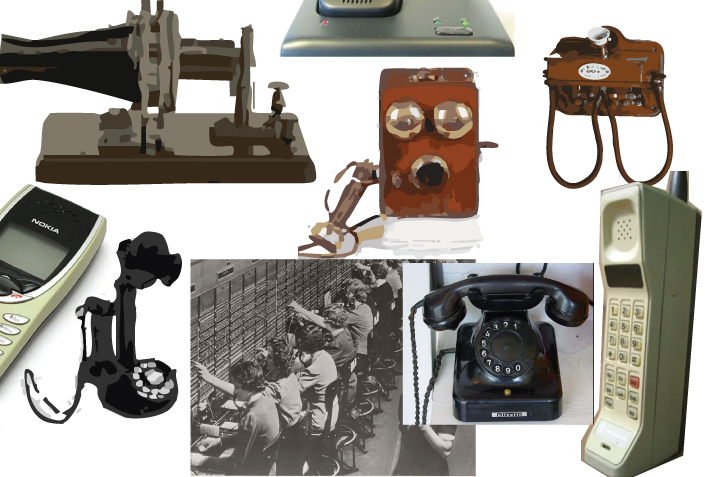
Dialing up history
The patent for the telephone turns 150 on March 7; the first call was made three days later on March 10, 1876.
Before the phone: One of the earliest ways to communicate outside of mail was the telegraph, invented by Samuel Morse in 1837. The telegraph revolutionized long-distance communication by transmitting messages in Morse code over wires. It required skilled operators to encode and decode.
1876 – The very first telephone was developed. Two inventors, Alexander Graham Bell and Elisha Gray, both independently designed devices that could transmit speech electronically.Bell reached the patent office mere hours before Gray and won the famous battle over the invention when his patent was passed on March 7, 1876.
Three days later, Bell transmitted the first discernible speech over the telephone to his assistant: “Mr. Watson, come here; I want to see you.”
The telephone used a diaphragm, a coil and a receiver to convert sound waves into electrical signals and back into sound waves, enabling real-time voice conversations.
On May 10, 1876, Bell presented his paper “On Telegraphing Musical Sounds,” later published in the American Academy of Arts and Sciences proceedings as “Researches in Telephony.”
1879 – The Top Box was one of the first business-focused telephones. This wall-mounted device, crafted from mahogany wood and Viaduct Manufacturing Co. hardware, became a common sight in both businesses and homes.
1880 – The Gower-Bell Telephone was another early commercial success. This telephone featured a diaphragm and a receiver, offering improved sound quality and reliability over earlier models. It was the main phone used in countries like Spain, Japan and England.
1892 – Telephone technology rapidly evolved in the early 1900s with the invention of the dial phone in 1892.
Almon B. Strowger invented a telephone that could perform the first automatic telephone exchange and did not require an operator.
Although Strowger filed the first patent for a rotary dial phone in 1891, the rotary phone devices did not make their way into the Bell System until the 1920’s.
1947 – AT&T finished the design for the North American Numbering Plan. There were originally 152 area codes, each one with enough capacity for 540 central offices. However, only 86 area codes were actually assigned — with New Jersey receiving the first one, 201. The second area code, 202, was assigned to the District of Columbia. Currently there are 317 geographic area codes in the U.S. and an additional 18 non-geographic area codes totaling 335 area codes.
1960s – Touch-tone dialing replaced the rotary dial. This advancement made dialing faster and more efficient, enhancing user experience.
1973 – The first mobile phone was created in 1973 by engineer Martin Cooper. In 1983, Motorola released the first commercially available handheld mobile phone – the DynaTAC 8000x.
Nicknamed “The Brick,” the Motorola DynaTAC was valued at $3,995 ($10,300 today).
Mobile phones began to gain popularity in the 1980s. By the 2000s they had largely replaced landlines.
1979 – Launched by Nippon Telegraph and Telephone , 1G was first introduced to the citizens of Tokyo. By 1984, the first generational network covered all of Japan, making it the first country to have 1G service nationwide.
It wasn’t until 1983, that Ameritech introduced 1G to the U.S. Soon after, Canada got coverage in the mid-1980s.
2007 – The iPhone was released in 2007 and revolutionized the mobile phone industry. Released in 2008, the iPhone 3G or (iPhone 2) paved the way for smartphones today. Apple’s cellphone demand was so high that 1 million iPhone 3Gs sold over the opening weekend.
As smartphones became popular, the demand for faster data and increased network capabilities was only a few years away.
More phones than people – According to the International Telecommunication Union, there were more than 8.58 billion mobile subscriptions in use worldwide in 2022, compared to a global population of 7.95 billion halfway through the year.
Will the numbers run out?An analysis of the North American Numbering Plan estimates that the current structure is good until around 2049. After that, some changes are going to be needed.One plan would add either a 0 or 1 to the beginning or end of an area code or the seven-digit number. Another option is to add 9 as the second digit of existing area codes. So the 213 area code for Los Angeles County, would become 2913.

Some numbersDid you know each year there are over 173 million 911 calls in the U.S.? Many of these are life threatening and some not, it is important that you are prepared for any emergency that comes your way.2-2-1: In 2000, the Federal Communications Commission issued an order reserving the 2‑1‑1 dialing code for providing non-emergency community information and referral services.2‑1‑1 is available in multiple languages, allowing those in need to access information and obtain referrals to physical and mental health resources; housing, utility, food, and employment assistance; and suicide and crisis interventions.

A little more about BellAlexander Graham Bell was 29 when he received the patent for the telephone.The Scottish-born Bell worked in London with his father, Melville Bell, who developed Visible Speech, a written system used to teach speaking to the deaf. Bell’s mother was deaf. In the 1870s, the Bells moved to Boston, Massachusetts, where Bell worked as a teacher at the Pemberton Avenue School for the Deaf. He later married one of his students, Mabel Hubbard. While in Boston, Bell became very interested in the possibility of transmitting speech over wires.Western Union was offered to buy the telephone patent but scoffed and called it a toy. Two years later they said if they paid $25 million now ($800 million today) it would be a bargain.The Bell Telephone Company was created in 1877, and by 1886, more than 150,000 people in the U.S. owned telephones.Bell had 18 patents granted in his name alone and 12 more he shared with his collaborators. Mostly for the telephone and telegraph, but his other inventions spanned interests and included a metal jacket to assist in breathing, the audiometer to detect minor hearing problems and a device to locate icebergs,In January 1915, Bell made the first ceremonial transcontinental telephone call. Calling from New York City, Bell was heard by Thomas Watson in San Francisco. Bell died in 1922 at age 75.
You can learn more about Bell here.
Sources: Smithsonian, American Academy of Arts and Sciences, History.com, Ooma.com, Nextivia.com, CBS News, Federal Reserve Economic Data, The Pew Research Center
#telephone #changed #world