

Africa’s biggest lenders are converging on Kenya, betting the country offers the best gateway into East Africa’s fast-growing but underbanked economies.
The impetus has come from new minimum-capital rules, which are forcing smaller Kenyan lenders to seek partners, creating a rare window for acquisitions. The opportunity is drawing interest from across the continent, particularly from South Africa’s biggest lenders, which are looking for growth beyond their sluggish home market.
As global lenders including Standard Chartered Plc, BNP Paribas SA, and Societe Generale SA scale back from the continent, homegrown banks are filling the void. Nedbank Group surprised investors in January with plans to buy Kenyan lender NCBA Group Plc. Rivals Standard Bank Group, FirstRand and Absa Group are now also exploring acquisitions, people familiar with the matter said.
The prize is a region of almost 500 million people, roughly the size of the European Union, with a $580 billion economy expanding at one of the fastest rates globally. From mineral riches in the Democratic Republic of Congo to Tanzania’s gas reserves, banks see countries in the belt as a big business opportunity.
“The region plays an important role in the relationships between the continent and other parts of the world, and we want to facilitate that activity,” Standard Bank Group Chief Executive Officer Sim Tshabalala said in an interview. “A bank grows on the basis of growth in GDP, and financial deepening is increasing in Kenya, and we want to be part of that,” he said, referring to gross domestic product.
East African economies are projected to grow at an average of 6.1% this year, outpacing 3.2% for the world, according to the International Monetary Fund. Still, less than 40% of residents have access to banking services, according to the World Bank’s Global Findex Database 2025.
When examined from a traditional banking perspective, Kenya and East Africa remain “structurally underpenetrated,” according to Maureen Kirigua, an analyst at NCBA. Private-sector credit is still low, while net interest margins are relatively high at as much as 6%, she said.
ADVERTISEMENT
CONTINUE READING BELOW

A Stanbic bank branch in downtown Nairobi, Kenya.
“When you put growth, credit under-penetration and profitability together, it starts to make sense why Africa banks — and in particular, big South African banks — are keen on the market,” Kirigua said.
And for firms from South Africa — which is grappling with persistently low economic growth at home — the opportunity to diversify into the continent’s east is impossible to ignore. Data from Kenya’s central bank show the average return on equity was 23% by June, almost twice that of global lenders at about 12% last year, according to Ernst & Young LLP.
West Africa isn’t much of a draw for them as they either already have units there or are facing stiff competition from homegrown banks. They’ve also been put off by recent challenges such as Ghana’s debt default, Nigeria’s currency devaluation and political instability across the Sahelian coup belt.
Nedbank sold its minority stake in Ecobank Transnational Inc. last year, saying a deterioration of the Nigerian economy, coupled with exits by South African clients from the region, had affected operations. It disposed of the stake at $100 million, having bought it for $500 million less than two decades ago. The biggest Nigerian banks — Access Bank Plc and Zenith Group Plc — have also bought Kenyan banks.
“East Africa has proven to be more stable — politically and economically — than West Africa, where banks have previously looked for growth,” said Adrienne Damant, a banks and insurance analyst at Avior Capital Markets.
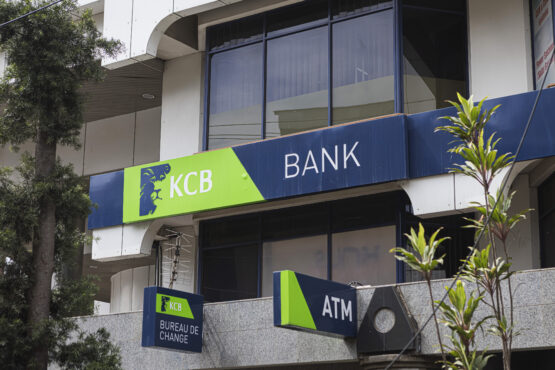
Signage for KCB Group in Nairobi, Kenya.
ADVERTISEMENT:
CONTINUE READING BELOW
The attention comes despite deadly protests that rocked Kenya in the last two years, with excessive force by security agencies resulting in at least 128 deaths, according to Amnesty International.
East Africa seems like an easier place to do business despite its “periodic spasms of instability,” according to Ilan Stermer, a research consultant at Anchor Stockbrokers in London. “The banks are forgetting the instability and/or looking through it as short-term episodes,” he said.
Central Bank of Kenya Governor Kamau Thugge agrees.
“All the banks want to strengthen their presence here,” he said in an interview in Nairobi.
Geopolitical risks — including tariffs — pose the biggest threat to the Kenyan economy, he said just days before the US-Israel attack on Iran.
“Kenya especially has been very stable, with a highly educated workforce, which is very creative, innovative, and it’s technologically quite connected, and well advanced,” NCBA Chief Executive Officer John Gachora said in an interview. “It’s got all the ingredients of growth.”
ADVERTISEMENT:
CONTINUE READING BELOW
Egypt’s Commercial International Bank SAE bought a majority stake in Mayfair Bank Ltd. for about $35 million in 2020. JPMorgan Chase & Co. has also set up a representative office, while Visa, Lloyd’s of London and insurance giant Prudential Plc have also moved in to serve their customers and distributors from Nairobi.
It’s not just banks that are eyeing the region. Vodacom Group, South Africa’s biggest mobile operator, has agreed to take control of top East African telecommunications provider Safaricom Plc in a deal valued at about $2.4 billion, while rival MTN Group said it wants to expand in East Africa in the next five years.
Foreign entries will most likely be through acquisitions, according to Tim Slater, a director for EMEA financial institutions at Fitch Ratings. Non-performing loan ratios, which eased to 16.5% in November after climbing to a two decade high of 17.6% in June — won’t be a put-off because Kenyan banks are still healthy.
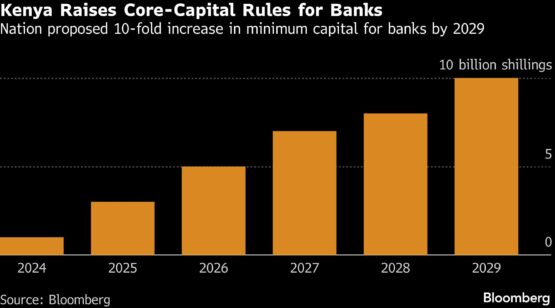
The central bank expects banks to gradually increase minimum capital to at least 10 billion shillings ($78 million) by the end of 2029. About a third were below the regulatory threshold set for 2025 and could be targets for the consolidation.
“Mergers and acquisitions offer low hanging fruit for market-entry in Kenya,” said Churchill Ogutu, an economist at IC Group. “More deals are in the near- to medium-term horizon.”
© 2026 Bloomberg
#Africas #biggest #banks #target #Kenya #regional #expansion #hub