
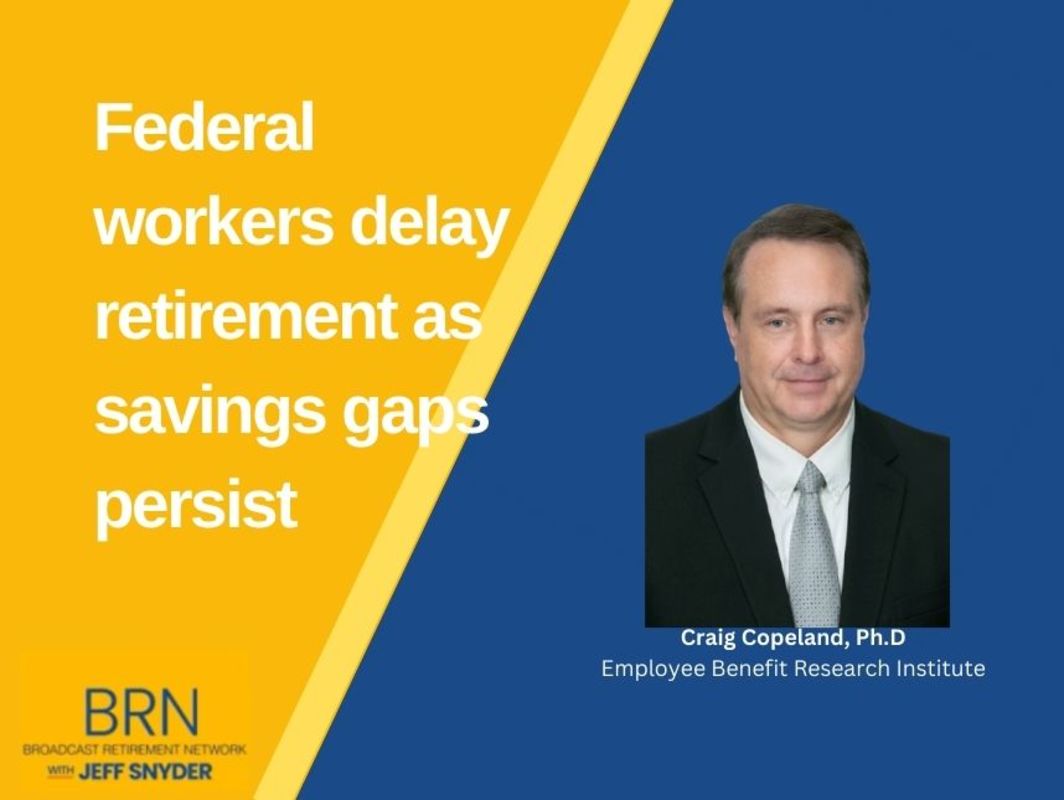
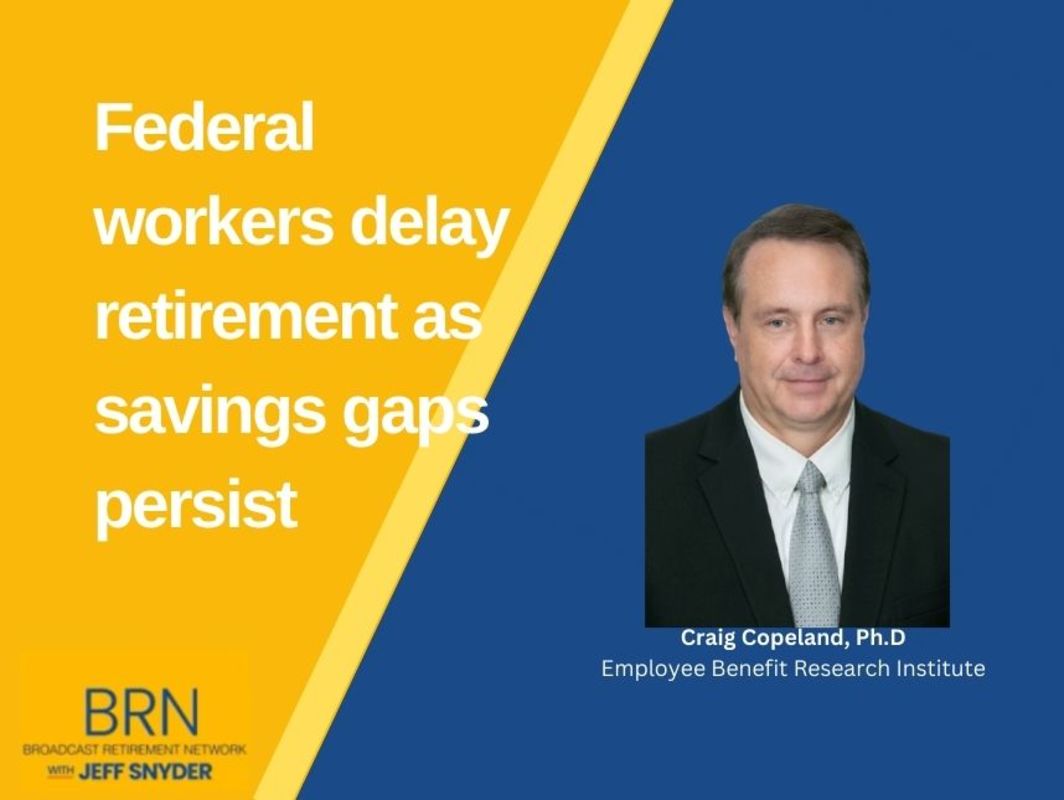
Broadcast Retirement Network’s Jeffrey Snyder discusses the state of Federal Workers’ retirement plans with the Employee Benefit Research Institute’s Craig Copeland.
Jeffrey Snyder, Broadcast Retirement Network
Joining me now is Craig Copeland of the Employee Benefits Research Institute. Craig, it’s so great to see you. Thanks for joining us this morning.
Oh, thanks for having me. And, you know, I guess for the audience’s benefit, we’ve had Ibrahim before. You guys have, for decades, provided so much great research in detail.
So it’s a privilege to have you on representing the organization. Let’s talk about a recent retirement confidence survey. I’m really interested in those results.
And what can you tell us about how federal workers are perceiving their retirement prospect? Are they confident?
Craig Copeland, PhD., Employee Benefit Research Institute
They seem to be a little bit more confident in general. They have been typically until this last year where there’s a lot of things that changed because the government programs were very, very good programs relative to what you would see in the private sector in most cases. But there’s a little bit, you know, concern with, you know, how the administration has been taking different approaches to keeping employees and not keeping employees.
So that’s kind of changed the comfort most recently. But in general, they are on track as well as anyone to be, you know, prepared for retirement. Then when you look at people in the private sector.
Jeffrey Snyder, Broadcast Retirement Network
Yeah, well, certainly understandable. I mean, you can’t help but read some of the challenges. I could empathize with that because if I was facing a job cut or layoff, you know, I would be very concerned about my short term and long term prospects.
But Craig, there’s a wealth of benefits when you think about the federal workforce. Some have pensions or a lot of them have pensions, but they also have the thrift savings plan, which is like the biggest defined contribution plan in the world. So there are a lot of rich retirement benefits that are available for these individuals relative to, you know, their employment.
Craig Copeland, PhD., Employee Benefit Research Institute
Right. I mean, they will have, you know, depending on which plan they’re on, but they at least have some minimum annuity payment benefit plus the pretty generous defined contribution through a savings plan that allows them to be better prepared and to have both be able to accumulate assets and then also have an income benefit along with what they would get from Social Security for those in the newer plan.
Jeffrey Snyder, Broadcast Retirement Network
Yeah, I mean, that is probably, you know, if you kind of compare apples to apples in the private sector, a lot of private sector workers have that 401k type vehicle, but may not have the pension. So that sounds, that kind of checks my box. I think I want to go work for the federal government now.
You know, when you look across all the different sectors of the economy, I mean, this survey really looked at the federal workforce, but you kind of alluded to that maybe the federal workforce may be feeling a little bit more confident than the private sector or not-for-profit workforce. Is that a true statement?
Craig Copeland, PhD., Employee Benefit Research Institute
Well, I mean, that was certainly the case going into 2025 when we, you know, we took this survey. I think maybe in 26, the confidence may be a little bit different, but when we focus in on retirement, given their benefits, they seem more confident with their benefits than what they would have in the private sector because they have both types of benefits, as you just pointed out. There’s still some shakiness on, you know, stability or, you know, being able to continue in those jobs because most people that work in the, would like to continue in jobs because they do have those benefits that they can get them better prepared for retirement and give them that more flexibility, potentially retire earlier and do something else because they’ll have that supporting either asset buildup in the thrift plan or the annuity payment as well.
Jeffrey Snyder, Broadcast Retirement Network
You know, Craig, retirement has been, it’s been a popular topic these past few months. First, we had, I think, using part of the 401k or the defined contribution plan that paid towards a home that kind of backed off a little bit on that. We had the Secure Act several years ago, and in the State of the Union, President talked about possibly having a national 401k-type plan.
I’m not sure how that all would work out, but your research informs a lot of the legislators and the regulators. What do you think is on track, you know, just hypothetically, in terms of possible retirement, you know, legislation or regulation? It would seem to me that there’s a lot of interest in helping Americans secure their retirement.
Craig Copeland, PhD., Employee Benefit Research Institute
Well, there are a number of things, and one of the big issues is that there’s still only, you know, 50 to 60, if you go to access, maybe 70 percent that have access to a plan. So, you have a sizable percentage of the workforce that doesn’t have access in the plan, and that’s the idea behind what President Trump said in the State of the Union was to address those individuals that didn’t have access to a plan. And how they’re going to do that still, you know, is up in the air, but there are some abilities to help facilitate people to save and to take advantage of the savers match that’s already built into the secure program that was passed a few years ago that will get more savings for low-income workers.
So, there really is that hope of getting that half, you know, quarter to half that’s not in a plan or don’t have the ability to save more money so they can build upon what they would have just from Social Security.
Jeffrey Snyder, Broadcast Retirement Network
Yeah, I mean, as a guy who’s been in the industry like yourself for a long time, you know, three decades, I’ve seen the iterative moves, and I’m excited because this has become a top issue. And just kind of as we close out thinking about the retirement confidence survey, it seems like many, many Americans are aware of needing to save for retirement. So, it’s not lost on them, you know, from all stripes, all parts of the economy that they need to save.
It’s really the how, right? I mean, is that what you took away from the survey results?
Craig Copeland, PhD., Employee Benefit Research Institute
Yeah, I mean, you do see that people know they need to do it. It’s the how is one thing, but also making that decision on where they can get their savings to is another important part. I mean, because there still is an affordability issue to some extent, you know, people with, you know, $30,000, $40,000, or $50,000 in earnings, it’s very hard to, you know, pay for, you know, general expenses and then save on top of it.
So, it’s really trying to address all those issues of getting the people to know how to do it, getting the discipline to do it, and also helping those that have the least ability to save.
Jeffrey Snyder, Broadcast Retirement Network
Craig, before I let you go, would you mind teasing out a little bit? You guys have so much research coming out. What’s kind of on the plate in terms of what should we be thinking about or hearing about from EBRI in the coming weeks and months?
You know, I talked about financial literacy with some of your colleagues. I would imagine long-term care, caregiving, those are things that are popping up on the radar screen.
Craig Copeland, PhD., Employee Benefit Research Institute
Yeah, I mean, next year’s retirement confidence survey, we’re going to be looking at caregivers because that’s a growing challenge for people, particularly people in the sandwich generation are caring for kids and for their parents. We’re looking at, you know, what’s happening in 401k plans and also the big thing that also we’re seeing more and more issues is how their finances are outside of the 401k plan or their savings plan and how that impacts what they can save. And that kind of gets us into the financial wellness offerings that’s possible to get those finances in order so they’re better prepared to save if they get their overall finances in order.
Jeffrey Snyder, Broadcast Retirement Network
Yeah, it’s great research and hopefully this informs the key decision makers in the private and the public sector to pull the right levers in order to get more and more of us saving for our retirement. And look, we’re going to be living longer, saving for our financial futures. Craig, we’re going to have to leave it there.
Great research as always. Thanks for joining us. We look forward to having you back on the program again very soon, sir.
Craig Copeland, PhD., Employee Benefit Research Institute
Okay. Thank you for having me.
#Federal #workers #delay #retirement #savings #gaps #persist