
Berkshire Hathaway is in a rare position. Although it is typically regarded as one of the most stable stocks, given the current market conditions, no stock is infallible.
The company failed to wow investors with its most recent set of earnings, falling short of expectations. And the latest stockholder letter didn’t help.
New CEO Greg Abel, penning his first shareholder letter, struck a very cautious tone but made one thing crystal clear. Berkshire isn’t in any mood to waste money. The investment company is sitting on a huge cash pile, but that is not something up for grabs.
“While some of this capital is required to support our insurance operations and protect Berkshire against extreme scenarios, it also constitutes our dry powder,” Abel wrote.
At the same time, Abel saw the need for a conciliatory tone. He said the company is not shying away from deal-making.
“Many times in Berkshire’s history, some observers have suggested that our substantial cash position signals a retreat from investing. It does not.”
However, investors continue to ask the same questions they have had for years. When does that “dry powder” actually get deployed? More importantly, what happens if it doesn’t?
The market’s initial reaction was blunt. Berkshire’s Class A shares fell by as much as 5.3%, and Class B shares fell by about the same amount. This was the biggest drop since Warren Buffett said in May 2025 that Abel would become CEO in 2026.
Operating profit, BRK drop as insurance and key businesses show pressure
Berkshire’s operating profit for the fourth quarter fell 30% to $10.2 billion. (Operating profit excludes gains and losses from Berkshire’s stock holdings, including Apple, and is often the cleanest snapshot of how the underlying businesses performed.)
Insurance, unfortunately, is the main pressure point.
Related: Samsung shocks Apple in smartphone war
Berkshire said Geico, alongside other insurance companies, posted a 38% overall decline.
The worst part is that Abel believes the pattern is not going to break. Instead, the insurance companies will repeatedly come under pressure to retain customers as competitors cut rates.
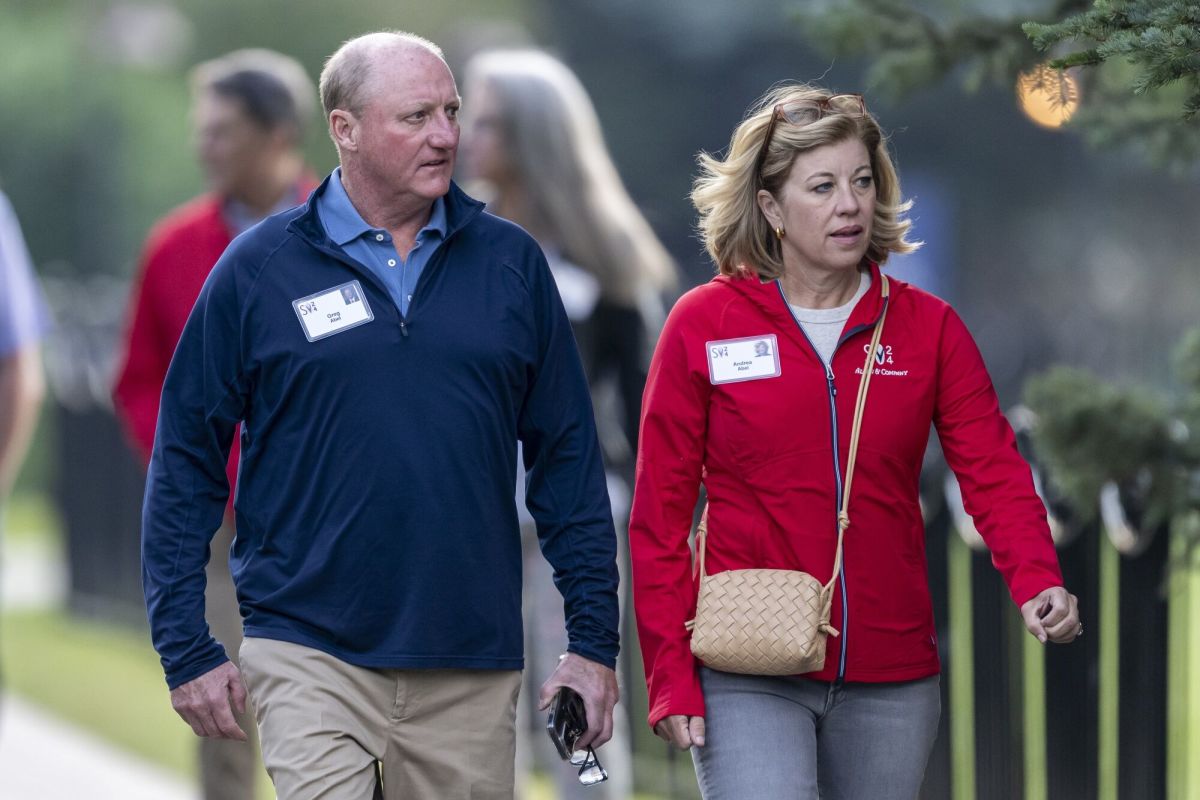
Photo by Bloomberg on Getty Images
“GEICO’s broad rate increases… have restored margins but come at the cost of lower retention,” Abel wrote. “Competitors’ rate reductions may extend that pressure into 2026.”
Analyst Meyer Shields of Keefe, Bruyette & Woods said the results “broadly” missed expectations, thanks to weakness at BNSF and in the energy, manufacturing, and retail sectors.
Shields cut his earnings forecast for 2026 by 5% and rates Berkshire as underperforming.
Berkshire Hathaway’s cash question gets louder as buybacks stay quiet
For long-term Berkshire holders, volatility in quarterly results isn’t usually something they are looking out for. Instead, the bigger narrative is capital allocation.
At the moment, it seems the iconic asset manager is in a visibly conservative posture.
- Roughly $370 billion-plus in cash and U.S. Treasuries (Abel pegged it as “dry powder”)
- No stock buybacks for about 18 months, with no clear signal on resuming
- No dividend, and no hint of a policy change
Abel gave, yet again, the same logic for not paying dividends. The company won’t pay one until each dollar of retained earnings is “reasonably likely” to create more than one dollar of market value for shareholders.
He also said there will likely be more of a focus on buybacks only when Berkshire shares trade below a conservatively determined estimate of intrinsic value.
That discipline is core to the Berkshire brand. However, after the earnings report dropped, investors suddenly wanted more.
The Abel transition is here, and tone matters more than ever
For me, Berkshire hathaway’s dip isn’t an “earnings miss” story. Instead, it’s a succession story.
Buffett had led Berkshire since 1965. He is as iconic as it gets from a CEO perspective. Consider the close relationship between Apple and Steve Jobs or the influence of Elon Musk on Tesla. The moment you hear these names, you think back to their CEOs.
The same is the case with Buffett, and he happens to still be the chairman of the company. His succession is therefore causing some headaches.
Related: Galaxy S26 brings ‘agentic AI’ to phones, and it’s bigger than Samsung
Abel took over as CEO on Jan. 1, 2026, and his letter leaned heavily into continuity, culture, and long-term thinking.
“Our role is stewardship,” Abel wrote. “Your capital is commingled with ours, but it does not belong to us.”
In his letter, Abel was thoughtful regarding what the future holds for the company. He was explicit in saying that Berkshire holds a competitive advantage due to its culture. Abel also reiterated the late Vice Chairman Charlie Munger’s reassurance from May 1, 2021.
Abel’s framing is simple, straightforward, and razor-sharp. Berkshire is not driven by personality. Instead, it’s foremost a system.
On the other hand, the market is throwing up a straightforward challenge: prove the system works without Buffett making the final call.
Berkshire by the numbers: what Abel highlighted from 2025
Abel’s letter gives a more in-depth look at how things are going, helping explain why Berkshire is both confident and cautious.
Key 2025 financial snapshots
- Operating earnings: $44.5 billion in 2025, down from $47.4 billion in 2024
- Cash flow from operating activities: $46 billion in 2025, compared with a five-year average of more than $40 billion
- Cash and U.S. Treasury holdings: Now exceeding $370 billion
- Insurance float: $176 billion at year-end 2025, up from $171 billion at the end of 2024 (and up from $88 billion at the end of 2015)
Insurance cycle signals (and why investors care)
Abel said that in the second half of 2025, the insurance industry saw “a deceleration or reversal” in pricing and policy-term trends.
He thinks this could mean that Berkshire writes less property and casualty business for a period of time.
More Warren Buffett:
- Warren Buffett’s Berkshire Hathaway shares mortgage warning
- Analysis: Why ‘cheap stocks to buy now’ is the wrong investing idea
He also disclosed an underwriting milestone.
Combined ratio (property and casualty): 87.1% in 2025, better than Berkshire’s five-year average of 90.7%, 10-year average of 93.0%, and 20-year average of 92.2%.
That’s a strong underwriting result.
However, Abel’s warning is more speculation about the road ahead. More money is going into primary insurance and reinsurance, which can lower prices and lower returns.
Non-insurance businesses: BNSF, energy, manufacturing and retail in focus
Abel took the opportunity to set expectations for several operating segments. These include BNSF and Berkshire Hathaway Energy.
BNSF: operational improvements, but not enough (yet)
BNSF produced $8.1 billion in net operating cash flows in 2025 and disbursed $4.4 billion to Berkshire in the form of dividends.
Abel said the company improved its operating margin to 34.5% from 32.0% in 2024. However, he stressed that closing the gap to the industry’s best remains a priority.
Interestingly, he expressed this improvement in monetary terms. Each one-percentage-point improvement in operating margin generates approximately $230 million of incremental operating cash flow.
Berkshire Hathaway Energy: AI demand meets wildfire risk
Abel, in the letter, also interestingly touched upon an industry investment cycle that is fueled by rising electricity demand from artificial intelligence computing. In addition, wildfire risk is growing, especially in the Western U.S.
He said the firm will pursue hyperscaler and data-center growth. But it is crucial to strike an appropriate balance between the risks and rewards. Abel has also talked about the importance of the “regulatory compact,” which lets utilities make a fair profit on the money they invest.
The equity portfolio: Berkshire’s core holdings (and what they pay)
Berkshire’s equity portfolio continues to grow, but it’s still concentrated on a handful of long-term positions.
Abel frames the concentration as intentional.
Here are Berkshire’s biggest U.S. equity holdings by market value at Dec. 31, 2025, as listed in the letter.
- Apple (AAPL): $61.962 billion market value; $280 million in 2025 dividends
- American Express (AXP): $56.088 billion; $479 million in 2025 dividends
- Coca-Cola (KO): $27.964 billion; $816 million in 2025 dividends
- Moody’s (MCO): $12.603 billion; $93 million in 2025 dividends
Abel also talked about Berkshire’s major investments in Japan, such as Mitsubishi, Itochu, Mitsui, Marubeni, and Sumitomo.
Added to the U.S. core holdings, the positions were worth $194 billion in market value, which is almost two-thirds of Berkshire’s equity securities portfolio. These assets produced $2.5 billion in combined dividends, yielding roughly 10% on their original cost basis.
What Berkshire did buy: 2 acquisitions Abel called out
Investors looking for action did end up with one piece of very valuable information. Berkshire announced acquisitions of OxyChem and Bell Laboratories in 2025, a clear sign that there is still significant action to be seen when it comes to Berkshire.
Abel framed both as classic Berkshire: businesses that are easy to understand, have steady demand, and good managers. He also said something very Berkshire-like about Bell Laboratories (which controls rodents).
That subtle sentence encapsulates the essence of Berkshire. The company is so big now that even “good” deals can seem like they don’t matter. This is one reason the cash pile keeps growing.
Why this matters for Berkshire shareholders now
The immediate story is that Berkshire shareholders are feeling the heat. After a rare misstep in earnings season, the firm is entering a new phase where:
- The insurance market may be less forgiving (especially at Geico).
- Some operating units have shown uneven performance.
- Berkshire is sitting on an enormous cash hoard.
- Buybacks remain paused.
- Investors are watching Abel’s every move.
Abel’s message during this time is unmistakable. He says Berkshire’s “fortress-like balance sheet” is strategic. It’s not accidental that it has a cash stockpile that size.
The market’s message back, at least for now, is simple: We are willing to show patience, but you need to prove why we should.
Related: Altman draws 3 red lines for Pentagon AI work and dares critics to ‘visit me in jail’
#Greg #Abel #sends #blunt #message #Berkshires #billion #cash #pile