
A sustained rise in oil prices could trim South Africa’s economic growth by about 20 basis points for every $10 increase in crude, according to Standard Bank Group economists.
The warning comes as the evolving conflict in the Middle East introduces fresh uncertainty into the global economic outlook, according to group chief executive Sim Tshabalala.
Listen/read:
Standard Bank profit rises to record on fee growth, client gains
Standard Bank’s commitment to bolstering the local economy
Middle East shipping attacks ignite fresh oil price spike above $100
On Thursday morning (12 March), Brent surged nearly 10% crossing the $100-threshold after Oman evacuated an export terminal and tanker strikes in Iraq heightened fears over regional energy flows, before retreating to mid-$90-a-barrel levels by midday.
“We are concerned about the conflict in the Middle East,” Tshabalala says.
“Unless the war ends very soon, elevated oil prices will start to negatively affect global inflation, then interest rates, and, ultimately growth.”
Speaking at a presentation of the lender’s annual results in Johannesburg on Thursday, Tshabalala said that although it is “too soon to comment with confidence” on the long-term economic effects of the conflict, it could have several consequences for African economies.
Across the rest of Africa, higher oil prices could push up inflation and keep interest rates elevated, while fertiliser prices could rise and affect food security in parts of the continent.
At the same time, some commodity-producing countries could benefit.
“But these negative effects could be counter-balanced by higher export prices for energy and metals,” Tshabalala says.
The impact across Africa will vary depending on whether countries are oil exporters or importers. Angola and Nigeria, for example, could benefit from higher oil prices, while oil-importing economies such as South Africa and parts of East Africa would likely feel the negative effects.
Listen/read: From crude to CPI: how oil swings shape inflation and rates
Despite the uncertain geopolitical backdrop, Tshabalala says the group has strengthened its risk management processes and developed internal scenarios to prepare for a range of possible outcomes.
“Standard Bank has taken the necessary actions to manage our risks and will continue to watch the situation carefully,” he adds. “We also developed scenarios to guide our actions over the rest of the year and beyond.”
Africa outlook remains strong
Chief financial officer Arno Daehnke says the group continues to see strong growth opportunities across the African continent.
The bank recorded growth of 16% in rand terms, with particularly strong performance in parts of West Africa.
Looking ahead to 2026, Standard Bank expects macroeconomic conditions to improve. “But new developments in the Middle East continue to introduce uncertainty and will impact these forecasts,” Daehnke says.
‘Second-order’ effects
A similar view is shared by Keagan Higgins, equity analyst at Anchor Capital, who says it is still premature to determine the precise impact the conflict could have on Standard Bank.
“But it would be through a combination of inflation and oil prices, along with broader negative market sentiment. The second-order effects could then flow through into weaker African growth,” he says.
Read:
Africa must use more of its own resources for growth – Standard Bank chief
East Africa emerging as the continent’s most strategic growth frontier – Tshabalala
He points out that geopolitical escalation tends to trigger risk-off sentiment in global markets.
“We think this could lead to currency volatility and slower investment flows into emerging markets.
“That combination could affect credit demand, deal activity and overall economic momentum across Standard Bank’s footprint.”
‘Balance sheet strength is a buffer’
Against this uncertain geopolitical backdrop, Higgins says the group’s latest financial performance and balance sheet strength provide an important buffer as it navigates potential macroeconomic shocks.
Read: Standard Bank backs Bafana Bafana ahead of World Cup
He points out that Africa is now a core pillar of the group, contributing roughly 40% of headline earnings.
“That highlights how important the franchise outside South Africa has become.”
He is of the view that South Africa will remain the lender’s anchor business, but the growth opportunities across the continent are stronger.
“Africa regions offer faster economic growth, infrastructure development, and lower banking penetration. It should therefore continue to play a key role in driving group earnings growth and diversifying the business,” Higgins adds.
Standard Bank’s share price closed at R295.36 on Thursday – 0.2% higher than the previous day.
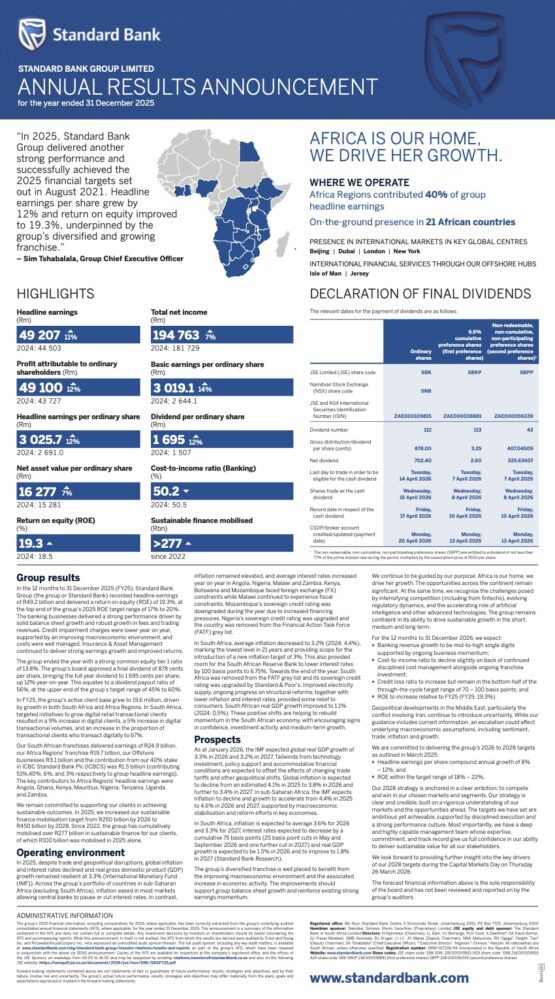
View or download a PDF of the above here.
Brought to you by Standard Bank Group.
#Higher #oil #prices #dent #growth #Standard #Bank