
For more than 50 years, Microsoft Corporation (MSFT) has been one of the world’s most influential companies, now a titan in software (Microsoft 365), cloud computing (Microsoft Azure), and AI technology (Microsoft Copilot).
The company revolutionized society by transforming computers from specialized business machines into essential personal tools. By licensing its MS-DOS operating system to IBM in 1980 and later introducing the user-friendly Windows platform, Microsoft fulfilled co-founder Bill Gates’ vision of “a computer on every desk and in every home.”
But MSFT’s beginnings were quite humble: In fact, the trillion-dollar company’s creation story began with merely an idea — and an inspiration taken from a magazine cover.
Who started Microsoft?
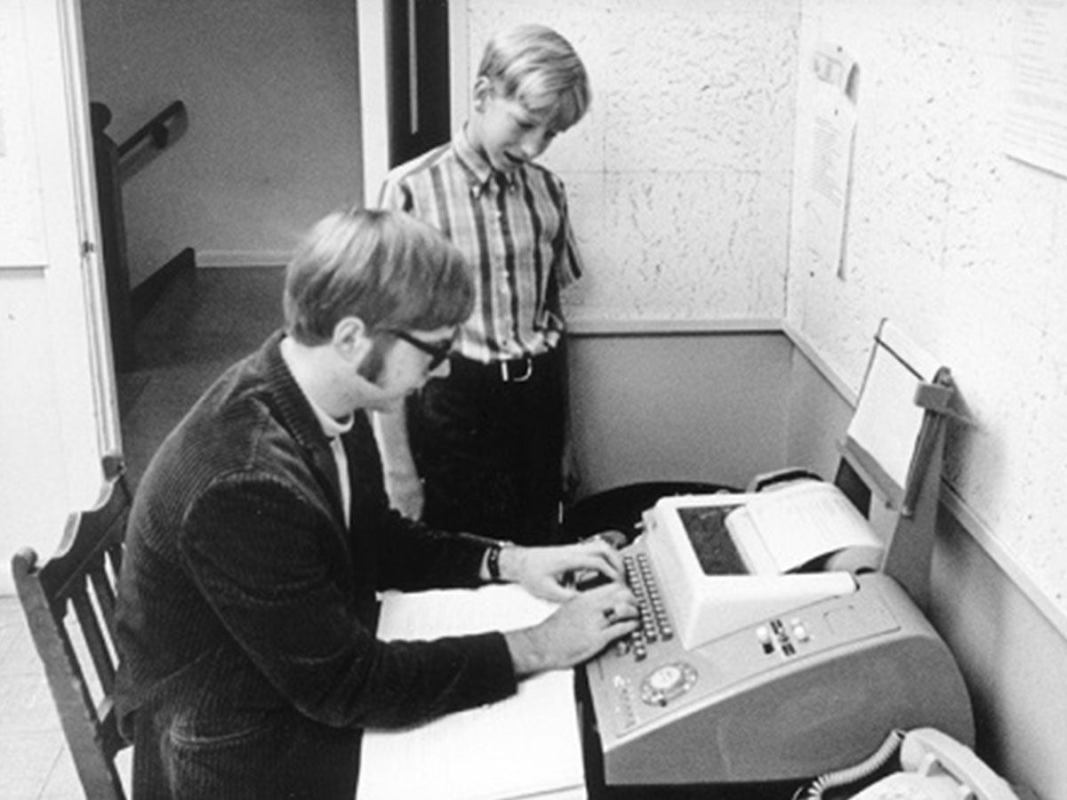
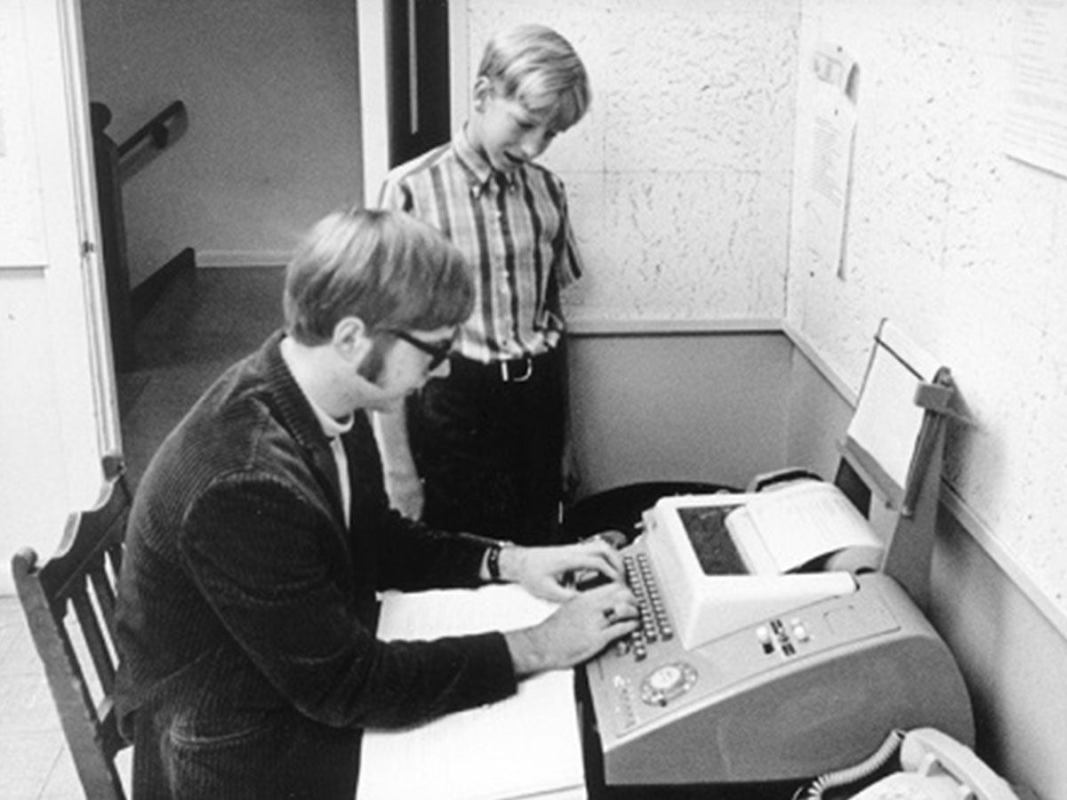
The story of Microsoft starts with friendship: In 1968, Bill Gates met Paul Allen at the Lakeside School, a prestigious preparatory school in Seattle, Washington. Gates was only in 8th grade, while Allen was a high school sophomore, but the two immediately connected over their love of computers and even started a programming club.
Eager to learn more, over the following years, the two teens spent time in the University of Washington’s computer science lab, which housed a rare and expensive Sigma mainframe computer (valued at $1 million at the time), allowing them to develop their software and coding systems.
But to gain free computing time, they had to hack into the computer system — and as a result, they were kicked out of the lab in 1971.
Still, this experience helps to set the trajectory of Microsoft’s future.

CC-BY-SA-3.0-migrated via Wikimedia Commons
Microsoft’s earliest beginnings
In 1973, Gates enrolled at Harvard University, studying math and computer science. He lived in Currier House, where he befriended another key Microsoft player, Steve Ballmer (who would serve as Microsoft’s CEO from 2000–2014).
Allen had been studying at the University of Washington, but he dropped out in 1974 to move to Boston to be near his friend, supporting himself by working as a computer programmer at nearby Honeywell Inc.
One day in 1975, Allen walked through Harvard Square and, passing a newsstand, he spotted an issue of Popular Electronics with an Altair 8800 on its cover.
This boxy and unassuming device, Allen believed, was a signal that the personal computing revolution had arrived.
It also meant that a critical market for software, especially more advanced programming languages, like the ones he and Gates had mastered, was opening up.
It was time for them to get their slice of the action.
Allen and Gates sent a letter to the manufacturer of the Altair 8800, MITS, offering to write software for the system in BASIC. MITS said yes; Gates left Harvard (he famously never graduated), and the friends moved to Albuquerque, New Mexico.
Off dusty Route 66, in the Sundowner Motor Lodge, the paie spent the next two months frantically working to adapt BASIC for the Altair system. By the fall, they finished the Altair BASIC program and licensed it to Altair’s manufacturer, and in the process, founded Micro-Soft.
And the rest, as they say, is history.
Microsoft’s milestones: A company timeline
April 4, 1975: Gates and Allen create Micro-Soft, a mix of “microcomputer” and software.”
They also launch their first product, Altair BASIC, as a partnership with MITS.
Sales total just $16,005 by the end of the year, but Gates and Allen had laid the foundation for explosive future growth — and in three years, revenues would top $1 million.
1979: The company moved its headquarters from Albuquerque to Bellevue, Washington, in order to make it easier to recruit engineers.
Related: Bill Gates’ net worth in 2025: How much has he made (& given away)?
November 6, 1980: Gates secures a deal with IBM to supply an operating system for its personal computer. There was just one catch: Microsoft doesn’t own one yet. So, Gates and Allen purchase the rights to “QDOS,” short for “Quick and Dirty Operating System,” from Seattle Computer Products for $25,000.
Later, Microsoft would use QDOS to develop its own operating system, MS-DOS.
In the contract, Microsoft also includes a clause giving it the right to sell the operating system to other companies. By doing so, Gates and Allen shrewdly realize that by controlling a computer’s operating system, they could also dominate the personal computing market because it was software, not hardware, that would drive the PC revolution.
Microsoft ends the year with $8 million in revenue.
1981: IBM introduces the first PCs outfitted with Microsoft’s operating system. They quickly become the standard, replacing IBM’s OS 2 operating systems, and would later be installed on over 90% of all personal computers.
February 1982: After being diagnosed with Hodgkin’s lymphoma, Paul Allen steps down from his daily role at Microsoft, although he would remain on its board of directors until 2000.
November 20, 1985: Microsoft launches Windows, a graphical operating system that features dropdown menus, icons, and mouse functionality, replacing the text-based commands that defined MS-DOS.
Suddenly, Microsoft isn’r just successful — it’s essential.
1986: Microsoft moves from Bellevue to its current campus location in Redmond, Washington.
March 13, 1986: Microsoft goes public on the Nasdaq stock exchange with an IPO priced at $21 per share. Shares end the day worth $35.50, generating $61 million for the company.
Between 1986 and 1996, MSFT shares would climb more than one hundredfold, and its revenues would grow from $197 million in 1986 to $8.67 billion by the end of 1996.
Bill Gates and Paul Allen become billionaires.
1990: The company unveils Microsoft Office, bundling together its Word, Excel, and PowerPoint products, which, as The Seattle Times said, was key to its success: “It was offering three products for one price while its competitors had all grown their businesses off a single product.”
1995: Microsoft launches Windows 95, which offers a more intuitive user interface, including its iconic Start menu, as Forbes put it, along with newly designed taskbar and desktop icons. Included with Windows 95 is Internet Explorer, making the internet accessible to mainstream dial-up users.
In 1995 alone, 40 million copies of Windows 95 are sold.
Related: 5 modern CEOs with unusual career paths
But inside the company, toxicity festers. Employees frequently work nights and evenings, toiling over 80 hours per week. Internal competition is endless. “Microsoft’s managers, intentionally or not, pumped up the volume on the viciousness,” wrote Vanity Fair, by introducing an employee ranking system that made each unit designate a certain number of employees as top-ranked, good, average, below average, and poor.
This leads to “employees focusing on competing with each other rather than competing with other companies.”
From the outside, Microsoft looks unstoppable. But from the inside, the pressure never lets up.
1998: By the late 1990s, Microsoft becomes one of the world’s largest and most profitable tech companies, but along with that success comes heightened regulatory scrutiny.
In 1998, the Justice Department and attorneys general from 20 states file an antitrust action against Microsoft, accusing the company of abusing its position in the market by:
- Directly driving competitors out of business, and by
- Integrating its own products into the Windows Operating System in such a way that no one could effectively compete.
The Microsoft antitrust suit spans a series of actions from 1994 to 2002, culminating in United States v. Microsoft Corp., which is settled in 2002.
January 13, 2000: Bill Gates steps down as Microsoft’s CEO and instead becomes Microsoft’s “Chief Software Architect.” Steve Ballmer begins his tenure as the company’s chief executive.
June 7, 2000: Judge Thomas Penfield Jackson rules that Microsoft has violated antitrust laws and orders the company to be split into two entities, sending massive shockwaves through the technology industry.
MSFT shares fall by 40% in just five months; seemingly overnight, Microsoft morphs from scrappy innovator into corporate villain.
June 28, 2001: However, a little more than one year later, the D.C. Circuit Court of Appeals reverses the breakup order, declaring that the lower court had used the wrong legal standard to evaluate Microsoft’s actions.
However, it upholds the finding that Microsoft maintained a monopoly and violated the Sherman Act; as a result, Microsoft is not broken up, but it is required to allow third parties access to its coding tools, enabling them to build competing software to run on the company’s Windows operating system.
This marks the end of Microsoft’s era of unchecked dominance. It also opens the door for the rise of competitors like Alphabet (GOOG) and Apple, Inc. (AAPL).
November 5, 2001: Microsoft enters the lucrative video game market with the introduction of the Xbox. The company would later acquire Minecraft (2014) and Activision Blizzard (2023).
February 1, 2010: Following years of development, Microsoft Azure goes commercial, and the company enters the cloud computing market, although it would take until 2017 for the service to significantly impact Microsoft’s bottom line.
May 26, 2010: Amidst the iPhone revolution, Apple surpasses Microsoft to become the world’s most valuable technology company, with a market cap of $222.1 billion compared with Microsoft’s $219.2 billion.
More on Bill Gates’ inner circle:
- Melinda French Gates’ net worth: Life after her billion-dollar divorce
- Warren Buffett’s net worth: A look at his fortune in retirement
- This plush toy is making Warren Buffett even richer
February 4, 2014: Soft-spoken engineer Satya Nadella becomes CEO of Microsoft. Nadella talks openly about empathy, learning, and growth, and Microsoft’s internal culture begins to shift from competition to collaboration, sparking innovation once again.
December 8, 2016: Microsoft acquires LinkedIn for $26.2 billion in cash. The move is part of its strategy to grow the networking site (which has a billion users at the time) as well as integrate it with Microsoft Office 365 and cloud computing services.
June 4, 2018: The company purchases the software development platform GitHub for $7.5 billion in Microsoft stock. It is maintained as an independent platform. This move helps to boost Microsoft’s cloud business and connects with the 28 million developers already using the platform. It also demonstrates Microsoft’s commitment to open source software.
October 15, 2018: Paul Allen dies. In a social media tribute, Gates says he is “heartbroken” about losing his “true partner,” calling him his “oldest and dearest friend.”
April 25, 2019: Microsoft tops $1 trillion in market capitalization due to growth in its cloud computing business, with quarterly revenues surging 73% in just one year.
According to Nasdaq, 95% of Fortune 500 companies had utilized Microsoft Azure for their digital transformation initiatives by 2021.
We remain committed to our partnership with OpenAI and have confidence in our product roadmap, our ability to continue to innovate with everything we announced at Microsoft Ignite, and in continuing to support our customers and partners. We look forward to getting to know Emmett…
— Satya Nadella (@satyanadella) November 20, 2023
July 2019: Microsoft enters a strategic partnership with OpenAI by investing $1 billion to support artificial general intelligence (AGI) development. Microsoft would go on to invest another $12 billion in the company, and during Sam Altman’s brief dismissal as CEO of OpenAI in November 2023, Nadella would even step in and offer personal mediation.
Microsoft’s partnership with OpenAI helps expand the company’s role in generative AI and leads to innovations across its Bing and Copilot platforms.
As a result, MSFT stock rises 310% from 2019 through 2024.
January 12, 2024: Boasting a market cap of $2.89 trillion, Microsoft overtakes Apple and becomes the world’s most valuable company.
April 4, 2025: Microsoft celebrates its 50th anniversary by reaffirming its commitment to AI.
October 28, 2025: Microsoft stock closes at an all-time high of $539.83.
Who owns Microsoft?
As a publicly traded corporation, Microsoft is owned by thousands of institutional and individual shareholders.
The Vanguard Group and BlackRock Inc. are its primary shareholders, controlling 70-80% of the company.
Former CEO Steve Ballmer owns approximately 4.5% of the company.
Co-Founder Bill Gates owns just 1.3% of the company, after years of selling shares to fund his philanthropy.
Who is the CEO of Microsoft?
The current Chairman and CEO of Microsoft is Satya Nadella, who took the reins from Steve Ballmer on February 4, 2014. During Nadella’s tenure, Microsoft expanded into cloud computing and artificial intelligence. He also helped to transform Microsoft’s internal workplace culture.
Related: Satya Nadella’s net worth: The Microsoft CEO’s salary & billion-dollar fortune
#History #Microsoft #Company #timeline #amp #facts