
Despite Finance Minister Enoch Godongwana confirming fuel levy relief of R3-a-litre at the eleventh hour on Tuesday, South Africans and businesses filling up on diesel will not be completely spared the pain, with diesel set to rocket by between R7.37 and R7.51 a litre from Wednesday, 1 April.
The petrol price will also surge, albeit by around by half that.
Without the emergency relief measure, which will be in place for just over a month (for now) in the face of the Middle East conflict and spiralling oil prices, diesel will have been increased by over R10-a-litre and petrol by over R6/l.
The Department of Mineral and Petroleum Resources (DMPR) confirmed diesel, petrol and other fuel increases for April on Tuesday afternoon, following a joint announcement with National Treasury on the short-term reduction in fuel levies.
It said petrol will increase by R3.06/l for both 93 and 95 octane grades.
It’s the second consecutive hike, with the war in the Middle East fuelling the spike in oil prices across the world. Brent crude prices have almost doubled since the US and Israeli-led airstrikes on Iran at the end of February, which has seen retaliatory action and an escalation in the conflict.
With the latest increases, SA consumers will now pay more than R23 for a litre of petrol at stations inland. Diesel rockets to more than R26 per litre inland.
ADVERTISEMENT
CONTINUE READING BELOW
This is the highest price for diesel. Before that, diesel’s highest price was R25.40 for a litre in July 2022, at the peak of the Russia-Ukraine war. In that same period, petrol hit R26.74 for a litre.
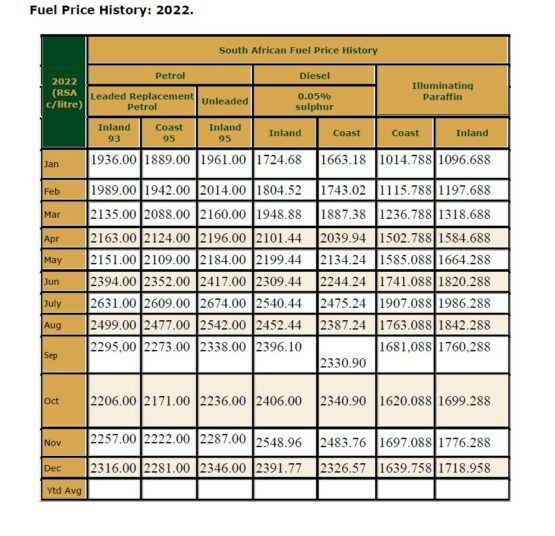
Fuel price history for 2022, at the height of the Russia-Ukraine war.
Read: SA fuel supply stable, but panic buying drives shortages
Other increases:
- Illuminating Paraffin (wholesale) will be hiked by R11.67 per litre
- Maximum Retail Price of LPGas will cost (R1.08 more per kg and R1.23 more per kg in the Western Cape
In addition to higher oil prices, the rand also depreciated on average against the dollar (from R16.00 to R16.64 to the dollar) during the period under review, according to the DMPR.
After extensive consultation between DMPR and National Treasury, government heeded calls to cushion the blow for consumers.
ADVERTISEMENT:
CONTINUE READING BELOW
The agreed approach consists of an immediate intervention for the next month, and a broader package of measures to support households and key sectors of the economy, according to a joint statement issued by the departments.
The key proposals are broken down below:
Phase 1: A temporary reduction in the general fuel levy and addressing fuel security concerns:
- The Minister of Finance proposes that the general fuel levy is temporarily reduced by R3 per litre from Wednesday 1 April 2026 to Tuesday 5 May 2026. This will reduce the general fuel levy for petrol from R4.10 per litre to R1.10 per litre and reduce the general fuel levy for diesel from R3.93 per litre to R0.93 per litre for one month. These amounts exclude other levies such as the Road Accident Fund levy and the Carbon Fuel Levy.
- It is estimated that the partial reduction in the fuel levy will cost around R6 billion in foregone tax revenue for the one-month period.
Phase 2: Broader package of measures where DMPR Minister Gwede Mantashe will continue work to review fuel pricing over the medium term.
“The relief measure will be reevaluated on a monthly basis for the following two months,” Godongwana and Mantashe said in the joint statement.
“Work is underway on a broader package of measures to support households and key sectors of the economy. Further details on additional support measures will be announced in due course,” the statement adds.
#April #Fools #joke #Diesel #rockets #R7l #petrol #R3l