
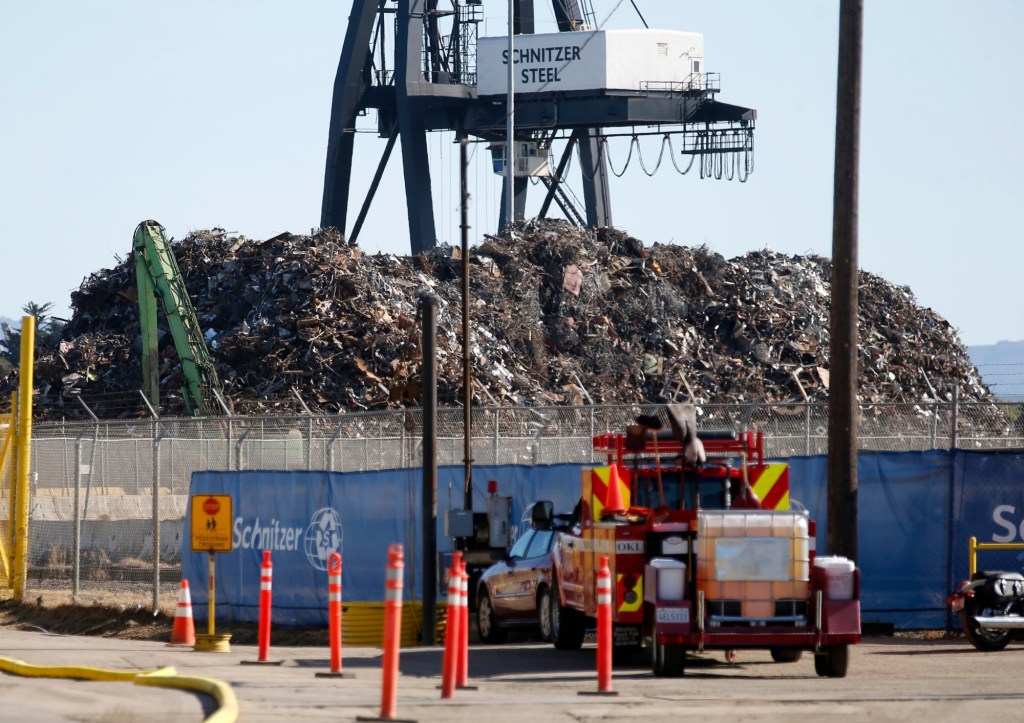
OAKLAND — Long after leaving Oakland, the A’s are still fighting in court and the California Legislature to push for an environmental crackdown on a longstanding metal-shredding plant that once stymied the baseball franchise’s dreams of a waterfront ballpark at the harbor.
The A’s abandoned the stadium-and-condo development bid in 2023 and left town altogether over a year ago. But in an apparent side mission from playing baseball in Sacramento and building new digs in Las Vegas, the A’s lawyers are again looking to sue state regulators over Radius, with no apparent financial incentive.
The franchise, named in legal documents as the Athletics Investment Group, sought in January to end an exemption that for years has allowed Radius’ facility in West Oakland to produce allegedly hazardous waste without meaningful regulation.
The facility, which opened in 1965, has been the site of several fires in the past two decades, including a massive blaze in 2023 that drew a civil lawsuit from Alameda County. Environmentalists in West Oakland have long blamed Radius for contributing to the neighborhood’s poor air quality.
Now, those advocates count the city’s last major professional sports franchise — whose messy divorce with Oakland helped tank owner John Fisher’s reputation among residents — as an unusual bedfellow.
“It’s as baffling to me as to anyone else,” said Brian Beveridge, the outgoing head of the West Oakland Environmental Indicators Project. “They no longer have a vested interest in the development, they have left town and yet their law firm is still here, working on the issue.”
Beveridge said attorneys hired by the A’s from San Francisco law firm Venable LLP have coordinated with his and other advocacy groups on opposition to the state bill. The franchise has also joined forces with environmental groups to oppose SB 811, a California bill that critics warn would loosen regulations governing California’s small handful of metal shredders.
The franchise has unsuccessfully taken on Radius in court before, but the difference now is that it no longer appears to have any financial stake in the legal effort, nor in its recent emergence as an opponent of the bill, whose supporters argue it would actually strengthen regulations, making them more uniform.

“Were metal shredders to be classified as hazardous waste,” the bill’s author, state Sen. Anna Caballero, said in a statement, “California would stand apart from any other jurisdiction worldwide and California’s metal shredding facilities would be unable to remain functional.”
Hammer mills at steel-shredding plants have historically been found by researchers to release air-polluting chemicals into the environment when they pulverize junk cars and other scrap metals. It is among the grievances activists have lodged against the port industries in West Oakland, where asthma hospitalization rates are higher than elsewhere in Alameda County.
In 2021, the plant agreed to pay $4.1 million to the Department of Toxic Substances Control and other prosecutors over allegations that the steel mills were emitting particles of hazardous metals, such as lead, cadmium and zinc.
Representatives for Radius, which has its official headquarters in Portland, Oregon, did not respond to written questions or an interview request.
The A’s previously sought, and failed, to get state regulators in 2023 to classify the plant’s waste as “hazardous,” which would subject the facility to stricter environmental rules. Regulators found at the time that nearby landfills showed no evidence of air or water contamination.
In January, an Alameda County court denied a petition by the A’s that would have compelled state regulators to require a new “hazardous waste” permit if Radius wanted to continue operating its West Oakland plant, which first opened three years before the A’s arrived in Oakland.

But the court appeared sympathetic to the A’s central claims, striking the petition only because a separate, ongoing legal process in Los Angeles has forced the state Department of Toxic Substances Control to keep its existing policies on the books for the time being.
Former team President Dave Kaval vocally attacked Radius at every opportunity while the franchise was in pursuit of the Howard Terminal development, an ambitious $12 billion real-estate venture that fell through in 2023 after construction costs ballooned during the COVID-19 pandemic.
Since leaving Oakland, however, the A’s have not offered much in the way of reasoning behind their continued legal standoff with Radius.
“The A’s were pleased to be joined by community members and environmental groups to shine a light on the need for greater environmental law enforcement,” Athletics vice chairman Sandy Dean said in a message, asserting that Radius has tightened its self-regulation as a result of the team’s various legal challenges.
Those interviewed for this story suggested several different ideas for why the A’s still care about Radius.
“I don’t know if they care about salvaging their reputation with the city of Oakland,” said Councilmember Carroll Fife, a skeptic of the axed Howard Terminal development whose district includes West Oakland and the port. “But if they did care, this is a noble way to do it.”
The regulatory standoff comes down to a Department of Toxic Substances Control policy established in 1988 — referred to in the industry as “OPP 88-6 — that has kept shredder waste from being formally categorized in the law as “hazardous,” even though regulators have sought to close the loophole since at least the turn of the century.
Judge Michael Markham said “almost everyone agrees” that the effective “safe harbor” protecting metal shredders from harsher standards is “a major problem and has got to be eliminated.” He left open the opportunity for the A’s or someone else to file a similarly worded lawsuit directly challenging OPP 88-6.

For now, though, state legislators are considering doing the opposite. SB 811, which is making its way through the Legislature, would create a regulatory scheme for shredders that falls outside the laws controlling hazardous waste.
It is a sequel to a very similar bill, SB 404, that was approved by the Legislature last year, passing unanimously in the state Senate, before Gov. Gavin Newsom vetoed it, saying the legislation “lacks clear definitions regarding the materials processed at these facilities, including what ‘hazardous waste’ requirements are applicable.”
Radius traces its roots to Oregon, where Russian immigrant Sam Schnitzer founded it as the Alaska Junk Company in 1906. Schnitzer opened its West Oakland plant in the 1960s, becoming a staple of the city’s port industry.
But the country’s manufacturing decline — as well as numerous environmental challenges, such as a string of fires at the harbor facility — has diminished Schnitzer’s revenue, partly leading the company to rebrand as Radius Recycling in 2023. The following year, the company lost $266 million with $2.7 billion in sales, the Oregon Business Journal reported.
Last year, the Oregonian reported that Radius had been sold to Toyota Tsusho Corporation, a Japanese auto conglomerate for $1.3 billion.
In Oakland, the company has encountered numerous foes, including former Alameda County District Attorney Pamela Price, who unsuccessfully tried to indict Radius on numerous felony charges in 2023 over a massive fire that left black smoke billowing in the sky.
Her successor, DA Ursula Jones-Dickson, dismissed the case last year but later filed a civil lawsuit against the company. Now the A’s are looking to get in on the legal action. It is an unusual twist in the story of a beloved sports institution that departed from Oakland so unceremoniously.
“There are a lot of people in the East Bay who will hate the A’s until they leave Earth,” Fife said. “But this is goodwill on the team’s part, and if people do good things, you have to acknowledge it, even if they have a not-so-great track record.”
Shomik Mukherjee is a reporter covering Oakland. Call or text him at 510-905-5495 or email him at shomik@bayareanewsgroup.com.
#Oakland #ally #push #environmental #justice