
On Holding reported earnings Tuesday morning, flaunting record sales and stronger profitability in its final quarter of 2025 — evidence that the company still has pep in its step.
Since coming to market during the pandemic, the Swiss footwear company has commanded a premium valuation on the market thanks to its rapid growth. In the fourth quarter, the company’s net sales grew 35.6% on a constant-currency basis, buoyed by a doubling of sales in the Asia-Pacific region, as well as an expansion into apparel and accessories.
That growth rate has dwarfed the figures posted by many of the company’s competitors, but on Tuesday, analysts focused on one figure in particular: In its 2026 guidance, On Holding sees its net sales growing just 23%, which some consider to be a sizable deceleration. Some outlets called it weak, and investors hammered the stock in the pre-market before an intraday recovery.
But even with that deceleration, there were a bunch of bright spots. To hear more about them, I sat down with On Holding Co-CEO and Acting CFO Martin Hoffmann to talk about the brand, the earnings, and how they’re thinking about new technology and innovation.
Note: This interview has been edited slightly for clarity and readability
Starting off our conversation, I asked Hoffmann to highlight some of the things he wanted to single out from the earnings report:
I think summarizing results, clearly we had a standout Q4, very strong momentum really in every region of the world across all the different channels, exceeding expectations.
But it’s always important for us. Q4 is not a sales moment; it’s more where you usually harvest all the work that you have done throughout the year, where we continue to win fans at full price and not engage in the discounting that is going on everywhere else.
But I think what’s more powerful is looking at the full-year numbers and basically where the Q4 led us to. For the first time, we exceeded the 3-billion mark, which is super, super important. If you convert this to US dollars, that’s almost 4 billion. Not only are the sales numbers exceptional, but also the quality of all the financials. We are at 36% growth, so there is clearly strong momentum.
We have gained a D2C share of 110 basis points, so we have grown our D2C channel stronger than our wholesale channel, which is a result of our expansion into our own retail. And this, put together with that vision to be the most premium global brand, is driving a very strong cross-profit margin profile.
Despite external forces like tariffs, we have achieved a cross-profit margin that we clearly didn’t believe would be possible two years ago.But 62.8% just shows the power of the brand. And this allowed us to actually reinvest into the product and technology, but also in product building, and at the same time, still driving an EBITDA margin of 18.8% which is also beyond the number that we had originally targeted for 2026. So, it’s a really strong profile, exceeded a billion in cash as well, which I think gives a lot of confidence in dreaming big in the future.
And this clearly shows that what we are doing is working and there’s a lot of confidence moving into the future.
You guys brought in these results at a time that businesses are traditionally looking to move a lot of inventory through discounts, promotions, Black Friday, and what have you. Year-over-year, your inventory stayed the same while you guys focused on that premium angle.
In some markets, like the U.S., there are a lot of worries aboutcomparable brands that are battling with that premium distinction. That’s to say, a lot of your success here has come at a tryingtime for consumer brands.
Can we talk about the factors that make you guys different? What’s giving you strength?Is it this pivot from being a “performance brand” focused on footwear to being a “lifestyle brand”catching all sorts of apparel spending?
So I think … first, I do not fully agree with the introduction of saying we pivoted from performance to more lifestyle. I think performance is still at the core. What you see in today’s world is really [that] sports is the new fashion or movement is the new luxury, and so products that are deeply rooted in performance but also have the right design language are attractive for a lot of consumers who want to make them part of a longer period of their day.
And I think this is where ON is so strong. That performance DNA is just part of our culture from the very beginning. This is how we have built a company out of Switzerland, where you either build a premium or luxury brand, but you never build a mass market brand. And I think this requires a lot of discipline, but it also always needs to be rooted in very strong, innovation-led products.
And I think this is where we have our strengths and keep on innovating our products and not compromising on the product. And then if you think about what is premium, then in the end, premium is only something that the customer can feel. It’s this emotion that you have for a premium brand. So when you engage with Apple or Dyson, whatever is a premium brand in your perspective, then you have a certain feeling and certain expectations.
And as a brand, you can curate them, and you need to make sure that you are consistent in each and every touchpoint. So when you come into the store, when you come to the website, when you get the parcel … this all needs to be the same [premium] experience you expect. And this is what we spend a lot of time and energy on — just elevating this experience. But all of this is always rooted in strong products that speak [for themselves]. They come from a performance core, but they combine the design language of a fashionable product as well.
Over the last few years, you guys have expanded the business into a number of new apparel categories. How do you guys think about investing in those categories and maintaining them, whether that’s R&D, investing in brand, like you just talked about, and the experience? And I think, most importantly, how do you maintain that quality without giving up the quality of the sourcing or the quality or integrity of the underlying product?
I think this comes from a clear understanding that … being a premium brand and having pricing power is something you need to earn. It’s not something you can dictate. So you need to earn this through your products. You need to earn this through innovation. It’s the result. It’s not the starting point. And if you don’t get this right, the consumer will see through it very quickly and not accept it.
We have more than 100 team members in the innovation department working on innovating on materials, on new foams, and around sustainability. And I’ll just take two examples that will hit basically the shelves and the consumer this year.
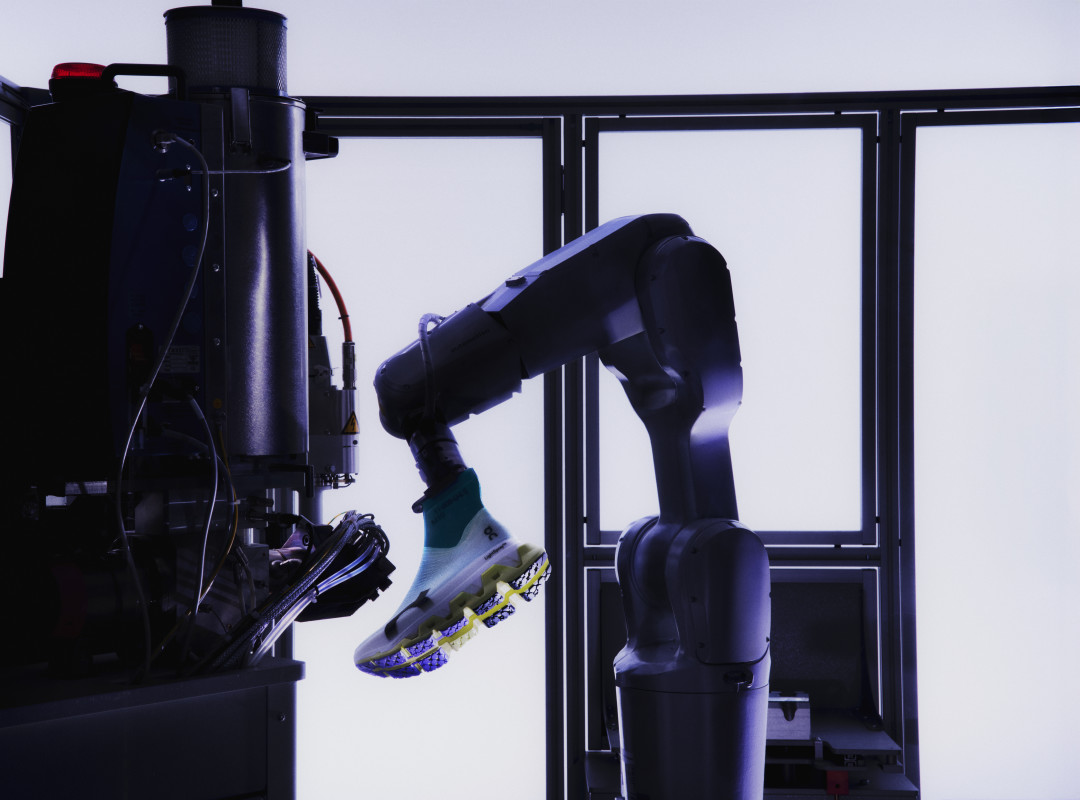
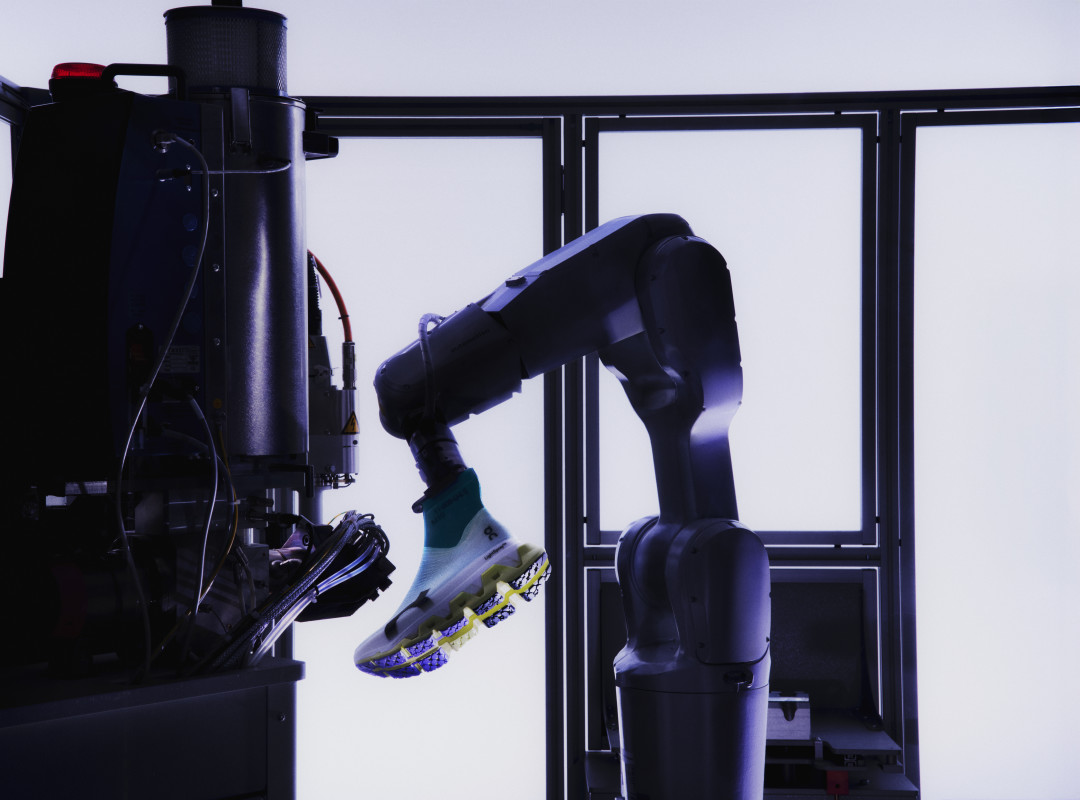
One is LightSpray, which you probably have seen. We opened our first factory in South Korea, where now 32 robots are basically spraying shoes in a fully automated way.This is not only a manufacturing revolution; it’s also a product evolution. It’s a super light product, but at the same time, because you connect the upper directly to the outsole, the performance is just at a very different level compared to a traditionally manufactured product. So this is the one thing that will come basically to the consumers now.
The other one is, we are currently in a phase where there’s a lot of evolution — or almost revolution — happening around foams that we are using on running shoes.And for the first time, we are able to combine this next generation of foams with our CloudTech, so with the holes in the shoes. And this really will elevate the sensation that you have when you use our products in the future. Comes in October.
So ,those are two examples where we have the most advanced foam laboratory outside of Asia in our headquarters in Zurich. We built that LightSpray technology in Zurich. So those are examples of like really deep innovation that we’re doing.
On that note, I wanted to maybe talk about supply chain modernization and maybe some of the trends you’re taking up while investing to build great products. On the product front, you mentioned robots. Right now, a lot of people are talking about automation and new technology, and I’m wondering where specifically you guys are making a point of investing?
I think one of the key goals that we have is to continue to automate manufacturing.Our footwear manufacturing or sports footwear manufacturing is highly manual today. There are almost 150 people involved in creating a product today. So moving away from this and basically achieving a higher degree of automation, I think this is a super important part of our future.
This will be the starting point, and to also be able to think about new places to manufacture products. With LightSpray, we have now gone basically into a fully automated world where we can basically produce the products in each and every place in the world because we are far less dependent on local labor expenses.
It is something that we will do as part of this shortening of the supply chain. And the lead times are super important in order to be able to react quicker to new innovations and to consumer demands. So by having a more automated manufacturing, by maybe being able to move manufacturing closer to your distribution markets, and then also shortening the timeline in your supply chain … those are very important pieces to be closer to the consumer.
I think the last piece I would call out is really the power that we see now coming from AI into the whole area of supply and demand planning, which of course for a premium brand is one of the most important things to do right because you know, an excess of inventory is the most dangerous element to your premium position, because in the end, it will require discounts, and basically, that would spread messagesthat you don’t want.
As you were just talking about planning and regionality, I am wondering how you can react to trends and implement them in the product and the vision with this new angle of attack.
Yeah, clearly, I think you can just think of the future in a more flexible way than the past, where the local labor expenses were among the most important factors to consider when deciding where you produce. That’s the goal that we have with automation. But then also, automation drives more quality, which I think is an important piece as well. But at the same time, all of this needs to make sense from a consumer perspective.
You don’t want to near shore just to near shore. Currently, the quality of product that we get from our factories is outstanding. There’s a lot of know-how in how to produce a product and how to innovate on the product in Asia. This is clearly something we want to tap into. This is why the first factory for light spray is in South Korea, because you have that knowledge there.
I think there are many factories. I think being more flexible around geopolitics is important. Yes, tariffs. Clearly, it’s thriving, also funding into that area because it will allow you in the future to maybe produce in your distribution markets, which allows you to not pay the tariffs. So there are many aspects in here, but it’s quite a complex infrastructure in the end.
At this point, we decided to jump into the Q4 results and the guidance picture for 2026:
Let’s talk a little bit about the outlook. Right off the bat, that net sales figure: 23%, down from 36% last year.
Analysts might look at the net sales as decelerating quarter-over-quarter, despite the impressive growth in 2025. Recently, markets have been penalizing any sign of deceleration, especially in consumer brands.
I’m wondering if we can touch on the factors feeding into that. Is this market or consumer-specific? What’s contributing to the figure here?
I mean, the way that I look at this, this is still an almost unseen growth rate at the size of company that we are. And I think it just shows the power that we have in the brand and the confidence that we have in the brand.
And at the same time, yes, we could grow faster, but we put a lot of focus on growing in a premium way, to grow in a highly qualitative way, and to be very selective on the wholesale partners that we work with … to be very selective on the new retail locations that we are opening in. And for us, it’s all about the long term and just being able to build a brand that can maintain very strong growth for a long period of time.
It’s something that we have proven. And at the same time, if you look at the profitability, we are well ahead of our original investor plan. We actually guide for a higher cross-profit margin this year.
So I think that the numbers are really strong and speak to the confidence that is there. We expect that our D2C channels continue to grow faster than our wholesale channels, which is an important piece to really connect with the customers to make use of the power of AI in the new ways of engaging with customers.
And then one category for us that is super exciting is apparel. It’s still a small part of our business. Apparel and accessories get us like 7% of sales, but it’s clearly growing much faster than the footwear business. And of course, this is a new part of our business that we are scaling as a company, and that will be an important part of the growth story going forward.
Speaking of sales growth and areas for opportunity, Asia-Pacific was a standout, with sales nearly doubling year over year. I wonder if you can talk a little bit about your region mix and how you guys are thinking about each of these regions, plus how they contribute to the picture for 2026.
So as a global company, we really look at the global business, and we are growing the company across all regions. When we speak to premium growth, we clearly look at “what are the regions where we have a strong momentum?” or “where are we accelerating?” and “which regions can we just also take the foot a bit off the gas?” And this is constantly evolving across different regions.
In Asia-Pacific, we’re experiencing that that strategy of “premiumness” connects so, so strongly with the consumer and the sentiment of the consumer at that time. If you go into shopping malls in China, Singapore, or Bangkok, the quality and the premium expression that the customer is experiencing there is at a very different level compared to other parts of the world. This is why I think a premium brand like On resonates so strongly with the consumer.
And at the same time, we are still at the beginning; we will see the strongest growth coming from the Asia region. Of course, always doubling [sales] is a big aspiration.
But then, if you look at Europe, we had done some strategic adjustments two, three years ago; they’re clearly paying off, and you see Europe accelerating on the growth side. And at the same time, also the U.S. will, of course, continue to be, from an absolute perspective, the growth engine.
I wanted to dig in a little bit on the D2C/wholesale mix. Obviously, it seems like one big question in all consumer brands right now is what the right mix is. I think the aspiration of most brand-forward companies favors D2C, but you see some brands making bigger investments in wholesale.
Obviously, for you guys, it seems to be quite a balancing act.How do you think about this from region to region, or even product to product?
There are, of course, differences country by country. I mean, clearly, China is probably the strongest D2C market because you simply don’t have a lot of wholesale partners. So you have a very high DTC share. Whereas you have other markets, like Japan, for example, where you have very strong wholesale partners, you can actually connect this customer very strongly to wholesale. When we think about channels for us, it’s very important to be where the customers are.
So we see the strengths and the beauty of being a multi-channel brand, and of really using the different channels to bring the right products to the right customers through the right channel. So this is how we think about this. But then you also have categories like apparel, where more than 60% of the sales are done through our D2C channels compared to the 44% DTC share that we have in the overall business.
This is because, when you think about your D2C channels, this is where we can show the full assortment, whereas our wholesale partners always have a selection of our products. Retail stores show most of our products; our e-commerce platform shows our whole assortment. And this is, of course, more important when it comes to how we can really create a brand world and show how we have thought about the products from head to toe or toe to head.
Whereas in footwear, if you put a single shoe on a wall, it’s still selling. And this is why. The apparel company that we are building will have a higher D2C share in the future. And this is actually the beauty: The categories that we are entering are increasing our D2C exposure. They drive a superior margin profile into the brand, and they allow us to connect more closely to the customer.
So, the evolution of product and the evolution of the premium business model, that really goes hand in hand. And this is what we sometimes describe as this premium growth.
With all the talk about AI right now, I am wondering how you guys think about implementing that into your business, whether thinking internally or as part of the customer journey?
Yeah, I mean, I think AI is changing every part of our business, but there are three areas where the impact at the moment is the most tangible and where we are also focusing on.
One is product creation, so being able to shorten development cycles and also improving the sustainability footprint in product creation, I think is important.
The second one we already spoke about is the whole supply chain, and really being able to match demand and supply in a way that we would not be able to do in the past.
And then the third one is really elevating the connection that you can have as a customer, and the insights and the engagements that you can have as a customer.We recently brought our new customer service platform to life, which is a conversational platform, but this is not just for talking about warranty cases or return cases. It’s really to engage with the consumer in a conversation and to learn much more about you than what we learned in the past from you clicking certain buttons. I think we will be able to use it to offer you something in the future that is much more specific to you and really allows us to drive new levels of engagement with the customers.
I think those are the three key areas that we’re working on.
Is there anything else that maybe I didn’t cover that you guys are particularly excited about, whether in this earnings report or plans for 2026?
I think you touched on a lot. Of course, behind this is always a team and a culture. And I think that’s something that sometimes gets forgotten by talking about the numbers.But in the end, having people who can be the creatives, but also executors of sending millions of pairs of products around the world. I think bringing those two things together just makes this the superpower of the brand.
#ONward #upward #interview #Holding #CEO #Martin #Hoffmann