
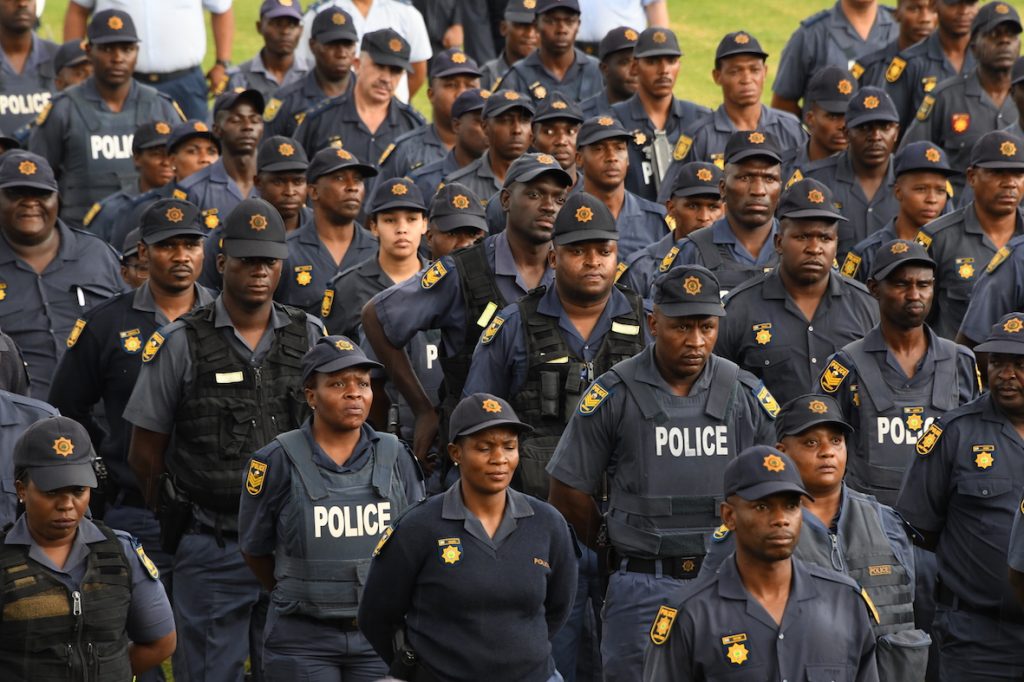
Greater urgency is required to purge the criminal justice system of the entrenched corruption and criminality that has hollowed it out and to fundamentally rebuild the South African Police Service (SAPS).
One proposal is to require every police officer from the rank of brigadier up to reapply for their positions. Those who meet the standard stay; those who don’t must go.
Read:
SA’s police are losing the war on crime [Nov 2023]
SAPS is drowning in unsolved dockets [Dec 2025]
“Even if it requires substantial severance packages, it will still be cheaper than sustaining an utterly dysfunctional police force,” argues National Anti-Corruption Advisory Council member David Lewis.
The current structure is bloated, mistrust runs deep among senior ranks, and leadership paralysis has become the norm.
The council has also been advised by retired police generals that SAPS Crime Intelligence — a unit that should be central to tackling corruption and organised crime — is so compromised that it should be disbanded entirely.
It is an “absolute corrupt” institution and utterly incompetent, although the officials have been quite competent in destroying the institution, Lewis said during the first Espresso Briefs podcast hosted by law firm Nortons Inc.
Critical interventions
The National Anti-Corruption Advisory Council (Nacac) handed its final report to President Cyril Ramaphosa in August last year. The report contains several recommendations on critical interventions in the struggle against corruption, which has become “an existential threat to South Africa’s democracy”.
Lewis says there must be urgency in the implementation of the recommendations – unlike the appointment of the Madlanga Commission of Inquiry, which should have been done the day former president Jacob Zuma was shown the door.
ADVERTISEMENT
CONTINUE READING BELOW
“The police have been in crisis forever.”
One of the key recommendations is the establishment of a Chapter 9 institution – the Office of Public Integrity (OPI).
To prevent this from becoming “just another institution to fail”, Lewis says the council recommended that the current Special Investigating Unit (SIU) be merged into the new institution.
It would require new powers, new skills and legislative changes. Because of the urgency, it will be quicker and financially more efficient to absorb the SIU within the OPI, as it can take years to set up a new institution.
Read/listen: Are the FIC’s teeth sharp enough to combat corruption?
Prevention before prosecution
The focus will be on prevention. Lewis accepts that there will be a lot of scepticism around whether one can prevent corruption, but he believes it’s possible.
“In no part of the world is the risk-return ratio on engaging in corruption more favourable to corruption than any other crime.”
Lewis say the returns are so great people calculate that, if they are smart and careful enough, the chances of being prosecuted for corruption are small. Hence the prevention strategy.
The OPI will be able to engage in systemic investigations by making use of experts in public administration and human resources, as well as forensic investigators to find the core reasons for corruption.
Lewis believes in many instances the wrong people are appointed in powerful positions, resulting in bad decisions. If that process is tightened up, half the people who are in powerful positions would not pass the first round of the selection committee.
ADVERTISEMENT:
CONTINUE READING BELOW
He also believes the court system needs attention.
Judges are far too permissive in allowing reviews and technical objections, he says, citing the Zuma trial as an example. “Any child will know that it is not real law that is being practised. It is just a way of delaying.”
He questions the court’s permissiveness, noting that not all instances can be attributed to due process and natural justice. “The courts must be told that we need justice to be done.”
Can-do attitude
Lewis is optimistic about the recent appointment of Andy Mothibi as the new head of the National Prosecuting Authority (NPA), replacing Shamila Batohi.
Mothibi was former head of the SIU and under his leadership the unit handled major investigations, including corruption related to Covid-19 funds, the Tembisa Hospital scandal, and infrastructure-related fraud.
Read/listen:
Can the new NPA leader restore confidence in prosecutions?
SIU reveals how syndicates looted billions from Tembisa Hospital
‘Corruption ultimately makes the poor pay’ – Andy Mothibi
Lewis says Mothibi has the energy, can-do-attitude and a good sense of how to communicate publicly. It is important for the NPA to have the public on its side.
“What must be hamstringing the morale of the NPA is the ridiculous criticism they get from the [legal] profession – who should know better – and the public.”
ADVERTISEMENT:
CONTINUE READING BELOW
As founder and former director of Corruption Watch, Lewis knows all too well how difficult it is to prosecute a secret conspiracy on a balance of probability “never mind beyond reasonable doubt”.
The problems
The public must understand, not as an excuse but as a way of explaining, why it takes a year to file court papers and why it is sometimes necessary to allow technical objections, he says.
Read/listen:
Scopa RAF inquiry to probe alleged corruption between judges and lawyers
Whistleblower assassinations expose state’s failure on justice
Anthony Norton, managing director of Nortons Inc, notes that the law firm’s recent interactions with the NPA in dealing with serious criminal matters have not been good.
The prosecutors showed little interest in prosecuting the matters, despite being handed the cases on a plate.
Norton wants to know how the dynamics of the NPA can be changed given the total lack of interest, the lack of application and the “complete skills deficit”.
According to Lewis it may require the assistance of the private bar with prosecutions.
Another issue that needs attention is the vast salary differential between the private and public sectors. He also questions the fact that the NPA cannot appoint and reward its own personnel, but is reliant on the Department of Justice for this.
#brutal #cure #proposed #SAPS