
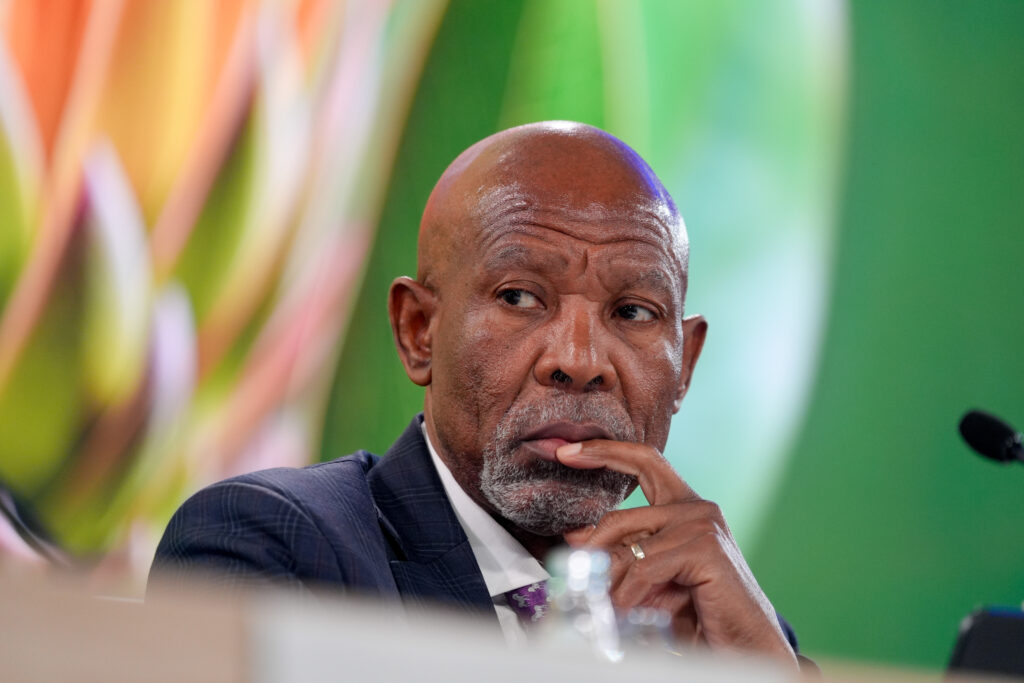
This week the focus shifts to the second interest rate decision this year by the South African Reserve Bank (Sarb) Monetary Policy Committee (MPC) on Thursday.
While there was a split on whether it would cut interest rates or leave them unchanged at the January meeting because expected inflation provided ample space for continued easing, the market is less split on expectations of a cut now.
In the wake of the war in the Middle East, the degree of uncertainty around the inflation trajectory has risen.
Read: Fed holds rates steady
The conservative MPC may not want to make further moves downward during these volatile times. As a net importer of petroleum products, South Africa is exposed to a material jump in fuel prices in April.
Should these elevated oil prices be sustained, this would shift SA from a period of fuel price deflation – which has helped contain overall inflation – to one of renewed fuel-driven inflationary pressure.
Read: SA sees little scope to ease fuel-price shock
ADVERTISEMENT
CONTINUE READING BELOW
The MPC had already considered the upside risks from an adverse turn in global oil prices and the rand at its January meeting: in a scenario where oil prices lift to $75 per barrel and the rand weakens to R18.50, inflation would peak at the top end of the tolerance band of 4% and policy easing would be delayed by one year.
“That said, the dynamism of inflation expectations is one of the pillars in the Sarb’s modelling,” say FNB economists.
“With expectations better anchored to the target and less backward-looking in their model, inflation shocks are more transitory as the generation of second-round effects is limited.”
In the first quarter survey results, the Bureau for Economic Research (BER) noted that inflation expectations had softened further towards the target – and, while this is positive, the second quarter expectations are likely to at least be influenced by higher energy costs.
“Should expectations quickly recover from this shock then the MPC would be in a more favourable position to look through this shock,” says FNB.
“Otherwise, we think monetary policy has all the reasons to be prudent and remain on hold, with some in the market already worried about a hike.”
In addition to higher fuel prices expected in April, Sanlam Investments economist Patrick Buthelezi says the accumulation in pressures caused by higher electricity tariffs, higher fertiliser costs and higher transport costs will make the pending policy rate decisions more difficult.
“Overall, risks to the inflation outlook have shifted to the upside. We expect the Reserve Bank to keep the interest rates on hold, delaying monetary policy easing, at least until there is more clarity on the outlook.”
ADVERTISEMENT:
CONTINUE READING BELOW
The repurchase rate currently stands at 6.75%, while the prime lending stands at 10.25%.
Read: CPI cools in February, unlikely to prompt rate cut
On the corporate front, it will be a quieter stretch ahead for local releases, with two sets of full-year results and one set of interim results due out this week.
- Thungela Resources (Monday): In its trading statement for the financial year, the group guided for a loss per share of between R53.50 and R56.00, down from earnings per share (EPS) of R26.76 in the 2024 financial year. This is driven by non-cash impairment losses of R8.8 billion across operations due to softer benchmark coal prices and stronger producing currencies against the US dollar. The company anticipates a headline loss per share of R5.50 to R7.50, further impacted by R1.1 billion of unrecognised deferred tax assets, though management emphasised these non-cash items do not affect cash flow, liquidity, or operational continuity.
- ADvTECH (Monday): In a trading statement, the private education group indicated that normalised EPS and headline earnings per share (Heps) for the year ended 31 December 2025 are expected to be between 14% and 19% higher than the comparative prior period, or between 229.9 and 241 cents per share. The company stated that 2026 student enrolment is on track and continues to grow in line with recent trends.
Investment holding company Remgro will release its half-year results on Wednesday.
In its interim trading statement, the company said Heps for the six months ended 31 December 2025 is expected to be between 914 cents and 948 cents, compared to 672 cents in the prior corresponding period.
The increase of between 36% and 41% is driven by continued improvement in operational performances across most of the group’s investee companies.
#week #ahead #Sarb #interest #rate #decision #geopolitical #tensions #bring #hawks