
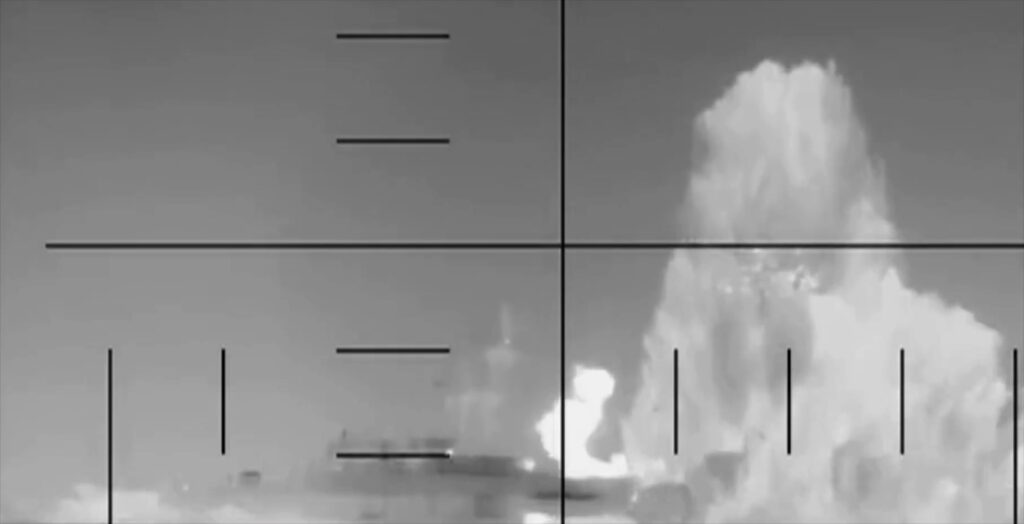
The US submarine strike on an Iranian warship in the Indian Ocean marked a sharp escalation in the war between the two nations, raising fresh security and economic risks across the Indo-Pacific.
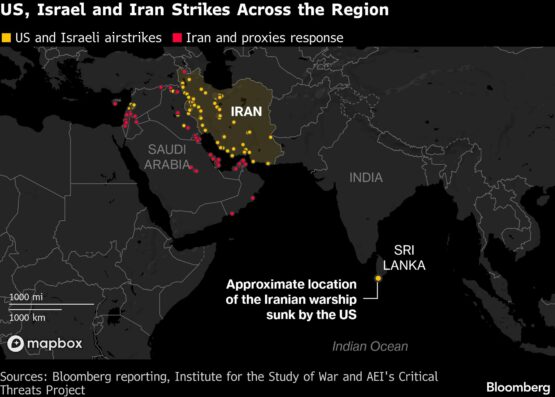
By striking the warship IRIS Dena about 40 nautical miles off Sri Lanka’s coast, Washington signaled no Iranian vessel is beyond reach. The move has drawn India and Sri Lanka closer to the fray. With Tehran vowing retaliation, the risk of naval clashes is rising along sea lanes vital to global commerce.
The sinking occurred far from Iran along a major shipping artery linking Asia, the Middle East and Europe. The presence of a US submarine conducting lethal operations near friendly nations such as India raises questions about how insulated Asia’s sea lanes are from external threats.
The incident “is likely to further unnerve Indo-Pacific nations, both friend and foe alike,” said Derek Grossman, a former US intelligence official who is now a professor of international relations at the University of Southern California. “Some will look elsewhere for their security needs, while others may hedge and hope for the best.”
Sri Lanka intervened with a second Iranian naval vessel in its waters and moved it to the northeastern port of Trincomalee, partly for safety reasons. And there are more vessels out there. Bloomberg maritime data show that over the past 30 days, ships linked to Iran have operated from Africa to Sri Lanka, Southeast Asia and China.
Potential targets could include what the US calls a “shadow fleet” transporting Iranian oil. The State Department last month blocked 14 shadow fleet vessels and in November designated 17 entities, individuals and vessels linked to the arms and oil trade for sanctions.
ADVERTISEMENT
CONTINUE READING BELOW
The US rarely discloses submarine deployments for security reasons but maintains a formidable fleet. The Navy operates about 50 nuclear-powered attack submarines in three classes: Los Angeles, Virginia and Seawolf. Designed for stealth, they can tail enemy vessels undetected. It was not clear which submarine fired the torpedo.
Balancing act
The conflict comes at a delicate moment for Asian governments balancing ties with their two most important partners, the US and China. Many remain unsettled by economic pressure from Washington since President Donald Trump’s return in 2025. The war has lifted energy prices and added inflationary strain to economies already hit by US trade measures.
US treaty allies including Japan, South Korea and the Philippines have sought trade deals to ease tariff pressure and now could see some American military assets in the region, which are there for their protection, being moved to the Middle East for the war.
Nations across Southeast Asia have largely been silent on the war. While Australian Prime Minister Anthony Albanese has since acknowledged that three defense force personnel were aboard the US submarine that torpedoed the Iranian warship, he also maintains they weren’t involved in operations related to the attack.
“As the conflict continues to escalate, the risks of miscalculation will rise sharply in fast-moving situations,” said Reema Bhattacharya, head of Asia risk insight at Verisk Maplecroft. “An accidental strike, a misread signal, a vessel in the wrong place could bring the region’s carefully maintained posture of neutrality under real strain.”
Asian dynamics
China maintains close ties with Tehran, and roughly 90% of Iran’s oil exports go to the Asian powerhouse, largely to independent refiners willing to buy discounted crude.
So far, there hasn’t been any evidence from the battlefield that Chinese weapons have been deployed. But, the Pentagon warned last year that China’s defense ties with Iran include companies supplying dual-use components for missile and drone programs.
ADVERTISEMENT:
CONTINUE READING BELOW
Experts say the submarine strike that resulted in more than 100 missing or dead does not mean the conflict is spreading to Asia, and Iran’s deputy foreign minister said in New Delhi on Friday that the ship was “unarmed” and “unloaded.”
The incident nonetheless adds to concerns over a potential Chinese move on Taiwan and Beijing’s assertiveness in the South China Sea.
For countries such as Malaysia, which host large numbers of Middle Eastern visitors, concern may shift to whether Israeli or American forces begin targeting individuals suspected of links to the Islamic Revolutionary Guard Corps or Hamas, said Shahriman Lockman, an analyst at Malaysia’s Institute of Strategic and International Studies.
In India, some former and current officials and opposition figures view the submarine strike as a strategic embarrassment. The Iranian frigate had participated in an Indian-hosted naval event in February, and India-US ties were already strained by the 50% tariffs Trump imposed last year.
Those were partially rolled back and tensions eased further Thursday when the US cleared the way for India to temporarily increase its purchases of Russian oil. The sinking in India’s backyard nevertheless complicates New Delhi’s balancing act with Washington.
“The US Navy is the world’s most powerful navy, no doubt. But can it act with such impunity in the Indian Ocean?” said C. Uday Bhaskar of the Society for Policy Studies in New Delhi. “The diplomatic optics are embarrassing for India.”
© 2026 Bloomberg
#submarine #strike #Indian #ocean #brings #Iran #war #Asia