
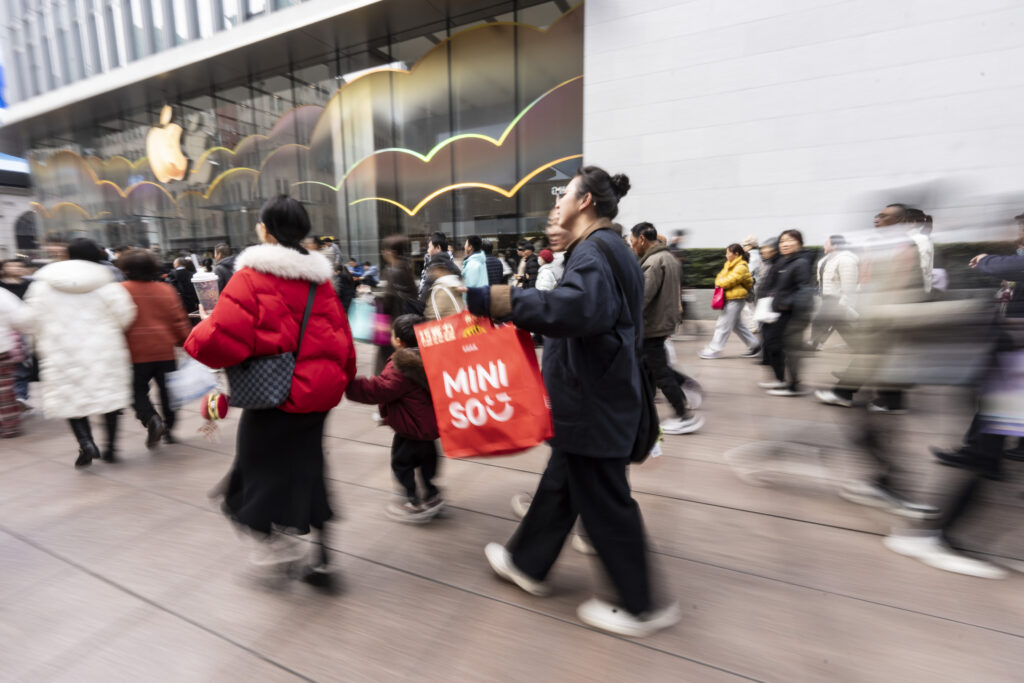
For decades, China’s leaders have failed to heed calls to rebalance the economy toward consumption as they pursued an investment-heavy, export-oriented growth strategy.
Now, a historic change is planned that — if successful — stands to reshape China’s economic relations with the world. In coming days, President Xi Jinping and his officials will unveil the 15th Five-Year Plan, including a goal to spur a “significant increase” in consumption by 2030 — language more urgent than previous Communist Party calls on domestic spending.
With overcapacity cutting prices, a property slump eroding wealth and US President Donald Trump’s protectionist push going global, the old growth model is challenged like never before. To power the next leg of expansion, Xi must convince his nation of savers to spend more on healthcare, tourism and other services as the middle class swells to 800 million people.
Read: US imports more from Taiwan than China for first time in decades
BYD’s $60bn wipeout points to deeper turmoil for China EVs
Currently stuck at an estimated 41% of GDP, Bloomberg Economics forecasts consumption will grow to make up 46% of the economy by 2030.
“Stronger consumption would not only unlock China’s next growth engine, it would help the world tap the full potential of its massive market,” economists Eric Zhu and Chang Shu wrote in a note.
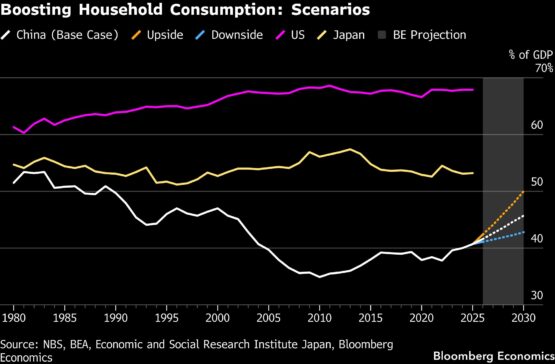
A bull case could see an even quicker advance, while a bearish scenario would see consumption’s share continue to languish.
A sustained recovery in consumer sentiment and spending will require bolder policies and cohesive execution from the government, the BE economists wrote. That should include structural measures, including child and elderly care subsidies, more efforts to increase the birthrate, and anti-involution measures to boost demand and tackle deflation.
“A more balanced Chinese economy underpinned by stronger domestic demand would generate far-reaching spillover effects globally,” said Robin Xing, chief China economist at Morgan Stanley. “Chinese and foreign companies alike would benefit from the depth and scale of the China market, which would help cushion today’s geopolitical challenges.”
ADVERTISEMENT
CONTINUE READING BELOW
Economies strong in services may benefit more from the pivot, Xing said. As Chinese people become increasingly affluent, household consumption growth is most likely to be driven by services such as education and healthcare, rather than goods, he added.
While officials seem more committed in their rhetoric toward boosting consumption, it’s unclear how they’re going to achieve it. Households’ spending on goods is actually largely on par with the level seen in advanced economies — it’s just that the goods they’re consuming are often cheaper. That leaves making consumers spend more on services central to the rebalancing effort.
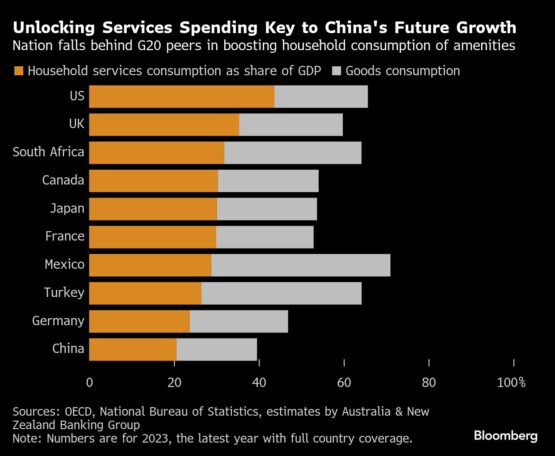
That focus on services creates a whole set of challenges.
Healthcare and education are tightly restricted industries as Beijing seeks to avoid a cost spiral that deepens social inequality. That’s meant efforts to date have tended to focus on stoking spending on so-called discretionary services such as tourism, recreation and sports.
Officials scolded by Xi for over-investing in high-tech sectors and infrastructure are now nurturing new revenue streams such as regional football leagues, tourist sites, and street food. And while there’s been glimmers of success — such as record spending over the recent Lunar New Year holiday — there are few signs of a meaningful pick up.
There are structural, not just cyclical, reasons for the under-spending, too.
China’s social security safety net is meagre, especially for those living in the countryside, which encourages so-called precautionary savings. The government’s social spending — including pensions, medical care, unemployment and low-income housing — was equivalent to 13.5% of GDP in 2024, Bloomberg calculations based on official data show, versus an average in OECD countries of 21.2%.
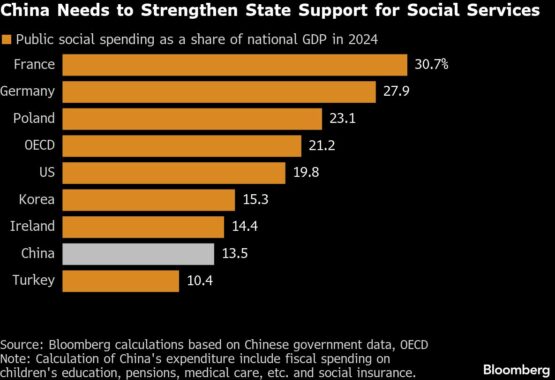
The inadequate and uneven social protection, coupled with a job market strained by intensifying trade tensions and the country’s years-long housing slump, has prompted households to save rather than spend.
ADVERTISEMENT:
CONTINUE READING BELOW
Household deposits exceeded 165 trillion yuan ($24 trillion) as of the end of 2025, with most being in low-return time deposits. More than 31% of disposable income is saved rather than spent, according to Bloomberg calculations based on government figures — much higher than the ratio in other major economies.
There’s a strategic rationale for the consumption imbalance, too.
“The policy priority in this country has always focused on industry, on the manufacturing sector – in economic terms, on the trade-able sector – because that sector involves a lot of technology, a lot of the security-related issues,” said Lu Feng, an economics professor at Peking University and an advisor to government agencies including the ministries of finance and human resources and social security.
China is already the largest exporter in almost 60% of product categories and accounts for more than 20% of global export flows, according to Oxford Economics. Growing strength in higher-value added sectors such as autos will leave economies including Slovakia, Czechia, Hungary and South Korea most exposed to China’s continued ascent, a recent paper from economist Artie Lam showed.
Chinese leaders typically see consumption as a derivative of industrialisation and development, rather than a driver of growth in itself, meaning even as they envisage an increase in consumer spending, they’re also aiming to keep manufacturing’s share in the economy at a “reasonable” level in the new five-year plan.
“Old habits die hard,” said Morgan Stanley’s Xing. “We are in a period of profound global change — a multi-polar world marked by persistent geopolitical tensions, where security increasingly takes precedence over growth. This naturally reinforces the view that manufacturing is the foundation of national strength and that industrial chains must be more competitive and self-sufficient.”
Echoing calls it has been making for 20 years now, the International Monetary Fund last month faulted China’s economic policies for causing waste at home and damage abroad and called for a reorientation by Beijing to embrace a model based on domestic consumer spending.
“Transitioning to a consumption-led growth model should be the overarching priority,” the IMF’s executive directors said in a statement alongside the Washington-based lender’s Article IV annual review.
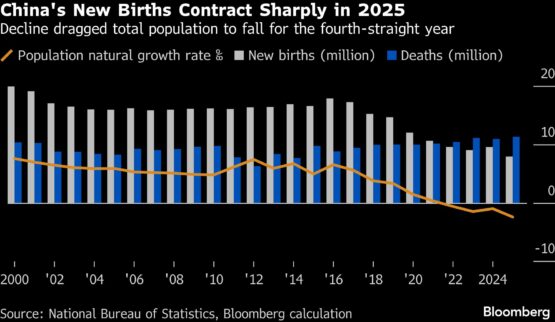
Per capita GDP now exceeds $13 000 and China’s middle-income group is expected to double to top 800 million over a decade. A low birth rate and population ageing mean the greatest opportunity in services may lie in industries such as aged care.
ADVERTISEMENT:
CONTINUE READING BELOW
The number of elderly people with disabilities and dementia exceeds 45 million, according to data from the China Research Centre on Ageing. That’s nearly 14 times the number of nursing home beds available.
Qi Yunlan, a researcher with the Development Research Centre of China’s State Council, identified elderly and child care, tourism and sports as among the areas where supply could be improved to encourage consumer spending. Digitalisation should be promoted and market access barriers torn down to make allocation of resources more efficient, she wrote in an article published by the state-run Economic Daily on Tuesday.
Opening up the health sector is gaining momentum, albeit gradually, as authorities look to unlock wealthy people’s demand for high-end services and tap the expanding global medical tourism market.
Last year, China’s first fully foreign-owned general hospital was launched in Tianjin. The owner, Singapore-based Perennial Holdings Pte, has developed four hotels adjacent to the institution to meet the needs of medical tourists. It also runs elder care projects with a total of over 1,800 beds in the vicinity — a model encouraged by policymakers.
To spur consumers, the government in July started providing subsidies for purchases of services including bathing assistance and rehabilitation nursing for some disabled senior citizens. It also began handing out childcare subsidies, while preschool fees are gradually being waived to ease education costs.
The initiatives fall under a new policy banner: “Investing in People,” a concept that marks a critical change in Beijing’s long-standing strategy of prioritising capital-goods investment.
Zhou Mi, a senior researcher at the Chinese Academy of International Trade and Economic Cooperation, a think tank affiliated with the Ministry of Commerce, expects the consumer market will grow steadily over the next five years.
“It will be easier for foreign companies to access the China market,” Zhou said. Still, officials remain committed to their export ambitions as foreign demand is a critical growth driver for companies and “that diversity is greater than what the domestic market alone can offer.”
© 2026 Bloomberg
#eyes #consumers #lead #era #Chinas #unbalanced #economy