
Ship traffic through the Strait of Hormuz remained blocked Thursday, even as a handful of Chinese vessels lined up to escape, with a very fragile ceasefire between the US and Iran yet to improve traffic flows in the region.
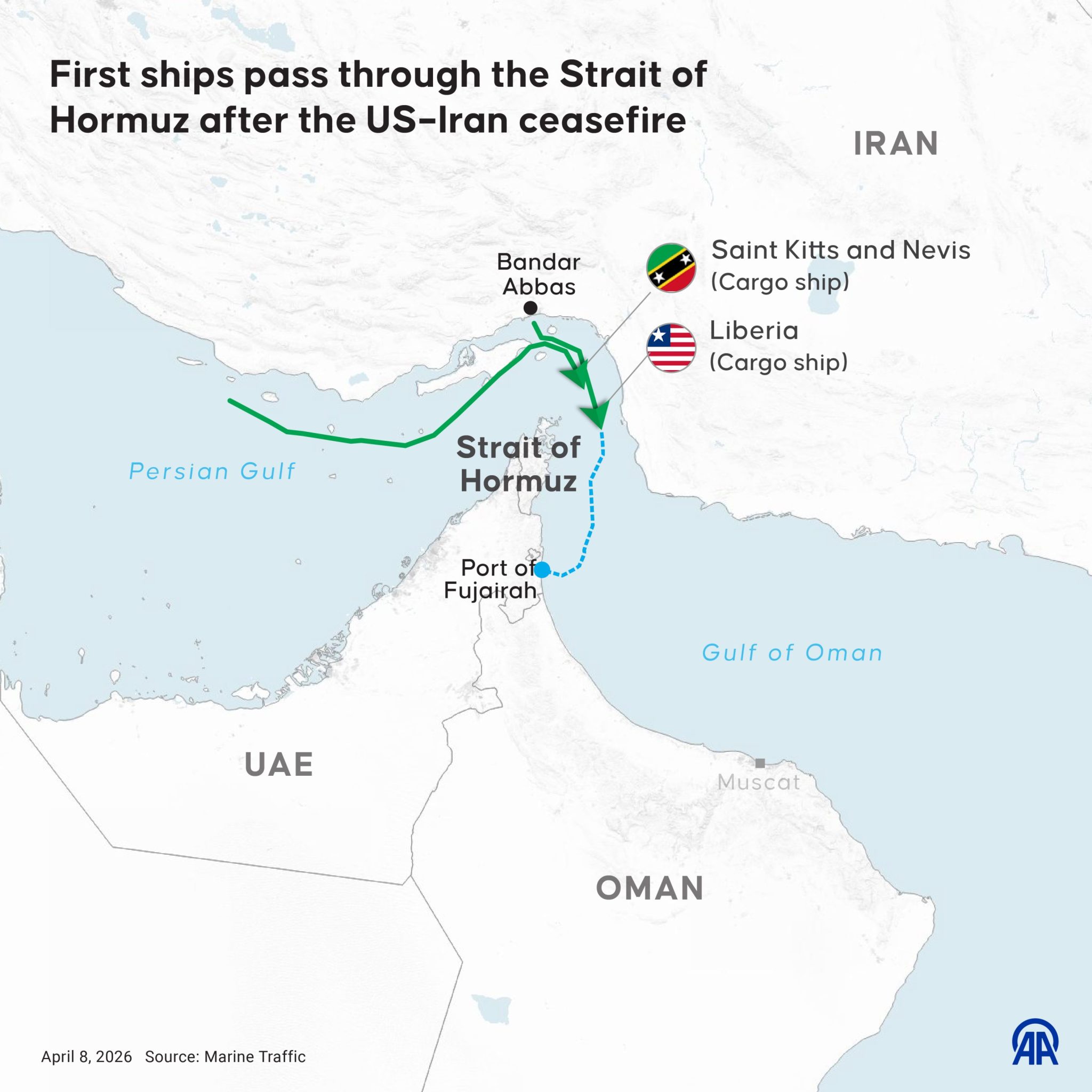
Just seven ships, all with some kind of prior link to Iran, were observed making the voyage out of the Persian Gulf on Wednesday and into Thursday morning. Normal transits in both directions are more like 135 a day.
In a sign of Tehran’s efforts to formalize control over the waterway, Iran’s Ports and Maritime Organization published two safe routes for shipping, according to state media. It said the routes were necessary to avoid the potential presence of various anti-ship mines in the usual sailing routes through narrow strait.
While Iran-linked vessels headed through the waterway, three Chinese oil tankers, fully-laden with Saudi and Iraqi crude, sailed toward Hormuz on Thursday before dropping anchor near the approach to the waterway that handles about a fifth of the world’s oil and liquefied natural gas.
The impasse comes despite the emergence of a ceasefire between the US and Iran earlier this week that caused oil to plunge.
‘Not Open’
While flows remain all but halted, the market is still acutely short of supply and despite a drop in futures prices, real world barrels continue to be scarce. US Vice President JD Vance said there were signs that Hormuz is starting to reopen but the boss of the UAE’s largest oil producer said Thursdday it remains effectively shut.
“Let’s be clear: the Strait of Hormuz is not open,” Sultan Al Jaber, chief executive office of Abu Dhabi National Oil Co., said in comments on LinkedIn. “Access is being restricted, conditioned and controlled.”
While Iran’s deputy foreign minister told the UK’s ITV news agency that “any” vessel is free to navigate, he said that doing so required communication with Iran’s military. He also confirmed the waterway was mined.
On Wednesday, the crew on one vessel reported hearing a warning from Iran that navigation through the strait still requires permission from the Islamic Republic, according to a person with knowledge of the matter. At least one oil tanker halted a plan to cross after it became clear that Iran was still insisting that vessels seek permission, a different person with knowledge of with the aborted transit said.
The speed with which Hormuz reopens is vital for energy markets across the globe.
Even if ships do begin to make their way out of Hormuz, it’s unclear if others will be willing to enter given the ceasefire only lasts for two weeks. It will also take anything from weeks to months for the oil to reach buyers once flows through the waterway do resume.
President Trump posted on social media overnight that US military personnel would remain in the region and that if there’s no deal “‘the ‘Shootin’ Starts,’ bigger, and better, and stronger than anyone has ever seen before.”
The head of the world’s main shipping agency, the International Maritime Organization, said on Thursday that any efforts by Tehran to permanently enforce a toll system on Hormuz would set a dangerous precedent and are unacceptable.
“What we cannot have is this different, or parallel, approach where another country introduces a different mechanism that is not in line with international practice,” Arsenio Dominguez, the IMO’s secretary-general, said in a Bloomberg TV interview.
He said that the IMO is working to return shipping in the region to the state it was in before the war broke out. A group of nations, including the UK, are working to establish whether there are mines in Hormuz or not, he said.
The return of discussions about mines in Hormuz is “the worst case scenario for shipping,” according to Martin Kelly, head of advisory at EOS Risk Group. “If the TSS is mined, the recovery for safe passage will take months at least,” he said, referring to the Traffic Separation Scheme ships use to cross it in normal times.
So far, there’s been only a limited volume of booking activity for ships to load oil inside the Persian Gulf.
One trading company booked a vessel to haul 1 million barrels from Iraq on Wednesday, according to lists of charters compiled by Bloomberg.
Another supertanker booking to haul crude from the Middle East made on the same day fell through, people involved in the market said. Two traders who handle Persian Gulf barrels, said there had been little change to cargo trading inside the region since the ceasefire.
The International Chamber of Shipping, an umbrella organization of trade groups representing owners of over 80% of the world’s fleet, said work more needs to be done before ships can go through en masse againg.
“There is not much movement because we do not have any solid confirmation as to securing a safe passage,” secretary general Thomas Kazakos said in a Bloomberg radio interview, adding that “as yet we have not received any solid information” on how traffic could return to normal.
#Hormuz #traffic #blocked #Iran #formalize #control