

South Africa’s rand soared, government bond yields tumbled and stocks jumped the most in six years as investors piled back into emerging-market assets that were worst-hit by the Middle East conflict.
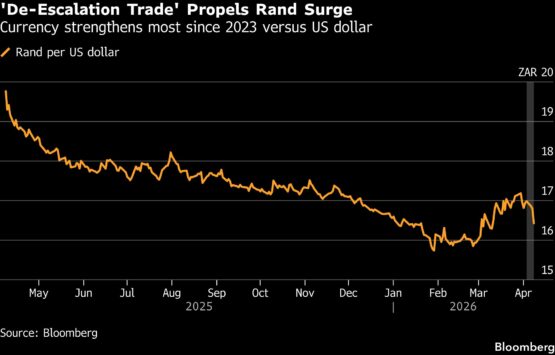
The rand had weakened most among emerging-market currencies since the start of the war through Tuesday, falling more than 5% against the dollar. On Wednesday, South Africa’s currency led gains as it surged as much as 2.6%, the most on an intraday basis since November 2023.
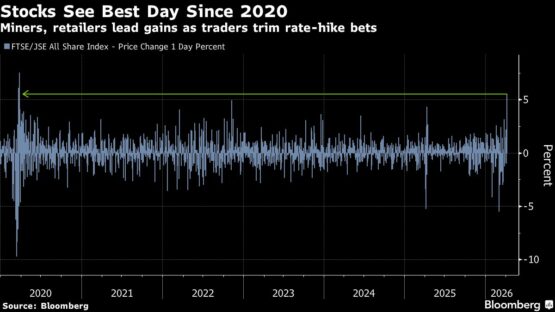
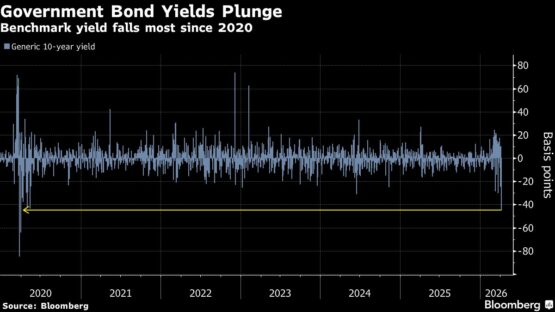
The benchmark government 10-year bond yield plunged 47 basis points, the most since March 2020, while the Johannesburg equity index climbed more than 5% as beaten-down mining stocks surged.
The stronger demand for developing-nation assets is part of a global relief rally spurred by a two-week ceasefire agreement that’s expected to result in the reopening of the Strait of Hormuz. Investors who had sold off risky assets as the war dragged on are now looking for the best buying opportunities.
The rand’s rally “depends on whether the US/Israel-Iran ceasefire is here to stay,” said Henrik Gullberg, a macro strategist at Coex Partners. “If it is, I think long-rand is the best de-escalation trade.”
ADVERTISEMENT
CONTINUE READING BELOW
Meanwhile, traders slashed bets on rate increases by the South African Reserve Bank as lower oil prices ease concern about inflation pressures. Money markets are now pricing in 37 basis points of hikes by year-end, compared with 83 basis points on Tuesday.
That helped fuel a rally in so-called South Africa Inc. stocks including retailers, banks, construction and telecommunications. The FTSE/JSE All Share Index’s 5.7% gain placed it among the top 10 stock markets around the globe on Wednesday.
Foreign investors sold a net R56 billion ($3.4 billion) of South African government bonds in March, driving the 10-year yield more than 100 basis points higher. On Wednesday, they were the best performers after Lebanon and Turkey among local-currency bond markets tracked by Bloomberg.
“The risk-off sentiment impacted emerging markets and South Africa disproportionately during the Iran war,” said Adrienne Damant, an analyst at Avior Capital Markets. “Therefore, the positive unwind should disproportionately impact us too.”
US President Donald Trump announced the agreement hours after Pakistan, a mediator in talks, implored the US leader to back off his deadline to unleash massive devastation on Iran. The deal buys time for the two sides to reach a longer agreement to end the war, which has killed thousands of people and sparked a global energy crisis.
ADVERTISEMENT:
CONTINUE READING BELOW
For the rally in South African assets to be sustained, investors will need confirmation that the ceasefire will hold and oil flows through the Hormuz Strait will normalize, said Kristof Kruger, a fixed-income trader at Prescient Securities.
“I still think the trade is to fade it,” Kruger said. “This seems to be too much too fast; the trick is to wait for the second move to confirm.”
For now, traders are happy to jump on board. The economic fundamentals that propelled the rand’s rally before the war remain in place, including relatively high yields relative to the dollar, said Hironori Sannami, a foreign-exchange trader at Mizuho Bank in London.
“From a macro perspective, the rand continues to offer high carry, while South Africa is relatively insulated from direct geopolitical risks compared to other high‑yield emerging markets,” Sannami said. “In an environment where tail risks are easing, the market tends to re‑engage with carry‑efficient currencies like the rand.”
© 2026 Bloomberg
#South #Africa #leads #rebound #emerging #markets #hit #Iran #conflict