
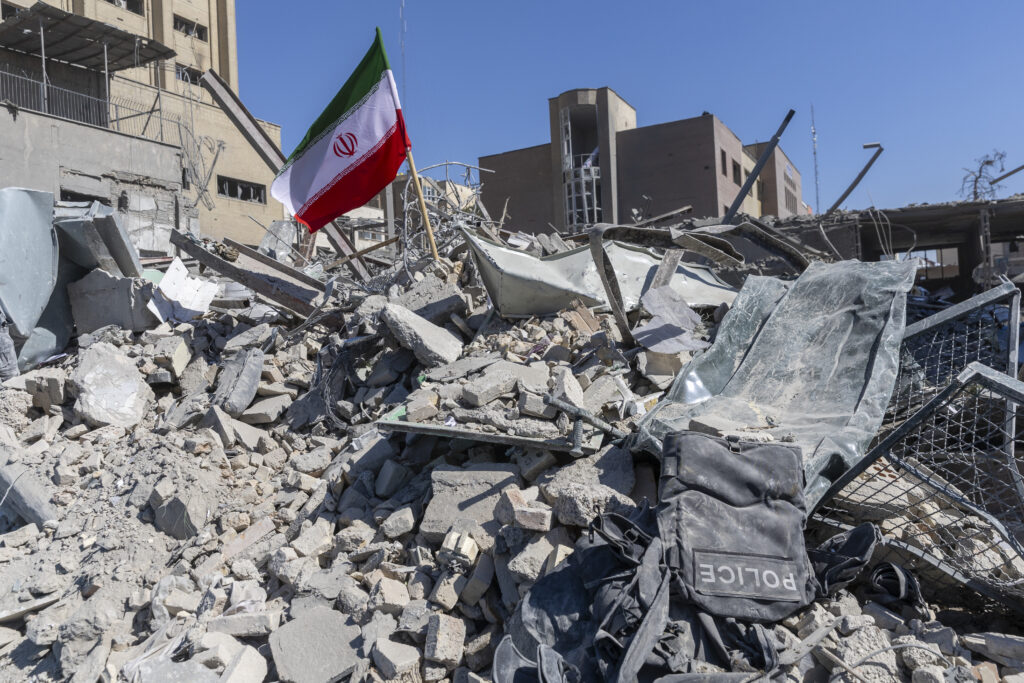
Stocks fell and the dollar rose as markets stayed jittery after President Donald Trump warned the US would hit Iran “extremely hard” within two to three weeks, disappointing traders who had hoped for clearer signs of an end to the war.
US futures slid while a gauge of Asia Pacific shares extended losses to as much as 1.7% shortly after Trump’s speech commenced. Across the region, Korean and Japanese stocks led the complex lower.
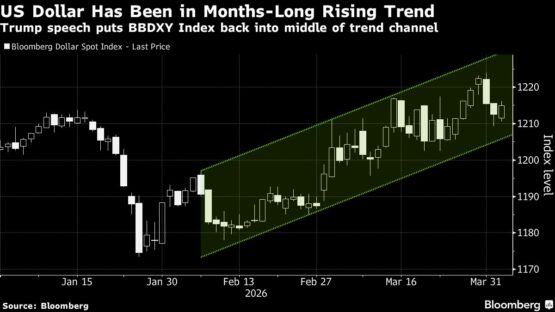
Meanwhile, a Bloomberg Dollar gauge rose as much as 0.3%. Traders had earlier said hedge funds bought dollar put options on Wednesday ahead of the speech, which would benefit from a weaker greenback as risk sentiment improved. Thursday’s move suggests a return to risk‑off positioning.
Here’s what analysts say:
Jumpei Tanaka, head of investment strategy at Pictet Asset Management Japan.
Trump’s speech was not what the market had hoped for — namely, signals pointing toward an end to the conflict. Instead, he suggested a potential escalation, stating that the U.S. could deliver extremely severe strikes against Iran within the next two to three weeks and warning that Iranian power plants would be targeted if no agreement is reached. As a result, the remarks are being interpreted as a negative factor for the equity market.
Ken Wong, Asian equity portfolio specialist at Eastspring Investments Hong Kong.
While everyone wants to move on from this, there is still much to unpack from the past month’s events in the Middle East. The question now is how much these developments will ripple through the global economy over the coming quarters. With oil shocks in play, the likelihood of the Federal Reserve lowering interest rates has diminished further.
ADVERTISEMENT
CONTINUE READING BELOW
Tomo Kinoshita, global market strategist at Invesco Asset Management Japan
As it becomes increasingly clear that the war is not progressing toward a resolution, markets are once again shifting toward lower equities, lower bond prices, and a stronger dollar. There’s a growing awareness that the Iran conflict could have broad spillover effects on the economies of many countries and regions.
Carol Kong, an economist and currency strategist at Commonwealth Bank of Australia
Looks like Trump failed to reassure markets that the war will de-escalate from here and the US will help secure access to the Strait of Hormuz. The reality is US military assets continue to be amassed in the region, keeping alive the the possibility of a ground offensive. That means the USD will remain well-bid in the near term.
Tareck Horchani, head of sales trading prime brokerage at Maybank Securities
Trump’s speech is a classic case of mixed messaging, and markets reacted exactly as you would expect, initially risk-off. The market is clearly pricing a renewed geopolitical risk premium, particularly around energy supply.
What’s interesting is that markets had actually started to rally into the speech on hopes the conflict was nearing resolution. So this feels more like a reset of positioning rather than a full-blown panic, investors were leaning slightly constructive, and now they’re being forced back into a more defensive stance.
Wee Khoon Chong, senior APAC market strategist at BNY
APAC FX, especially among net oil importers, is likely to continue to be under pressure from high oil prices, as well as an elevated USD. Adding to this is foreign capital outflow pressure. Foreign investors were net sellers in record amounts in Korea, Taiwan, and India in March.
ADVERTISEMENT:
CONTINUE READING BELOW
Upside inflationary pressure may further delay the potential Fed easing path. This, along with flight-to-quality demand, is likely to support the USD in the near term. In the event of de-escalation of tensions in the Middle East, the risk-on rally will likely be felt most in the equity complex, while FX will have to deal with ongoing terms-of-trade pressure, depending on the evolution of crude oil prices.
Sean Callow, a senior FX analyst at ITC Markets
A return to 1,222 on the Bloomberg Dollar gauge would not surprise given that Trump offered no plan to reopen the Strait of Hormuz beyond dropping the problem on others’ doorstep and an optimistic notion that it opens “naturally”.
Dilin Wu, a research strategist at Pepperstone Group
His speech is indeed disappointing. Trump announced victory while also threatening strikes on Iran’s energy and electricity facilities and saying he might deliver major blows over the next two to three weeks — so effectively it’s business as usual. The earlier talk about withdrawing from the Middle East now looks more like a way to calm markets while keeping pressure options open. He clearly still prefers a pressure‑first strategy rather than a clean de‑escalation.
Nick Twidale, chief market analyst at AT Global Markets
The market was craving some clarity on when the conflict will finish, but this speech has just added more uncertainty. Investors are clearly unimpressed, and I think we could see more downside for global markets today.
I think we were hoping that he would announce an end today, and markets are disappointed that it did not happen. Overall, I think that despite him saying it’s ending soon, the key update that he will hit Iran in the next few weeks is hugely negative for the markets. It means the war may continue.
© 2026 Bloomberg
#Trumps #renewed #Iran #warning #risks #volatility #analysts