
The spike in the price of jet fuel following the start of the Iran war (or ‘military operation’) has added more than R800 to a one-way airline ticket between Johannesburg and Cape Town.
Data from Iata (International Air Transport Association) shows that the price of jet fuel has roughly doubled since the end of February, from around $100 a barrel to the $200 level.
Read:
Expensive avionics ‘walking out’ of SAA Technical
R10k return to Cape Town this Easter?
FlySafair, the country’s largest carrier, says the price of standard jet fuel (A1) at SA’s coastal airports increased by 70% in a single week at the start of the conflict.
Because of this, the price of jet fuel now accounts for more than half the direct operating costs of each flight. In March, it estimated an additional expense of about R35 000 per flight.
The airline implemented a “temporary dynamic fuel surcharge” from 12 March to ensure its operations remain sustainable. It has elected to show the surcharge separately on each flight to keep “fares transparent so that customers can clearly see what they are paying for, rather than quietly building temporary cost increases into the base fare”.
Its rivals have chosen to increase base fares instead.
The surcharge varies by route and is calculated based on distance. Longer routes burn more fuel; hence, the surcharge is higher.
ADVERTISEMENT
CONTINUE READING BELOW
FlySafair originally implemented this until 12 May and later extended it to 31 July. This has now been lengthened again – to 7 August, likely due to its various hedging arrangements (linked to forward prices of fuel as well as oil).
As fuel prices have ratcheted higher, the airline has adjusted the surcharge. Because this is published separately, one can track the impact of higher fuel prices over time.
Originally, this fee for a Joburg to Cape Town flight added an estimated R167 to a ticket. Today, the surcharge for this route is R832.60 (or R824.55 to Lanseria).
On the far shorter Joburg-Durban route, the surcharge is R460.
Cape Town flights to Nelspruit and Hoedspruit (both popular destinations for foreign tourists) have a surcharge of R999.35.
For its furthest international destinations, Zanzibar and Mauritius, the surcharges are R1 228 and R1 448 respectively.
The surcharges mean that flying has become a lot more expensive. It is all but impossible to book a return flight to Cape Town for under R4 000 now.
Searches across FlySafair and Lift for the cheapest dates in May (Tuesdays, middle of the month) show a round-trip price of R4 600 and R4 400, respectively (both fares include a checked bag).
SAA and Airlink are in the same ballpark (between R4 200 and R4 400), while Cemair is noticeably higher (it operates smaller aircraft, and this is not a main route for the airline).
ADVERTISEMENT:
CONTINUE READING BELOW
Flights to Durban from Johannesburg are now around R1 200 to R1 300 each way, substantially more than the R700-odd this used to cost.
This means that airfares have more or less doubled in the last two months.
Google Flights confirms this with average return fares for the Joburg-Cape Town route increasing from R2 018 just 54 days ago to the current R4 022 level, which it describes as “high”.
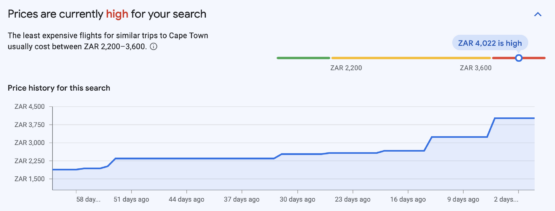
Source: Google Flights
While there are still plenty of seats available, a relatively ‘last-minute’ trip to Cape Town to take advantage of the two public holidays at the end of the month is at least a R7 000 per person exercise.
And this involves flying at odd hours to take advantage of the cheapest seats.
If you want to max out your stay and fly at more comfortable times (late afternoon/early evening on Friday 24 April and Sunday 3 May), the fare jumps to closer to R9 000.
#Jet #fuel #spike #sees #domestic #airfares #double