
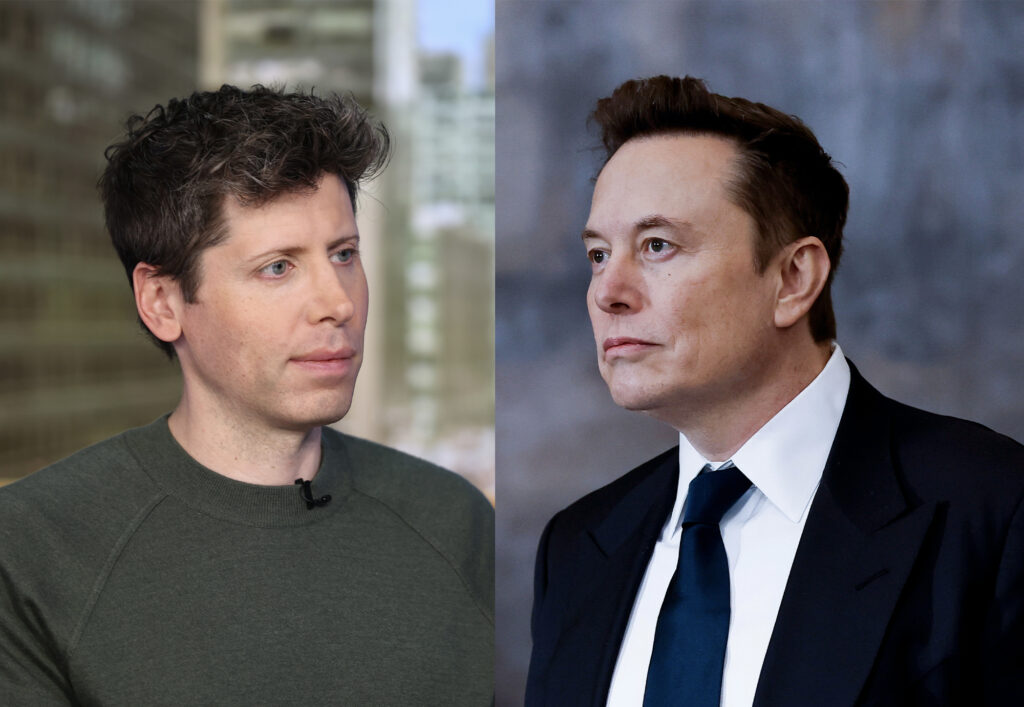
Elon Musk testified Tuesday he’s suing OpenAI and two of its co-founders — Sam Altman and Greg Brockman — because the startup’s pivot from a charity to a for-profit business is wrong and sets a concerning precedent for other philanthropic efforts.
“It is not okay to steal a charity, that’s my view,” Musk told jurors at the outset of a trial in federal court in Oakland, California.
The closely watched trial is the culmination of years of animosity and public feuding over the startup the three men worked together to found in 2015, before their relationship soured and they became rivals.
Musk said the consequences of the legal fight go far beyond the people involved, and that if Altman and Brockman’s conduct isn’t deemed improper, “this case will become case law and become precedent to looting every charity in America.”
An attorney for OpenAI, William Savitt, objected to Musk’s explanation, asking US District Judge Yvonne Gonzalez Rogers to strike the testimony because Musk isn’t a lawyer who can provide legal analysis. Gonzalez Rogers denied the request.
In his own statement to the jury, Savitt argued that Musk’s lawsuit is primarily an attempt to undermine a top competitor to his own AI company, xAI. Savitt also contended that Musk himself was a proponent of restructuring OpenAI as a for-profit entity in its early years.
The outcome of the three-week trial could shape OpenAI’s future as it eyes a much-anticipated public offering that is poised to be one of the largest in history as the company approaches a trillion-dollar valuation. Among the changes Musk seeks is a court order unwinding the for-profit restructuring of OpenAI that was completed in October.
Musk spent much of his early testimony telling the jury about his business ventures, including Zip2, PayPal, SpaceX, Neuralink and Tesla. He said he had long been interested in artificial intelligence but always had concerns about the technology becoming smarter and more powerful than human intelligence.
Musk, wearing a black suit and tie as he has in other courtroom appearances, looked comfortable and enthusiastic on the witness stand, at times making short quips. The business mogul has testified before a number of juries in legal disputes around the country, winning most of his cases.
Musk told jurors there was a risk that AI could be a “double-edged sword,” a tool that made significant contributions and advancements to society, but that something that could also go wrong.
“It could make everyone prosperous, but it could also kill us all,” Musk said.
Around 2015, Musk said he was talking to “anyone and everyone” he could about the capabilities of AI, along with his concerns about how the technology might be developed. That included Google co-founder Larry Page.
ADVERTISEMENT
CONTINUE READING BELOW
Musk said he felt the tech executive “was not being sufficiently caring about the safety of AI” and was dismissive of questions Musk asked about a hypothetical future where “AI wipes out humans.”
“He said that would be fine as long as artificial intelligence survives,” Musk said. “Then he called me a speciesist for caring about humans more than AI.”
Musk said he thought this was “nuts” and he became convinced there needed to be a counterpoint to Google’s technology, because the company was an early leader in developing AI. At the time, Musk said they had “all the money, all the computers and all the talent for AI.”
“I thought, ‘what would be the opposite of Google?’” Musk said. “An open source, nonprofit.”
Alphabet Inc.’s Google, which is not a party to the trial, didn’t immediately respond to a request for comment.
Musk’s lawyer, Steven Molo, told the jury the trial will show that Altman and Brockman took advantage of Musk’s money, reputation and guidance to get OpenAI off the ground — and then decided to abandon its public-focused principles and capitalize on the project for their own benefit.
Molo alleged that Microsoft Corp. was a knowing accomplice to that betrayal when the software giant pumped $13 billion into OpenAI starting in 2019, a year after Musk left the startup’s board.
Microsoft stood by Altman and Brockman as they made an “absolute mockery of OpenAI’s charitable mission,” Molo told the nine-person jury.
In his own statement to the jury, Savitt said that in OpenAI’s first year as a nonprofit research lab, Musk said in an email: “probably better to have a standard C corp with a parallel nonprofit.”
The next year, Musk said in another email that “it might have been a mistake for OpenAI to be set up as a nonprofit, given progress Deepmind was making,” Savitt said, referring to an AI project at Google.
In 2017, Musk and others at OpenAI recognized the company would need to spend far more on computing resources to support its technology than they had previously expected. The founders had “dozens” of meetings and aligned on an idea to create a for-profit arm.
“During these intense discussions in 2017, Mr. Musk never expressed the view that OpenAI should remain purely nonprofit,” Savitt said. “The exact opposite was the case.”
Musk, Savitt said, “wanted to turn OpenAI into a full-on for-profit company and take absolute control of it,” but “the other founders refused to turn the keys of artificial intelligence over to one person.”
ADVERTISEMENT:
CONTINUE READING BELOW
Musk said during his testimony that he was always open to the idea of creating a for-profit subsidiary of OpenAI, so long as profits were capped and any money it did make would go to the nonprofit.
One proposal being discussed at the time would have given the four key leaders at OpenAI an equal equity split in the for-profit entity. That group would include Musk, Altman, Brockman and Ilya Sutskever, who was OpenAI’s chief scientist.
Musk said he felt that would be “unfair and inappropriate,” given that he was “providing all of the funding” up to that point. He had hoped to hold the majority interest in an OpenAI for profit — a position he expected to weaken quickly, as more investors came forward.
Today, OpenAI’s nonprofit foundation remains in control of the organization. As part of its for-profit conversion last year, the company said OpenAI would continue to be overseen by the nonprofit entity, now dubbed the OpenAI Foundation. The nonprofit also received a 26% equity stake in the company. Microsoft got a 27% stake.
Russell Cohen, an attorney for Microsoft, said the dispute has little to do with the software company, which he said “has been a responsible partner every step of the way.”
“Together Microsoft and OpenAI have helped fund one of the largest nonprofits in history,” he told the jury.
“Unlike Mr. Musk, Microsoft never tried to control OpenAI,” Cohen argued. “It saw a partnership without control. It saw a partnership that could benefit everyone.”
The jury is set to hear from a parade of VIP witnesses and will be asked to wade through years-old emails, text messages and corporate documents from OpenAI’s founders.
The jury will issue an “advisory verdict” after the conclusion of testimony. A final ruling on Musk’s claims — and any remedies — will be issued by Gonzalez Rogers, using the jury’s findings as a guidepost.
The case is Musk v. Altman, 4:24-cv-04722, US District Court, Northern District of California (Oakland).
© 2026 Bloomberg
#Musk #testifies #hes #suing #OpenAI #stop #Altmans #looting