
The US economy is poised to become more reliant on spending by the government and businesses for growth in 2026 as inflation driven by the Iran war hits consumers.
A report Thursday is expected to show that dynamic was already developing in the first three months of the year, even before the impact of the war really kicked in. Gross domestic product probably advanced at a 2.2% annualized pace in the first quarter, while consumer spending was likely up just 1.4%, according to a Bloomberg survey of economists.
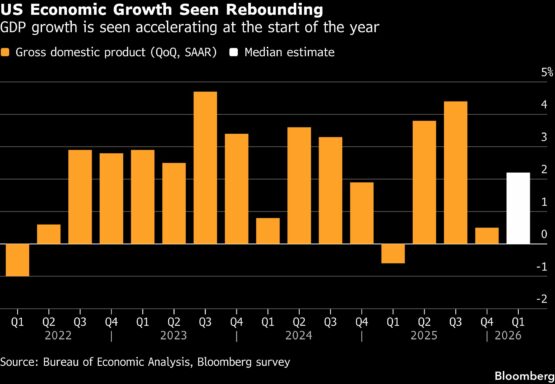
The headline figure will likely be flattered by a sharp rebound in government spending following a record-long federal shutdown at the end of 2025, and forecasters expect rising defense outlays to support growth if the war drags on. Meanwhile, figures on business investment will likely reflect an ongoing boom in spending related to the artificial intelligence buildout.
“Sustained investment in AI does provide a very strong tailwind to overall growth,” said Joe Brusuelas, chief economist at RSM US. Beyond that, “what could have been a fairly strong start to an above-trend year in growth is going to arrive a bit disappointing.”
ADVERTISEMENT
CONTINUE READING BELOW
The GDP numbers from the Bureau of Economic Analysis will follow an interest-rate decision Wednesday from the Federal Reserve, which is widely expected to hold rates steady as it awaits clarity on the impact the Iran war will have on the labor market and inflation. Gasoline prices surged in March by the most on record, Bureau of Labor Statistics data showed, and have continued to climb in April.
With the war now entering its third month, economists say energy prices will remain elevated — even if there is a resolution soon — because of the damage incurred by Middle East energy production and refining facilities. They also expect food prices to rise this year as war-related disruptions to fertilizer markets make their way through global supply chains.
Inflation picture
The early inflationary impact of the war will be clear in the Fed’s preferred price gauge, also out Thursday. The personal consumption expenditures price index is forecast to climb 3.5% in March from a year earlier, the fastest pace since 2023.
Higher tax refunds — thanks to legislation passed last year — are expected to have boosted consumer spending last month after severe winter weather in much of the country likely curtailed it somewhat at the start of the year. But economists warn rising inflation could soon overtake the extra income.
“You can expect a little bit of a buffer from higher tax refunds, but a large part of that will go into higher prices at the pump,” said Gregory Daco, chief economist at EY-Parthenon.
AI investment
Investment in AI has been a key driver of business spending over the past year, and is expected to remain so in 2026. Economists will look at outlays in categories including information processing equipment and software to gauge the impact AI had in the first quarter, as well as the extent to which construction spending was concentrated in the data-center buildout.
The contribution of those AI-related investments to overall GDP growth has been tempered by the fact that much of the hardware components involved are imported from abroad, which means they are netted out of the calculation.
Many economists expect the report to show net exports weighed on GDP in the first quarter, reflecting a surge in AI-related imports and front-running of new tariffs after the Supreme Court struck down many of President Donald Trump’s previous levies in February. Jennifer Lee, a senior economist at BMO Capital Markets, sees net exports shaving about a percentage point off of growth.
Government spending
Between weaker growth in consumer spending and the offset to business investment from rising imports, government outlays will be an important contributor to the first-quarter GDP numbers. Bloomberg Economics forecasters led by Anna Wong estimate GDP rose 2% in the first three months of the year, but just 1.3% excluding government spending.
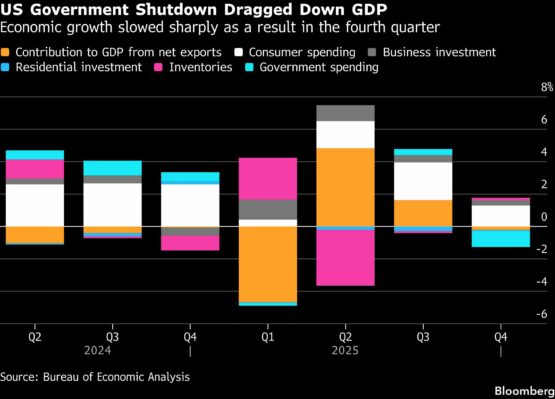
The pop in the first quarter will largely reflect the unwind of the shutdown which spanned much of October and November, disrupting services and resulting in more than a million workers going without pay. The BEA previously said the reduction in federal services during the shutdown subtracted around a percentage point from fourth-quarter GDP.
ADVERTISEMENT:
CONTINUE READING BELOW
But economists said rising military spending spurred by the Iran war could also provide a lift to government outlays if the conflict persists.
“The data was too early to catch the tailwind that’s going to show up in GDP for government spending due to rising defense orders,” RSM’s Brusuelas said. “We will likely see goods orders in the second and third quarters that then will ease off a bit.”
© 2026 Bloomberg
#watch #economys #report #card