

At first glance, Ford’s first-quarter earnings results last week were pretty solid. So why are Ford shares down another 2% Monday, May 4, bringing its five-day decline to more than 6%?
Ford saw net income rise by nearly 20% to $2.5 billion year over year. Adjusted EBIT rose by nearly 30% to $3.5 billion, revenue jumped 6.4% (despite lower vehicle sales), and paid subscriptions to Ford Pro rose 30% to 879,000.
For the year, Ford increased its adjusted EBIT guidance by $500 million, to a range between $8.5 billion and $10.5 billion.
“Ford is off to a strong start, our products are winning with customers, and we raised our full-year outlook,” Ford CFO Sherry House said of its Q1 performance.
While the stock movement may be perplexing to some, analysts at BNP Paribas have a solid reason for maintaining their neutral rating and $13 price target.
Ford’s unpredictability gives BNP Paribas analysts pause
Ford topped BNP Paribas’ revenue expectations ($43.3 billon vs. $41.7 billion), adjusted EPS expectations (66 cents vs. 18 cents), and adjusted EBIT ($3.5 billion with 8.1% margin vs. $1.2 billion with 2.9% margins), but the firm maintained its neutral rating and $13 price target anyway.
BNPP is more concerned about the multiple headwinds the company is facing, including rising commodity prices, the continued fallout from the Novelis supplier plant fire, and investments in Model e, than the multiple tailwinds the company has at its back.
“We expect the shares to trade lower… amid Ford’s high quarterly earnings volatility, and, at times, unpredictability, with its ’26 revised guidance now implying a -$2B reduction to 2Q-4Q adj. EBIT (-25% lower) vs. its prior outlook. This compares to just an -8% revision to GM’s implied 2Q-4Q guidance change,” BNPP auto research analyst James Picariello said in a note emailed to TheStreet.
“We understand Ford’s moving pieces to the guide with respect to favorable 1Q cost timing that now proves more pronounced over the remainder of the year, and of course, the IEEPA refund, as well as the additional commodity/metals costs that are now hitting OEMs. But it’s the sheer-magnitude of Ford’s financials, when they move, that continue to temper our full-confidence behind the Co.’s future earnings trajectory.”
Ford’s tailwinds for the year include the $1.3 billion tariff refund the company expects to receive after the Supreme Court struck down a portion of President Donald Trump’s tariffs. That one-time benefit led the company to raise its guidance, but BNPP analysts don’t believe it’s enough to lift the company’s rating.
Meanwhile, Ford itself is also expecting commodity costs to add a $2 billion headwind to its efforts this year, up from its previously stated $1 billion, driven by higher aluminum prices.
Ford shares were down about 2% Monday, May 4.
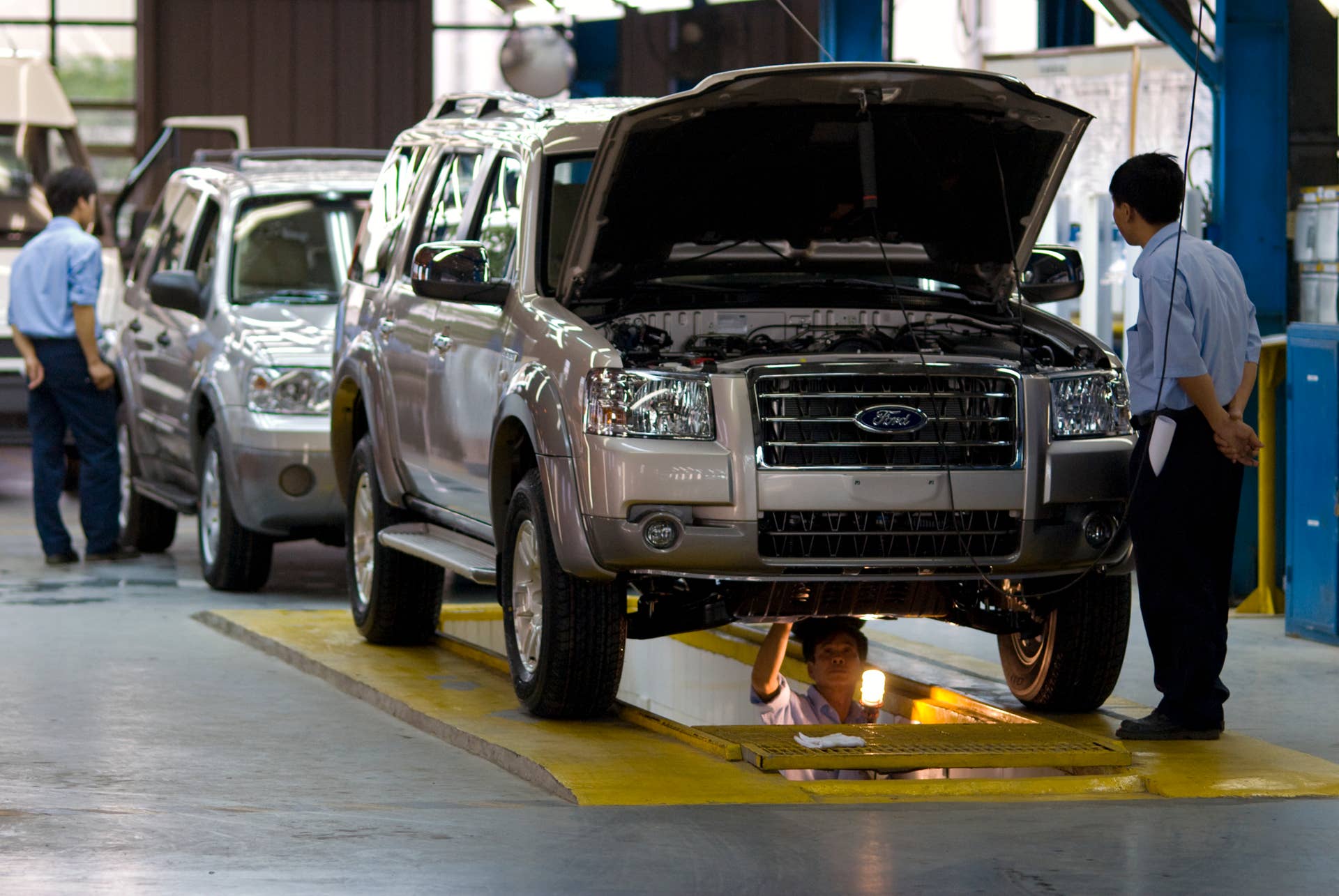
Raymer/Getty Images
President Trump puts more pressure on Ford after doubling aluminum tariffs
While President Donald Trump unveiled the first batch of aluminum tariffs more than a year ago, on April 6 of this year, the government officially increased them to an ad valorem rate of 50% for goods made almost entirely of aluminum, steel, or copper. This includes coils and aluminum sheets, like the ones carmakers use for the bodies of their vehicles.
Both auto industry execs and the White House have said they’ve been in constant contact since before the first batch of auto tariffs went into effect, but the latest attempts to soften their tariff burdens have fallen on deaf ears, according to a recent report.
“In recent weeks, Ford has petitioned the Trump administration for assistance, asking officials for relief from the duties at least until Novelis’ Oswego plant returns to full service,” the Wall Street Journal reported, citing “people with knowledge of the conversations.”
Inventory levels for the F-150 have been falling due to fallout from the September fire at the Novelis plant in Oswego, New York. At the time, Ford said it was pivoting to other aluminum suppliers; however, it also estimated that it would lose between $1.5 billion and $2 billion in EBIT in the fourth quarter due to the disruption.
Ford previously said it doesn’t expect to return the mill at Novelis to operations until “somewhere in the middle of the year, the range between May and September.” It did not immediately return a request for comment for this story.
According to the report, the “administration hasn’t budged,” leaving Ford in a billion-dollar hole from which it can’t escape. White House officials say the administration has already given the automotive industry a break by allowing companies to recoup some of what they paid on automotive parts subject to the 25% tariff.
Related: Ford maintains a big advantage over GM in one key area
#Ford #analyst #blames #039unpredictability039 #postearnings #swoon