
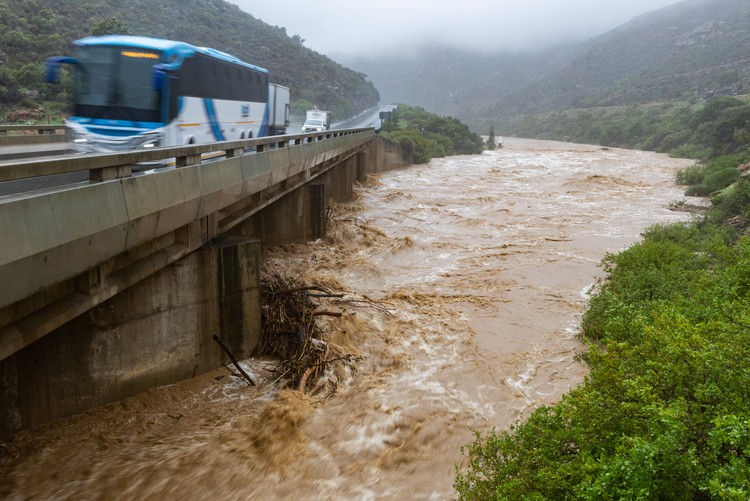
Short-term insurers have warned that some claims linked to the devastating Western Cape storm may become more complex where liability disputes arise, particularly involving fallen trees that damaged neighbouring homes and vehicles.
Ernest North, co-founder of Naked Insurance, says initial claims and social media footage suggest that “many claims from this event may include some contentious liability elements”.
Read/listen:
Western Cape mops up after the storm
Meat producers count the cost of inclement weather on the sector
Huge storm batters Knysna
A powerful storm battered Cape Town and large parts of the Western Cape from Sunday 10 May to Tuesday 12 May, leaving flooded and washed-away roads, fallen trees and rockfalls in its wake.
As at Tuesday (12 May), three people had been confirmed dead in incidents involving falling trees during the storm – in Kenilworth in Cape Town, Knysna and George – while widespread damage to homes, vehicles and infrastructure from uprooted trees was reported across parts of the Western Cape.
The Cape Chamber of Commerce and Industry noted in a newsletter on Wednesday that authorities are still assessing the cost of what is considered “one of the worst storms in living memory”, which generated wind speeds of up to 140 km/h according to some reports.
Read: Extreme weather in South Africa is disrupting tourism [Jul 2024]
The severe weather has destroyed critical infrastructure, with serious implications for exports and supply chains, the chamber says, adding that farmers, “already reeling from the impacts of the ongoing Middle East crisis”, are now grappling with how to get goods to market while repairing extensive flood damage.
Liability disputes
North explains that where a tree from one property falls onto another person’s home or vehicle during extreme weather, it is “typically considered out of the owner’s control”, meaning the affected person’s own insurer would usually cover the damage.
However, liability could arise if the property owner failed to take reasonable care.
ADVERTISEMENT
CONTINUE READING BELOW
According to North, this could include situations where a tree was “visibly dead, rotten or unstable”, where the owner had been warned it was dangerous, or where requests to remove or trim it had been ignored.
The recent storm has meanwhile renewed focus on the growing frequency and severity of extreme weather events in South Africa, with insurers increasingly recalibrating risk models and underwriting criteria as repeated flooding, hail and wind-related claims affect multiple provinces.
The Western Cape Department of Infrastructure says it had to operate under difficult conditions dealing with flooded and washed-away roads, fallen trees and rockfalls.
In Cape Town, city officials were working around the clock to respond to electricity outages and repair weather-related damage to infrastructure following gale-force winds and torrential rain that battered homes, uprooted trees and caused severe flooding.
Several roads across the Western Cape remained closed on Wednesday due to flooding, damaged road surfaces and storm-related infrastructure damage.
Affected routes stretched across the Garden Route, West Coast and Cape Winelands districts, as repair and clean-up teams continued working to restore safe access in severely affected areas.
While provincial and metro emergency teams worked to reopen roads and restore access to affected areas, insurers were dealing with an influx of storm-related claims.
Assessments and claims
Discovery Insure has officially activated its catastrophe-response plan, according to chief commercial officer Precious Nduli.
“[This] means we’re scaling up quickly. Based on current volumes, we have enough assessors in place and we’re bringing in additional capacity, including assessors from other regions to support affected areas,” she says.
Nduli stresses that Discovery generally only carries out full assessments once conditions are safe.
ADVERTISEMENT:
CONTINUE READING BELOW
“During severe weather, access is often limited, and conditions can be dangerous. Where needed, we step in early with temporary measures, like tarpaulin installations, to limit further damage.”
Read: SA’s next infrastructure crisis is here
Coenraad de Bruin, executive head of specialist lines at Hollard Insure, says the industry generally supplements existing assessment capacity by redeploying assessors from other regions and appointing independent loss adjusters where necessary.
“While there can be short-term bottlenecks immediately after the event, the industry generally has the ability to scale assessment capacity once the initial influx of claims becomes clearer,” he says.
Remote assessments
Hollard also delays physical inspections until conditions are safe for assessors to access affected properties.
“That said, insurers will often authorise remote assessments, emergency approvals, or interim actions based on photographs, videos and geolocation data, particularly to enable urgent mitigation and temporary repairs if needed,” says De Bruin.
Naked Insurance also says it is not “entirely reliant” on physical assessments and can “where appropriate” assist clients remotely.
“Clear photos and videos, a detailed description of the damage, and records of any emergency repairs can help us assess and process claims more quickly,” says North.
The full scale of claims is only likely to emerge over time.
North says there is typically a lag in storm-related events as homeowners wait for conditions to improve, return to affected properties or identify damage that was not immediately visible.
ADVERTISEMENT:
CONTINUE READING BELOW
“This may be further affected by the fact that some impacted areas include properties used primarily as holiday homes, where owners or occupants may not currently be present to assess and report any damage,” he says.
“[The] spike in claims we have seen so far suggests that the event is already translating into meaningful claims activity, particularly for property-related damage.”
Naked also expects vehicle claims to increase, especially where cars have been driven through flooded roads or damaged by falling trees or debris.
Extreme weather risk
The storm has also renewed focus on the increasing frequency and severity of extreme weather events in South Africa, with insurers warning that repeated flooding and storm damage are reshaping how risk is assessed and priced.
“We are seeing an increase in the frequency and severity of similar events across the country, including in KwaZulu-Natal and Gauteng,” says Nduli.
She says this trend is influencing how insurers model risk as more data from recurring weather events is incorporated.
Read:
Southern Africa floods that killed 300 fuelled by global warming
South Africa gets its first climate index to track weather risks [Oct 2025]
Hollard’s De Bruin says insurers have had to recalibrate underwriting criteria, exposure limits and excess structures to ensure they can continue providing cover and honouring claims.
“These adjustments are not about short-term reactions, but about ensuring the long-term viability of insurance as a mechanism for risk transfer,” he says.
#Cape #storm #fallout #spark #liability #disputes #fallen #trees #warns #insurer