
South Africa is poised to join a handful of central banks in raising interest rates to contain the inflationary fallout from the Iran war in coming weeks, even as most peers keep borrowing costs on hold.
The conflict that erupted in late February has driven up energy, food and fertiliser costs due to the blockade of the Strait of Hormuz — a key shipping route for about a fifth of the world’s seaborne oil and liquefied natural gas, and a significant portion of crop nutrients.
Read: Sarb to hike next week to save some pain later?
A number of African nations have raised fuel prices, with some deploying subsidies and suspending taxes to soften the blow. The higher costs and knock-on effects have forced policymakers to rethink extending their easing cycles that looked likely just months ago, with the possibility of rates remaining higher for longer.
“All of Africa’s central banks are having to make a big shift on policy,” said Charlie Robertson, chief economic adviser at Equity Group Holdings Plc. “Across the continent nearly all central banks will at best be on hold in coming months, but hikes will become commonplace unless Hormuz is re-opened.”
Policy will likely remain restrictive, with further tightening contingent on a more pronounced inflation impulse, although fragile economic growth across several economies will constrain the ability to tighten aggressively, according to Angelika Goliger, EY Africa’s chief economist.
Read: Sarb names Makrelov as sixth MPC member
ADVERTISEMENT
CONTINUE READING BELOW
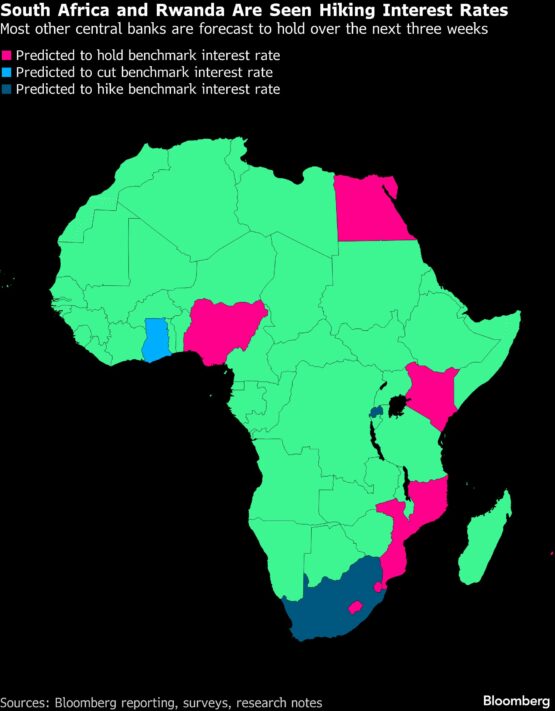
The wave of interest-rate decisions will start with Ghana, Mauritius and Nigeria on Wednesday, followed by Egypt and Rwanda on Thursday.
Ghana’s policymakers are expected to join a small group of African nations, including Zambia and Angola, in cutting interest rates. Inflation, while edging higher in the West African nation, remains subdued at 3.4% and borrowing costs are restrictive at 14%. The central bank is forecast to lower the benchmark rate by 50 basis points, extending an easing cycle that began in July.
Read: Sarb won’t budge on inflation target despite global shocks
Monetary policy committees in Mauritius, Nigeria and Egypt are all set to stand pat.
Policymakers in Mauritius and Nigeria, who are meeting for the first time since the conflict began, will likely seek to gain greater clarity on its impact, with price pressures already intensifying.
Egypt is also set to remain cautious as currency weakness and administered-price adjustments reinforce inflationary risks and limit the scope for easing, Goliger said.
Rwanda and — a week later — South Africa will likely raise interest rates. Botswana is so far the only African nation to do so since the war began.
Read: Kganyago keeps options open as CPI risks rise
ADVERTISEMENT:
CONTINUE READING BELOW
Price growth in Rwanda has returned to double digits for the first time in almost three years, pushing the gap between the benchmark interest rate and annual inflation to negative 5.75 percentage points.
South Africa is predicted to raise interest rates by 25 basis points to 7%. An increase would be the first since May 2023.
“The balance of risks has shifted towards a more hawkish direction, with easing effectively off the table and the possibility of an increase in the policy rate in 2026 should inflation pressures intensify,” Goliger said.
Inflation is forecast to surge above the central bank’s 3% target in April and May because of higher fuel prices.
The rates call in Africa’s largest economy will weigh on neighbouring Eswatini and Lesotho, whose currencies are pegged to the rand and are set to announce their own decisions a day later.
Read: Stagflation looms – with debt an extra wrinkle
Mozambique will deliver its rate decision next week and Kenya, on June 9, and both are expected to remain on hold. The two nations are net fuel importers and have seen inflation quicken because of higher energy costs, which have sparked protests in Kenya and further strained Mozambique’s budget.
© 2026 Bloomberg
#set #rate #hike #war #fuels #inflation