
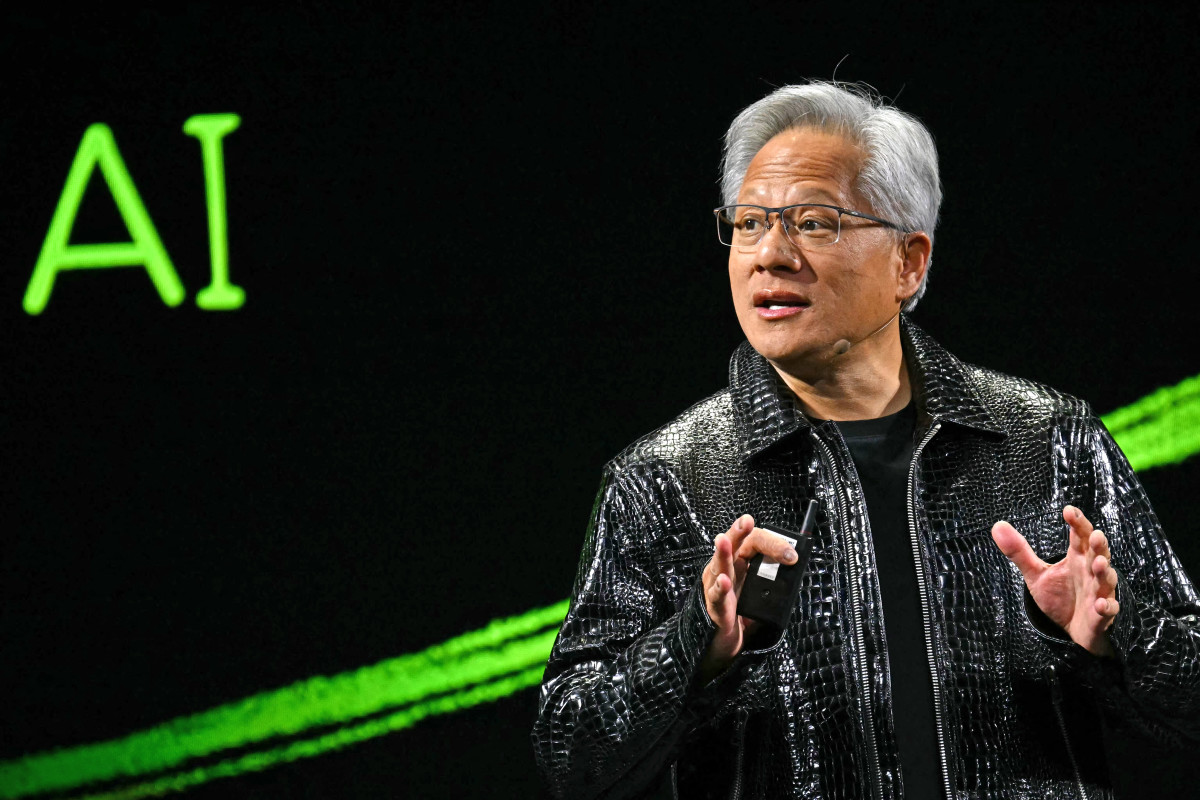
If you’re feeling envious of Nvidia, well, that’s the idea.
In fact, the green-eyed monster is baked right into the AI chipmaking titan’s name, since it is a mash-up of the Latin word invidia, meaning “envy,” and the letters NV for “next version.”
The name is intended to evoke the idea of creating products that others would envy, and Nvidia’s (NVDA) green logo is designed to evoke the phrase — you guessed it — “green with envy.”
And perhaps it’s not surprising that the company that CEO Jensen Huang co-founded in a Denny’s restaurant in San Jose, CA, in April 1993 with Chris Malachowski and Curtis Priem might spark a little resentment in some circles.
Since that first meeting, when the initial business plan for the company was reportedly sketched out on a paper napkin, Nvidia has mushroomed into a multi-trillion-dollar company employing tens of thousands of people and serving the likes of such hyperscalers as Amazon (AMZN), Meta Platforms, (META) Alphabet (GOOGL), and Microsoft (MSFT).
“We are in every cloud,” Huang said in an earnings call. “We are in every center. We are all over the world.”
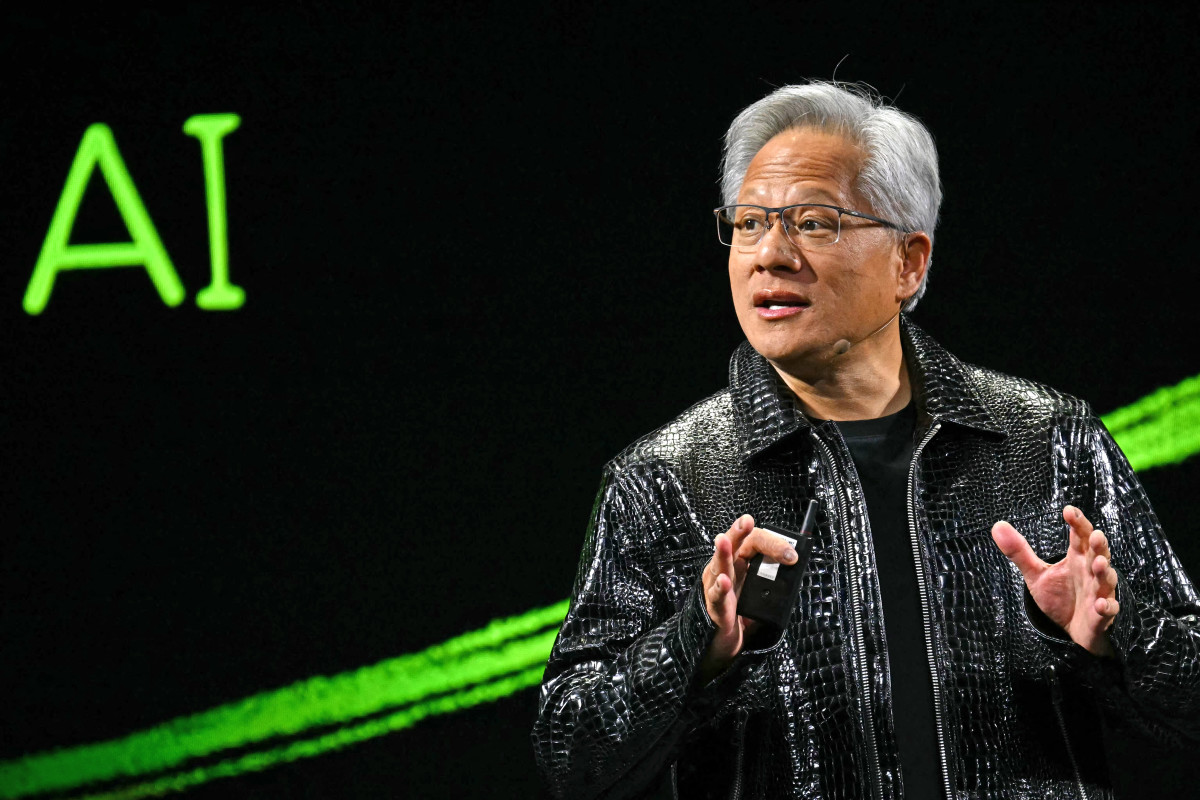
Fallon/AFP via Getty Images
Nvidia CEO: Suffering is part of the journey
Not bad, considering Huang once washed dishes for Denny’s, which commemorated the historic meeting by placing a plaque above the booth where the company was born and offering “Nvidia Breakfast Bytes” last year, featuring four sausage links wrapped in buttermilk silver dollar pancakes, one of the CEO’s favorites.
But it wasn’t an easy road to that place of honor on Denny’s menu.
More Nvidia:
- Nvidia stock gets major reality check on ‘$100B’ number
- Nvidia CEO delivers blunt 7-word rebuttal on software stocks
- Bank of America resets Nvidia price target after earnings
Nvidia was on the brink of bankruptcy in the mid-1990s after a failed deal with video game colossus Sega to build a graphics chip for the Dreamcast, which did not align with Microsoft’s DirectX.
Running out of cash, Huang flew to Japan to tell Sega’s CEO the product wouldn’t work and that they should cancel the deal, while also admitting Nvidia needed the final $5 million payment to stay afloat.
Sega paid the remaining funds and allowed them to keep the money, providing a crucial six-month lifeline to develop the RIVA 128 chip, which ultimately saved the company.
“Suffering is part of the journey. You will appreciate it for these horrible feelings that you have when things are not going so well. You will appreciate it so much more when they do go well,” Huang said, according to Fortune.
The company went public on Jan. 22, 1999, at $12 a share.
Nvidia invested billions in AI research and development over a decade before the AI boom. While others focused on traditional computing, Huang believed that graphics processing chips (GPUs) would be essential for future computing.
He has also popularized what he calls “Huang’s Law,” which states that GPU performance for AI workloads more than doubles every two years, far outpacing the traditional, slowing pace of Moore’s Law.
Related: History of Nvidia: Company timeline and facts
Analyst: Nvidia center of AI bull market
Nvidia is now the dominant supplier of high-end GPUs worldwide, with a commanding share of the discrete graphics market.
The company, which has consistently offered a quarterly cash dividend since 2014, joined the Dow Jones Industrial Average on Nov. 8, 2024, replacing tech giant Intel (INTC), as AI rapidly overhauled the semiconductor industry.
OpenAI’s ChatGPT service was built using Nvidia’s GPUs, and the company is a primary driver of technical innovation, graphical fidelity, and performance standards in PC gaming.
Related: Goldman Sachs resets Nvidia stock forecast after earnings
Nvidia recently launched its Rubin platform, its next-generation AI computing architecture, which the company said “sets a new standard for building, deploying and securing the world’s largest and most advanced AI systems.”
Major U.S. tech hyperscalers are projected to spend hundreds of billions of dollars on AI-related capital expenditures over the coming years, and Huang has no doubt that Nvidia’s customers will continue to grow their CapEx.
“I am confident in their cash flow growing,” he said during an earnings call. “We have now seen the inflection of agentic AI and the usefulness of agents across the world and enterprises everywhere. You are seeing incredible compute demand because of it. This new world of AI, compute is revenues.”
Following a recent quarterly report, several analysts expressed their support for Huang’s vision after Nvidia beat Wall Street’s earnings expectations.
“Nvidia’s earnings come at an opportune time, as investors were extremely hungry for confirmation that AI is still a positive storyline for stocks, and Nvidia’s blowout earnings did just that,” said James Demmert, chief investment officer at Main Street Research.
“We are in an AI and tech-led bull market that favors hardware and infrastructure stocks, and Nvidia is at the center of this.”
Related: From start-up scrappiness to AI ambitions: How Salesforce adapts to challenges
#Nvidia #cornerstone #modern #computing