
As the world’s leading public health officials gathered for emergency meetings in Geneva to discuss a deadly form of Ebola that’s likely circulated undetected for months in Africa, one group was missing from the table: a formal US delegation.
In past outbreaks, the US often led surveillance, laboratory support and emergency response efforts through the Centres for Disease Control and Prevention and the now-dismantled US Agency for International Development. The large field teams and hundreds of millions of dollars the US once deployed during health emergencies are also absent. The work was culled by the US exit from the World Health Organization and exacerbated by mass layoffs, leadership upheaval and the gutting of foreign relief operations under President Donald Trump and Health Secretary Robert F Kennedy Jr.
Read:
Asian countries up Ebola precautions after WHO declaration
Ebola’s silent spread in Congo exposes surveillance gaps
WHO Ebola emergency declaration seeks to spur global response
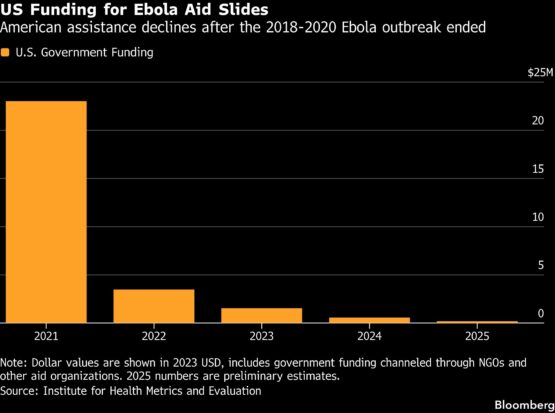
While it’s difficult to pinpoint how much former USAID and WHO funding would have directly supported the current outbreak response, estimates from the Institute for Health Metrics and Evaluation show US spending on Ebola-related aid, research and operational support – including government funding delivered directly or through international aid organisations – fell to roughly $186,000 last year. That’s down from about $23 million in 2021 and even more a year earlier, as the last major Ebola outbreak in the Democratic Republic of the Congo was ending.
“This is the nightmare scenario,” said Jeremy Konyndyk, president of Refugees International and former head of USAID’s Ebola response during the 2014 to 2016 West Africa epidemic that killed more than 11 000 people.
Fraying networks
US-backed teams helped build surveillance and response networks, coordinating everything from contact tracing to safe and dignified burials during previous Ebola outbreaks. The CDC said it still has more than 30 people in Congo and 100 in Uganda providing technical support, plus dozens of dedicated staff in Atlanta now working on the emergency response. One senior technical coordinator has been deployed to Congo.
The outbreak, declared a public health emergency of international concern on 17 May, has continued to spread.
ADVERTISEMENT
CONTINUE READING BELOW
The WHO has tallied almost 600 suspected cases and 139 deaths, mainly in Congo’s northeastern Ituri province, though researchers said Monday the true number of infections may already exceed 800. One American aid worker who tested positive was transferred to Germany for care.
The circulating strain, known as Bundibugyo, has no approved vaccines or therapies, and experts say it could take months before an experimental immunization is ready for human trials.
Congo was “already stretched to breaking point” by conflict and years of aid cuts before the Ebola outbreak struck, said Manenji Mangundu, Oxfam’s country director in Congo. Funding reductions had weakened disease surveillance systems, leaving the country “effectively blind to Ebola” and allowing the outbreak to go undetected for weeks, he said.
Secretary of State Marco Rubio criticized the WHO as “a little late” to identify the outbreak during a briefing with reporters on Tuesday. The US State Department is funding up to 50 Ebola treatment clinics in Congo and Uganda, where cases have now been reported.
A senior State Department official said cuts to USAID didn’t play a role in delaying the detection of the outbreak.
Aid collapse
Elon Musk’s so-called Department of Government Efficiency gutted USAID, slashing hundreds of millions of dollars in foreign assistance and contributing to a 68% decline in humanitarian funding disbursed to Congo, according to the Center for Global Development.
Some health programs, including the President’s Emergency Plan for AIDS Relief and contributions to the Global Fund to Fight AIDS, Tuberculosis and Malaria, were later shifted to the State Department rather than eliminated entirely. Congress reallocated some funding, though part of the money is being used to help settle liabilities stemming from the USAID shutdown, CNN reported.
Other donor countries, including the UK and Germany, have also reduced foreign aid spending, compounding the impact of the US cuts. Reductions in global health funding could contribute to 9.4 million additional deaths by 2030, according to a study published in February in The Lancet Global Health.
ADVERTISEMENT:
CONTINUE READING BELOW
Resources are increasingly being shifted away from development assistance toward “traditional security concerns” and domestic economic priorities, said Richard Hatchett, chief executive officer of the Coalition for Epidemic Preparedness Innovations. “The environment as a whole is very challenging.”
Shrinking response
The State Department said it would provide an additional $250 million to support United Nations response efforts in Congo and Uganda. US humanitarian aid to Congo fell from about $906 million in 2024 to about $179 million during Trump’s first year back in office, according to agency figures.
Congo appealed for $1.4 billion in international aid in January after cuts to USAID-backed healthcare and nutrition programs contributed to medicine shortages and reduced outbreak-response capacity, the government said.
The Red Cross has people trained to carry out safe and dignified burials of Ebola victims but lacks the money to pay for them, said Joanne Liu, a public health professor at McGill University who led Doctors Without Borders’ response during the 2014-2016 West Africa Ebola epidemic. “Time is everything,” she said.
Congo has amassed deep experience responding to 17 Ebola outbreaks since 1976, but this is the first to unfold since the US withdrew from the WHO, cutting the agency’s funding and access to CDC expertise. Its location, spreading in Ituri province where conflict and displacement have left about a million people uprooted, is making contact tracing more difficult and exacerbating the situation.
The WHO has tried to ramp up its response despite losing its largest donor — the US contributed almost $1.3 billion in 2022 and 2023. The agency approved an additional $3.4 million for the Ebola response, bringing its total emergency funding to $3.9 million.
Global risks
The Ebola epidemic in Congo’s Ituri and North Kivu provinces that ended in 2020 infected almost 3,500 people, killing nearly 2,300. The current outbreak could become comparable in scale, but with fewer resources available to contain it, said Refugees International’s Konyndyk.
ADVERTISEMENT:
CONTINUE READING BELOW
“How big this could get is a function of how the world responds to it,” Konyndyk said.
US efforts have focused heavily on preventing the virus from entering the country. Federal agencies issued travel advisories and restricted entry by non-citizens traveling from Congo, Uganda and South Sudan.
The risk to the American public remains low, the CDC said, though experts warned that continued spread in Africa is likely. International travel means Ebola infections could still reach the US, as it has in the past, even if a widespread domestic outbreak remains unlikely, Konyndyk said.
With no treatments or vaccines developed specifically for Bundibugyo, the response depends heavily on contact tracing, quarantine and coordination between international agencies.
“Because we are not in the WHO, because we’re not closely connected with that international coordination, it would take longer for us to reestablish what’s on the ground to be able to help,” said Nahid Bhadelia, director of Boston University’s Center on Emerging Infectious Diseases.
How far the current outbreak will spread is unknown.
“This is what happens when you defund the public health systems designed to keep us safe,” said Nina Schwalbe, a senior scholar at Georgetown University’s Center for Global Health Policy & Politics, who helped establish USAID’s Covid-19 vaccine access initiative.
© 2026 Bloomberg
#Ebola #spending #plunged #years #outbreak