
There is no doubt that Eskom is performing much better than it was a year to five years ago – when South Africa regularly had to endure Stage 4 load shedding – but the real reasons for the recovery in the availability of electricity are not to be found inside the state-owned operator of ageing coal-fired power stations.
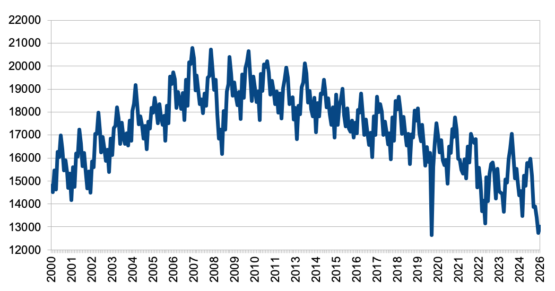
Figures in the latest report from Statistics SA on the generation of electricity and available for distribution show that Eskom actually distributed nearly 11% less to SA users in January 2026 than it did a year ago.
It had 13 007 gigawatt hours (GWh) available for distribution in SA this January compared with 14 554GWh in January 2025.
Read: Moment of truth for South Africa’s electricity reform
Current generation is barely higher than during the Covid-19 pandemic, when the whole of the country shut down and did not need much electricity. Eskom then produced 12 640GWh of electricity for distribution in SA per month.
The real reason we have more power
That electricity seems to be readily available has more to do with lower demand due to lacklustre economic growth as well as the growth in new (and renewable) power generation.
Stats SA says electricity generation decreased by 6.2% year on year in January 2026, although generation was higher than in December when demand is usually lower.
“Seasonally adjusted electricity generation increased by 1.5% in January 2026 compared with December 2025, following month-on-month changes of -1.4% in December 2025 and -1.3% in November 2025,” according to the report.
“Seasonally adjusted electricity generation decreased by 2.5% in the three months ended January 2026 compared with the previous three months.”
Moneyweb worked through 25 years’ worth of Stats SA reports, extracting figures to track what Eskom has been delivering.
The numbers show that Eskom’s production is steadily falling, while that of independent power producers (IPPs) is rising.
Electricity available for distribution from Eskom (GWh)
Source: Data extracted from Stats SA reports
ADVERTISEMENT
CONTINUE READING BELOW
From 2000 to 2008, electricity distribution increased due to higher demand during a period when the economy was growing. The 2008 global financial crisis hit demand (and supply, since electricity cannot be stored).
It’s been downhill since then.
From a peak of above 20 000GWh in the first decade of the 2000s, Eskom’s distribution of electricity has declined steadily to the current levels of below 15 000GWh.
Renewables
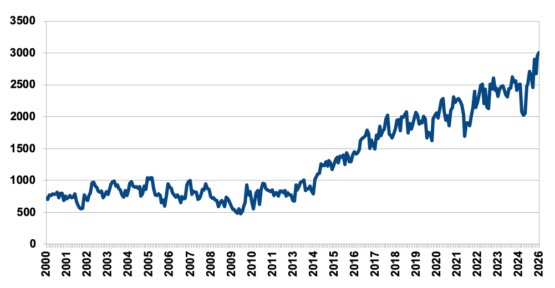
The Stats SA figures of the last 25 years disclose that the production of electricity from other producers however, has been increasing rapidly.
IPPs generated only 725GWh in 2000, less than 5% of total production.
This had increased to 3 009GWh by January 2026, and currently comprises nearly 20% of the total electricity running through Eskom’s distribution network.
Electricity available from other producers is on the up (GWh)
Source: Data extracted from Stats SA reports
Small rooftop solar installations and private medium and large off-grid renewable systems are growing in number – fuelled by steep increases in the price of Eskom electricity.
The sharp rise in the oil price from around $60 per barrel at the beginning of 2026 to the current $84 due to the war in the Middle East, will impact energy prices overall, Eskom’s viability and local electricity prices too.
Read:
How renewable energy is revolutionising SA’s power grid
To be or not to be green – that is the question, Eskom
Eskom backtracks on pollution pledge, risking World Bank angst
The implications are being noticed.
David McDonald, CEO of SolarAfrica, says electricity is already very expensive in SA and there are huge risks in Eskom’s old power stations that make electricity supply fragile.
‘The end of load shedding!’
ADVERTISEMENT:
CONTINUE READING BELOW
“At this year’s State of the Nation Address, President Cyril Ramaphosa declared load shedding a thing of the past,” says McDonald.
“Not even the official end of the Covid-19 pandemic was announced with as much assuredness.”
He describes the pandemic as another nationwide crisis that almost left our economy on the brink of collapse. “So for a country that has spent more than a decade planning daily life and business-as-usual around blackout schedules, you can imagine that this was music to the ears of South Africans.”
McDonald acknowledges that, operationally, things have improved.
“Energy availability has increased. Maintenance is finally being done. Diesel usage is better managed than it was at the height of the crisis. But we need to remember that stability is not the finish line.
“If anything, the conversation has simply moved away from the whether the lights will stay on to what will it cost.
“For many commercial and industrial users, the question of cost has become the real crisis.”
Cost now the real crisis
McDonald says tariff increases have compounded well above inflation over the last five years.
“The National Energy Regulator of South Africa [Nersa] recently confirmed that tariff adjustments will be higher than initially anticipated, with a 5.36% increase effectively rising to 8.76% following calculation corrections.
“Cost certainty is critical, as businesses need predictability if they are to accurately forecast, invest and grow.
“Initially, the narrative was that abnormal hikes were driven by diesel spend during load shedding, which made sense at the time, given that emergency generation is expensive,” he says.
“But while load shedding has eased, the trajectory of price increases has not. Electricity is one of the biggest input costs for businesses and when that line item becomes unpredictable, it stalls business decisions that could unlock growth.”
Read:
Nersa’s mistakes turn 5.36% tariff increase into 8.76%
Nersa costs South Africans even more in tariffs
ADVERTISEMENT:
CONTINUE READING BELOW
There are several reasons for high tariff increases. Eskom carries a significant debt burden and coal plants are rapidly ageing, with a significant portion of the fleet running at availability levels that would not be acceptable in most developed markets.
A large percentage of the coal-fired power-station fleet will need to be retired by 2030. When those units go down, gas and diesel generation will inevitably step in.
“While they may have high availability factors, they are not cheap. These costs don’t just disappear into the system; somewhere down the line they’re passed on to paying customers,” says McDonald.
He says fragility is disguised as stability – “there is an uncomfortable truth here”.
Read:
The comfort trap: When ‘truthiness’ becomes policy
Ramaphosa and SA’s stabilising electricity system
“When we talk about improved energy availability, we often look at the blended number across the system, including renewables, gas and diesel that naturally perform at higher availability levels than ageing coal plants.
“If you isolate the coal fleet, the picture is less comforting. Around 30% of units are under maintenance at any given time and a meaningful portion of capacity will need to be retired within the next five years.
“Given that there are no new coal stations waiting in the wings and our current stability is heavily supported by expensive backup generation, it may be more precarious than we realise.
“While this doesn’t mean load shedding is inevitable, it does mean that maintaining this stability is going to cost us,” he says.
Another risk is emerging …
“When tariffs continue to escalate aggressively, customers look at alternatives,” says McDonald.
Read: South Africans are leaving the electricity network
“If even 10% of paying customers begin reducing grid reliance significantly, the revenue base narrows, and the pressure on the remaining customers intensifies.
“This is the start of what many refer to as grid defection – it doesn’t happen overnight, but the longer prices rise without structural reform, the more businesses will pursue other options and the more significant the impact.”
#electricity #generation #barely #Covid #levels