
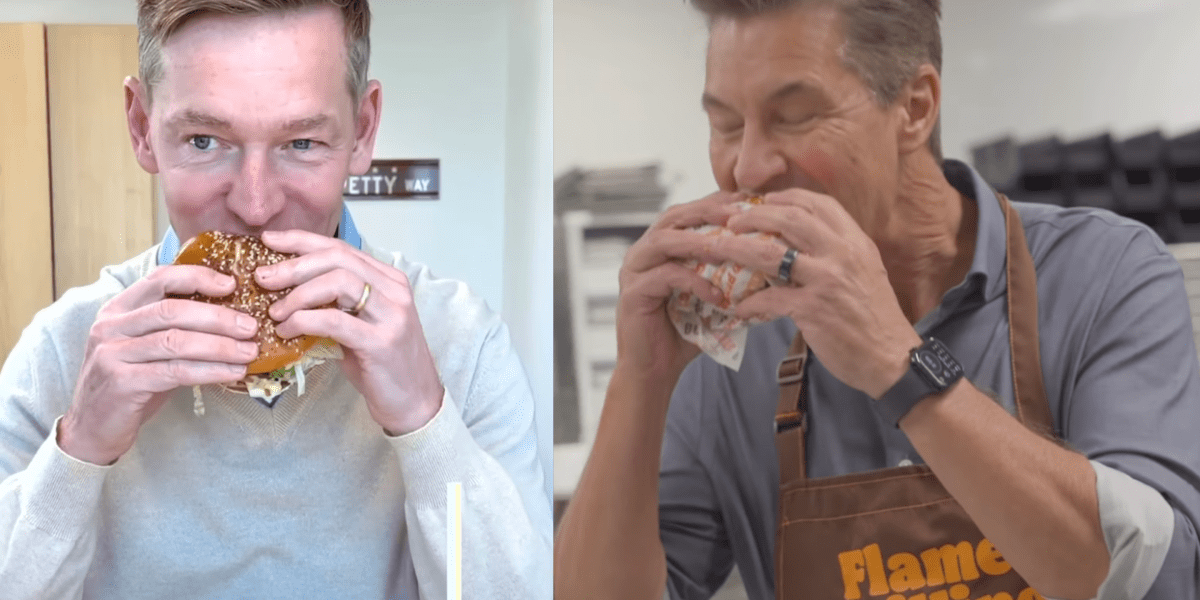
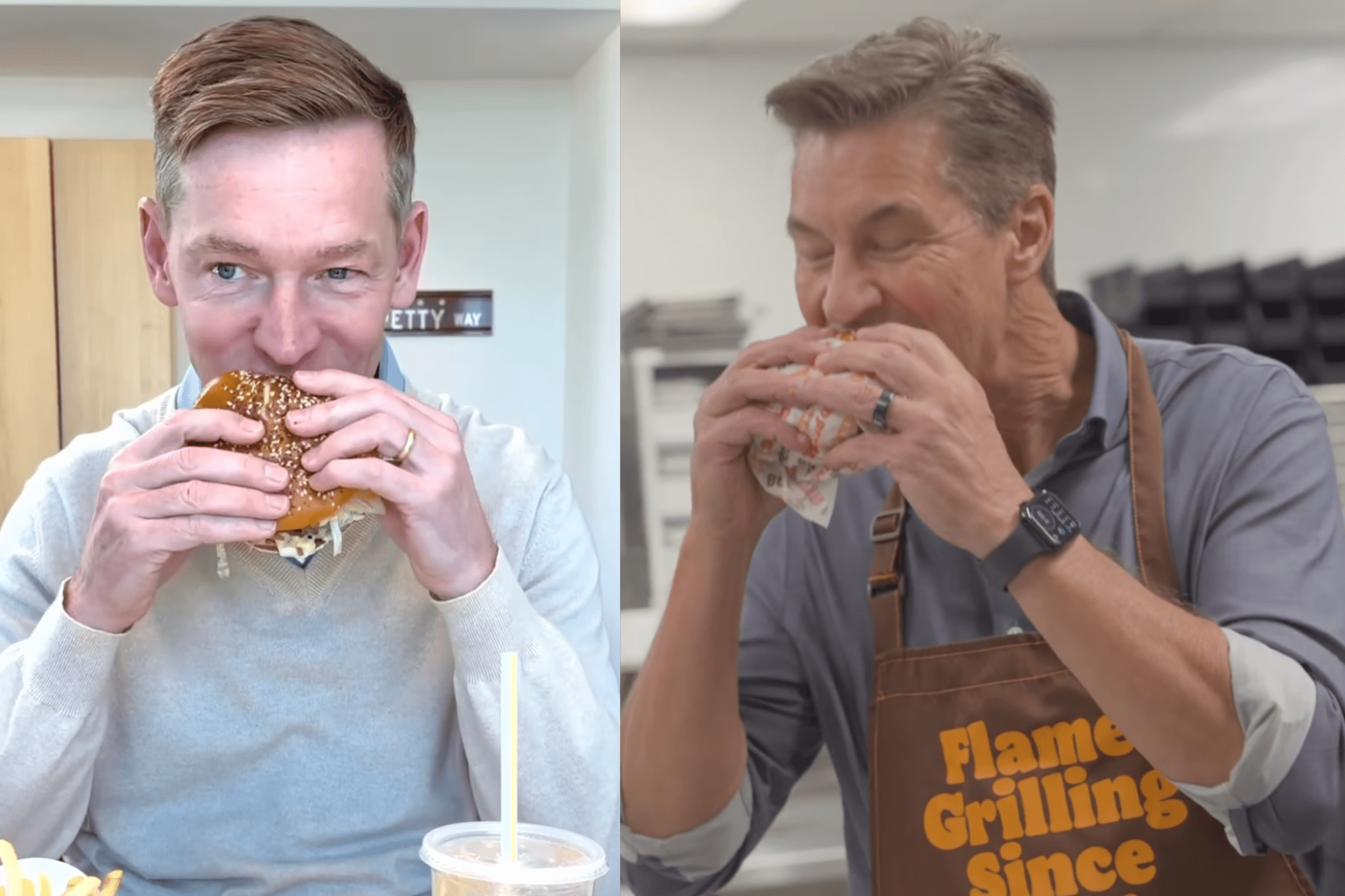
But one small, hesitant bite was all it took to turn the launch into a viral punchline, and hand archrival Burger King a chance to do their own spoof at the CEO’s expense.
In early February, McDonald’s CEO Chris Kempczinski posted a seemingly routine video to promote the chain’s new Big Arch Burger—billed as a “love letter” to fans after successful tests in several international markets. On camera, Kempczinski showcased what he referred to as the new “product,” stacked with two patties and a whopping 1,020‑calorie count that amounts to roughly two‑thirds of an adult’s daily intake.
“I don’t even know how to attack it. God, so much to it,” Kempczinski says in the clip. One small nibble later, the chief executive promises viewers he will “enjoy the rest of [his] lunch” off‑screen, adding, “that’s a big bite for a Big Arch.”
The innocent taste test went largely unnoticed for weeks until creators began stitching their reactions and flooding social feeds with a storm of memes and satirical posts. “This man does not eat McDonald’s,” comedian Garron Noone quipped in a TikTok video that has racked up over 10 million views. Others commented that the CEO looks more likely to eat a salad than one of his chain’s burgers.
Archrival Burger King seized on the moment immediately, posting a 13-second video of its president, Tom Curtis, taking a large bite of a Whopper. “Thought we’d replay this,” the caption reads. A spokesperson told NBC News, “We can confirm that this video was not created in reaction to anything,” adding, “While the timing may seem quick, the video was part of ongoing efforts to spotlight the recently elevated Whopper and Tom’s direct engagement with Guests.”
Other competitors followed suit, with A&W Restaurants and Wendy’s piling on with their own tongue‑in‑cheek taste‑test spoofs. “This is what it looks like when you don’t have to pretend to like your ‘product,’” Wendy’s wrote in a snarky post after sharing a video of its U.S. President, Pete Suerken, eating a Baconator. The brand even took the burger wars further, announcing a new Chief Tasting Officer gig and offering a $100,000 salary for anyone to make video reviews—no experience or qualifications required.
McDonald’s tried to reclaim the narrative with a winking Instagram post of its own, sharing an image that read, “take a bite of our new product,” with the caption: “can’t believe this got approved.” A McDonald’s spokesperson told Fortune on Thursday, “We’re glad the Big Arch has everyone’s attention,” adding that early sales of the new burger were “beating expectations.”
While critics mocked the gimmick, the video earned Kempczinski attention most executives crave: more followers, more visibility, and a viral moment that put McDonald’s squarely in the social spotlight.
McDonald’s Chief Executive Influencer
Most CEOs avoid that level of online exposure, but the misstep landed harder because Kempczinski has spent years building his social media presence, while other executives shy away from first-person content or delegate their feeds to social media managers, ghostwriters, and corporate communications teams.
On LinkedIn and Instagram, he routinely shares career advice, taste tests, and leadership lessons in short-form videos that he appears to film from his office at the fast-food giant’s Chicago headquarters. Kempczinski joined McDonald’s in 2015 as executive vice president of strategy, business development, and innovation, after senior roles at Kraft Foods, PepsiCo, and Procter & Gamble, and then stepped into the CEO role in 2019. As the leader of the No. 165 Fortune 500 company with $26.89 billion in annual revenue in 2025, Kempczinski appears to shoot on an iPhone, making content that feels personal and relatable rather than glossy and overproduced. He has maintained an active LinkedIn presence since 2020, growing his platform to over 168,000 followers and has even been recognized with a Shorty Award in 2025 for “demonstrating how authentic leadership content can transform executive communications into community-building moments.” His videos regularly generate hundreds of likes on LinkedIn, and his Instagram posts often earn tens of thousands of views. The Big Arch video, however, is a runaway hit with nearly 11 million views on Instagram, helping to grow his overall followers by 30%, a source told Fortune.
Kempczinski’s stumble comes as the modern C-suite, especially the corner office, has quietly turned into a content studio, whether executives like it or not. Today’s CEOs and executives are expected to be always-on creators: posting short-form videos, drafting mini leadership manifestos, and curating personal brands that crowd LinkedIn feeds. It’s an extra task on an increasingly long list of to-dos, and often one shepherded by a small army of social media managers, public relations professionals, and ghostwriters.
Behind the scenes, communications teams often ghostwrite the updates that appear under a CEO’s name. But followers may not realize the “thought leadership” they are applauding was actually written by someone they’ve never heard of. The real challenge is making sure the message still sounds like it was written in the executive’s voice, not the social media manager’s. Some chiefs like Microsoft’s Satya Nadella, General Motors’ Mary Barra, and TIAA’s Thasunda Brown Duckett primarily use LinkedIn to deliver polished product updates, interview highlights, and company kudos, while others like Meta’s Mark Zuckerberg or Tesla’s Elon Musk treat the social platforms they own as their personal broadcast networks, mixing corporate announcements with glimpses into their hobbies, political views, and moods.
Prior to a pivotal 2013 SEC ruling, social media was largely uncharted territory for executive communications. The guidance followed an investigation into then-Netflix CEO Reed Hastings, who had been accused of violating the agency’s selective disclosure rules through a Facebook post, an incident that ultimately led the SEC to clarify how companies could use social platforms to share material information. Now, boards are rewarding executives who cultivate followings before they even consider the corner office. Boston Consulting Group emphasizes the importance of a social presence for CEO hopefuls and suggests that executives start cultivating a following and demonstrating the ability to represent a company at least five years before they expect to take the top job. That guidance is colliding with a wave of younger faces in the corner office and a historic wave of turnover: in 2025, 168 new CEOs were appointed across the S&P 1500, the highest level since 2010, with 84% stepping into the enterprise CEO role for the first time, according to Spencer Stuart’s 2025 CEO Transitions Report. Incoming CEOs were also younger on average, at 54.4 years old, down from 55.8 the year before.
The growing Fortune 500 digital footprint is no longer just about personal branding; it’s also about building trust. A 2025 U.S. News-Harris Poll survey found that 72% of respondents felt disappointed in business leaders, and 82% said the values held by today’s business leaders don’t match those of everyday Americans. Research from FTI Consulting similarly found that 92% of professionals say they are more likely to trust a company whose senior leaders are active on social media. Employees also favor a CEO with an online presence. Research from Weber Shandwick revealed that 81% of executives believe a visible public CEO profile is essential to a company’s reputation, and more than half say it helps attract and retain top talent.
Dr. Ann Mooney Murphy, a professor of strategic management at Stevens Institute of Technology, has documented how social media fosters one-sided “parasocial” relationships that can increase buying intentions and loyalty among customers, employees, and other stakeholders. “People get drawn to people, not firms,” Murphy tells Fortune. “You don’t form parasocial interactions with a company.”
Done carefully, she argues, a CEO’s routine presence on social media can be a mechanism to connect with customers or investors they normally wouldn’t reach. “You want it to be authentic, because that’s what’s going to draw the attention,” Murphy says. “But that said, they can really make mistakes, and that can be a problem too.”
When social media backfires
Kempczinski is far from the first fast-food chief executive to discover the hard way that their off-the-cuff remarks can take on a second life across social media.
In a 2024 Fortune interview, then‑Chipotle CEO Brian Niccol flatly denied that the chain’s portions were getting smaller and offered a tip: Customers who wanted more food could give crew members a knowing “look” at the line to signal they wanted a bigger scoop. Diners who were already frustrated by “shrinkflation” seized on the comment, which garnered nearly 17 million views on Fortune’s TikTok account, as proof that executives were out of touch with rising prices and shrinking portions. The interview, intended to reinforce Chipotle’s image of generosity—big portions are “kind of who we are,” Niccol said—fueled a wave of outrage, and was even cited in a class-action lawsuit alleging the company had been dismissive of the customer outrage.
By contrast, positioning a CEO in front of a camera during a corporate crisis could help rebuild trust rather than damage a brand. Red Lobster, the once-struggling seafood chain known for enduring an $11 million endless shrimp fiasco, among other mistakes, turned to the charisma of its 36-year-old CEO, Damola Adamolekun, who took the top job after its May 2024 bankruptcy. Chief Marketing Officer Nichole Robillard told Campaign that the chain noticed a spike in restaurant traffic after Adamolekun appeared in a February 2025 episode of The Breakfast Club, with one social video earning 1.8 million views alone.
“He came out of that [conversation], and immediately sales started to go up,” Robillard told the publication. The brand has since appointed Adamolekun as its official spokesperson, a role he’s embraced, regularly sharing product launches and videos asking for customer feedback on his personal Instagram and LinkedIn. It’s paying off; Adamolekun told the Wall Street Journal in February that sales are up 10% from last year.
The millennial chief executive also actively looks to social media for customer feedback, telling Good Morning America: “We read the comments. My marketing team does, and I do personally,” Adamolekun said. “I read the comments and see what people are saying, and we try to react really quickly to deliver people what they want.”
McDonald’s record-breaking revenues
The burger saga comes amid a winning streak for McDonald’s, which recently reported a strong fourth-quarter performance. The chain has doubled down on value messaging to cost-conscious diners, and reported that U.S. sales grew at their fastest pace in more than two years.
“We’ve listened to customers and adjusted along the way with a relentless focus on delivering leadership in value and affordability, and our efforts are working,” Kempczinski said during an earnings call on February 11, before his viral social video took hold.
The Golden Arches is also riding high on a soaring stock price, hitting a record high of just over $341 on February 27, up nearly 12% year over year. Since Kempczinski took on the CEO role in 2019, the stock has risen 72% under his leadership. The brand is a favorite of billionaire Warren Buffett, whose Berkshire Hathaway conglomerate owned roughly 30.4 million shares valued at about $1.4 billion at the end of 1996. But less than just two years later, the Oracle of Omaha decided to sell—a mistake that proved costly.
“In particular, my decision to sell McDonald’s was a very big mistake,” Buffett wrote in his 1998 letter to shareholders. “Overall, you would have been better off last year if I had regularly snuck off to the movies during market hours.”
It’s not the first time the brand faced backlash for a new burger launch. Back in 1996, Fortune chronicled how McDonald’s dedicated an estimated $200 million to a promotional blitz for the Arch Deluxe, a quarter-pound hamburger marketed to adults, and promising a “grownup taste.”
The company hosted what Fortune reporter Shelly Branch referred to as “one of the more bizarre corporate ceremonies in recent memory,” featuring an appearance from actress Debbie Allen and a performance by hip-hop group the Village People.
“Employees in attendance, stacked like a Big Mac in a three-story atrium on the company’s Oak Brook, Illinois, campus, were encouraged to break into a silly little dance in celebration of the new Deluxe line of beef, fish, and chicken delights,” Branch wrote. “At least some of the workers had memorized the dance steps by studying instructional videos the company had supplied weeks before.”
#McDonalds #CEOs #viral #burger #taste #test #silver #lining