
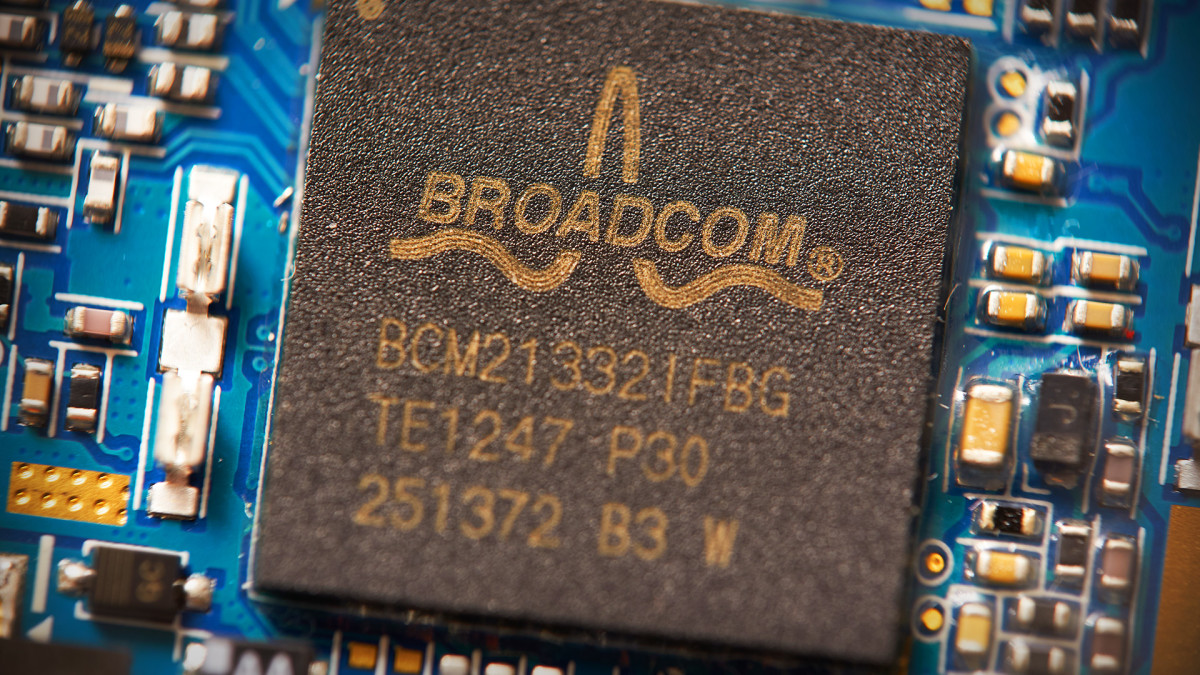
Broadcom (AVGO) reported its Q1 earnings on March 4. The company’s report was strong, with revenue hitting 29% year-over-year growth to a record $19.3 billion. The stock closed 4.8% higher at $322.77 on the next day, according to Yahoo Finance.
AI-heavy stock not crashing following the earnings report has become a rarity, even when the earnings are very strong, as we’ve seen with Nvidia. For more on that phenomenon, read my article “Bank of America resets Nvidia price target after earnings.”
“Consistent with our commitment to return excess cash to shareholders, we returned $10.9 billion in the first quarter through $3.1 billion of cash dividends and $7.8 billion of stock repurchases,” said Broadcom CFO Kirsten Spears.
I think the buybacks are what saved Broadcom from a sell-off — smart move.
AI hype has created an extremely volatile stock market atmosphere, in which investors imagine that the technology can replace anyone and anything. I wrote about how AI can’t even replace a simple search in my article “Salesforce AI faces backlash from customers.”
Failing to understand the limitations of AI, we see investors thinking that software companies will be beaten by AI companies.
It’s obvious that things have gotten out of hand when the CEO of a semiconductor company needs to explain that software companies can’t make chips.
During the earnings call, Broadcom CEO Hock Tan addressed the idea that LLM makers could start making their own chips, without Broadcom’s help.
“They face tremendous challenges. You need the best silicon design team around. You need cutting-edge, really cutting-edge SerDes, very advanced packaging. We’ve been doing this for 20 years, more than 20 years in silicon.”
“I would say we are by far way out there, and we will not see competition in [customer-owned tooling] for many years to come,” he concluded.
Broadcom also delivered very strong guidance for Q2 2026:
- Revenue of approximately $22.0 billion
- Adjusted EBITDA of approximately 68% of projected revenue
I have covered Q4 results in my article “Bank of America resets Broadcom stock price target.”
Shutterstock
Morgan Stanley raises Broadcom stock price target
Following the report’s release, Morgan Stanley analyst Joseph Moore and his team updated their view on Broadcom stock.
The team noted that the company set guidance to more than $100 billion of AI chip revenue in fiscal year 2027. Analysts estimate that the company will achieve approximately $120 billion of AI revenue in the same period and see potential for upward revisions.
More Tech Stocks:
- Morgan Stanley sets jaw-dropping Micron price target after event
- Nvidia’s China chip problem isn’t what most investors think
- Quantum Computing makes $110 million move nobody saw coming
Analysts raised their estimates for fiscal year 2026 for revenue, non-GAAP gross margins, and EPS to $107.7 billion/74.7%/$11.69, respectively, from $100.3 billion/72.7%/ $10.73.
The team also raised its estimates for fiscal year 2027 for revenue, non-GAAP gross margins, and EPS to $168.3 billion/71.0%/$17.98 from $132.4 billion/70.4%/$14.22.
In a research note shared with me, Moore reiterated an overweight (buy) rating for Broadcom stock and raised the price target to $470 from $462, based on a 27 multiple of his estimate for ModelWare EPS for 2027 of $17.39. This corresponds approximately to 24 multiple non-GAAP EPS of $19.54.
Analysts noted downside risks for Broadcom:
- Losing a networking market share to Nvidia (Mellanox)
- ASIC chips being uncompetitive or losing customers to competitors
- Execution of the VMware acquisition
Upside risks:
- Stronger AI revenue
- Faster recovery in core semiconductor businesses
- Realized VMware synergies
Broadcom launches VMware Telco Cloud Platform 9
Broadcom unveiled the VMware Telco Cloud Platform 9, built on VMware Cloud Foundation 9. The platform is a private cloud platform for telco data centers.
According to the company, it is designed to help global telco operators drive greater hardware efficiency and lower operational costs when delivering sovereign and AI services.
Benefits of VMware Telco Cloud Platform 9 include:
- An estimated 5-year cumulative total cost of ownership (TCO) savings of 40%
compared to siloed architectures - Lower power consumption and associated costs by an estimated 25-30%
- An estimated 38% lower memory and server TCO
“The integration with VMware Telco Cloud Platform shows how Nokia’s multi-cloud strategy helps telecommunication providers ensure requisite automation, security, resilience and scaling,” said Kal De, senior vice president, core software, Nokia.
“By using our cloud-native core network portfolio on VMware TCP, telcos can monetize their core networks with total confidence on the cloud platform of their choice, while reducing operational risk and accelerating time to market.”
Related: 5-star analyst resets Marvell forecast before earnings
#Morgan #Stanley #resets #Broadcom #price #target #earnings