
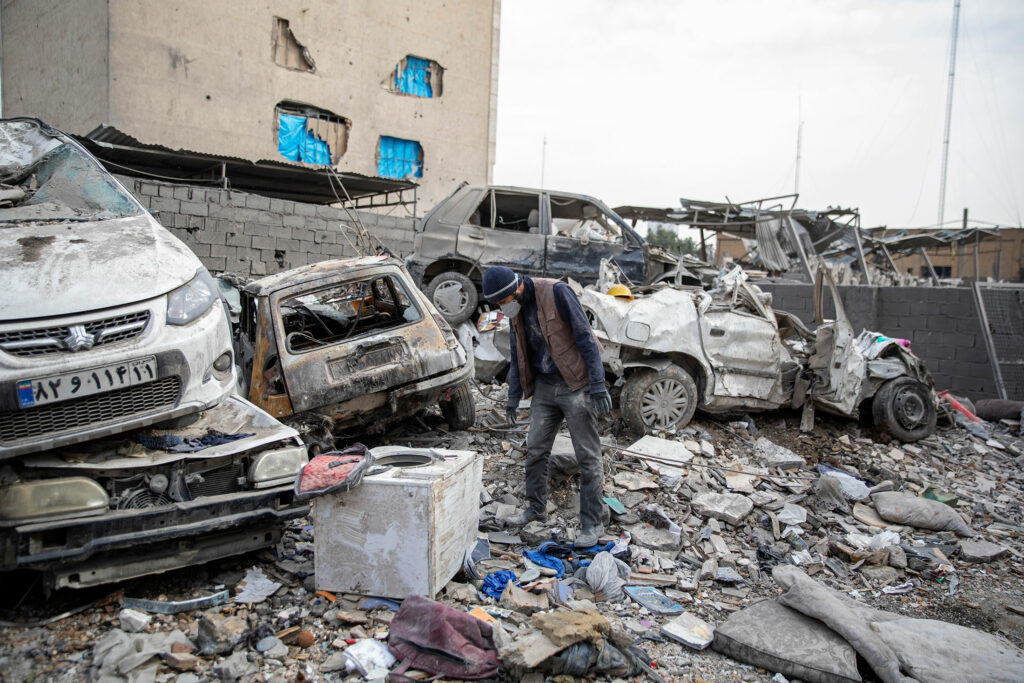
US President Donald Trump threatened Iran with further attacks after the Islamic Republic’s new leader signaled defiance and suggested there would be no easing of a war that’s upending energy flows and global markets.
“We have unparalleled firepower, unlimited ammunition, and plenty of time,” Trump said on Truth Social. “Watch what happens to these deranged scumbags” on Friday, he said, referring to Iran’s leaders.
Yet pressure is building on Trump at home given the chaos the war’s caused across the Middle East and with oil prices rising above $100 a barrel because of Iran’s effective closure of the Strait of Hormuz.
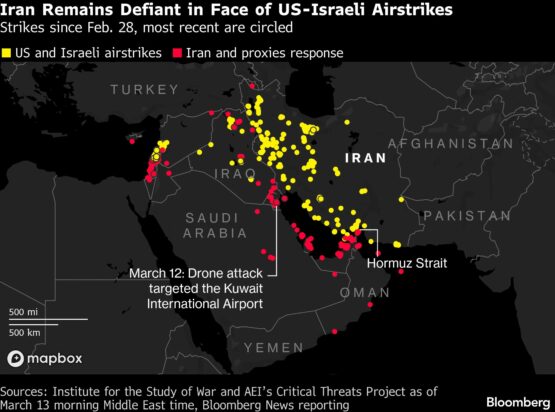
Trump’s warning came after Iran’s Supreme Leader Mojtaba Khamenei said the Islamic Republic would seek to ensure the strait remains effectively closed. In his first public comments since succeeding his father, he also said Tehran would look to open other fronts in the war, now in its 14th day, if the US and Israel persist with their attacks.
The fighting has killed more than 2 500 people, most of them in Iran, and brought the waterway — through which around one-fifth of the world’s oil and natural gas flows — to a near standstill. Fears of a prolonged war are weighing on stocks and currencies in Asia.
“We are really in a moment of flux where we don’t know yet precisely in which direction this is going to go,” Kim Ghattas, an author on the Middle East, said to Bloomberg TV on Friday. “This Iranian regime and its axis have definitely been weakened over the last two years, but they’re still able to fight back and impose and inflict tremendous economic damage to the region, to the world economy.”
Airstrikes on the Islamic Republic and Tehran’s retaliation across the Arab Gulf and against Israel continued overnight.
A French military staffer was killed in an attack in Iraq’s Erbil region and several soldiers were injured, French President Emmanuel Macron said in an X post. Reuters reported it was a drone strike and said at least six French soldiers were wounded.
A US refueling aircraft crashed in western Iraq in an incident that involved another plane that landed safely, the American military said. It’s unclear what happened to the crew, though the US said the plane came down in “friendly airspace.”
ADVERTISEMENT
CONTINUE READING BELOW
Seven American service members have died so far, most of them in the opening days of the war.
In Oman, two people were killed after drones crashed in the Sohar region, state media said on Friday. Oman’s Port of Sohar has suspended operations.
Dubai, the commercial and financial hub of the United Arab Emirates, reported missile threats and a “minor incident” in the emirate’s central area the same day. Saudi Arabia intercepted more than a dozen drones in its airspace.
Kuwait reported on Thursday that several drones were fired at its international airport, resulting in material damages.
Israel’s military said it struck more than 200 targets in central and western Tehran, including ballistic missile launchers, defense systems and weapon-production sites.
Iran has likely begun laying mines in the Strait of Hormuz, UK Defense Secretary John Healey told reporters on Thursday. Iran’s deputy foreign minister denied that his country was doing so, according to the AFP.
Even so, there’s little sign that Hormuz will be reopened for normal levels of traffic soon.
Three commercial ships were struck in the Arabian Gulf in the past two days, highlighting the risk that maritime disruptions to transport are expanding.
Ports in Oman and on the UAE’s east coast — both outside the narrow waterway — are being used as emergency gateways for goods bound for the region. The US Navy could start escorting tankers through the strait by the end of this month, Energy Secretary Chris Wright said.
The blockage of the Strait of Hormuz has disrupted millions of barrels a day of supply and caused what the International Energy Agency described as the biggest hit to global production on record. Saudi Arabia, Iraq, Kuwait, and the United Arab Emirates have all had to curb crude output.
ADVERTISEMENT:
CONTINUE READING BELOW
On Thursday evening, the US announced a second authorisation for buyers to take Russian oil cargoes already at sea to help ease prices. Treasury Secretary Scott Bessent said the move was designed to be a “narrowly tailored, short-term measure” that “applies only to oil already in transit and will not provide significant financial benefit to the Russian government.”
The US and Israel first launched airstrikes on Iran on February 28, killing Supreme Leader Ali Khamenei, after accusing the Islamic Republic of pursuing nuclear weapons — an allegation Tehran has long denied. Iran struck back, firing missiles and drones at Israel and nations across the Gulf, plunging the oil-rich region into crisis.
Some 1 858 people have died in Iran, according to the Human Rights Activists News Agency. Almost 700 people have been killed in Lebanon, where Israel is battling Iran-aligned Hezbollah. Around a dozen Israelis and several more people in other Arab countries have also died.
Trump has sent mixed messages about the likely duration of the war, signaling at times that an end was imminent and at others that it could continue for weeks. Surging gasoline prices, the approach of midterm elections in November, and widespread opposition to the war in the US are increasing pressure on him to quickly halt the fighting.
Although Trump has cited the overthrow of Iran’s leadership as a motive for the military campaign, Israeli Prime Minister Benjamin Netanyahu on Thursday said there was no guarantee the government that has ruled the country for 47 years would be toppled — even in its now-weakened state.
“A regime is ultimately brought down from within,” he said at his first press briefing since the war began.
The new supreme leader, a 56-year-old hardline cleric, was appointed after his father was killed in the first day of US-Israeli attacks. Iranian media had reported that the younger Khamenei had been injured.
Trump said he thinks the new supreme leader is “damaged” but “alive in some form,” in an interview on FOX.
US officials told lawmakers the first six days of the war cost more than $11.3 billion, a person familiar with the matter said, the most detailed assessment yet of the campaign’s expense. The US Central Command reported that about 6 000 targets had been struck since military operations started.
© 2026 Bloomberg
#Trump #warns #Iran #watch #war #hits #twoweek #mark