
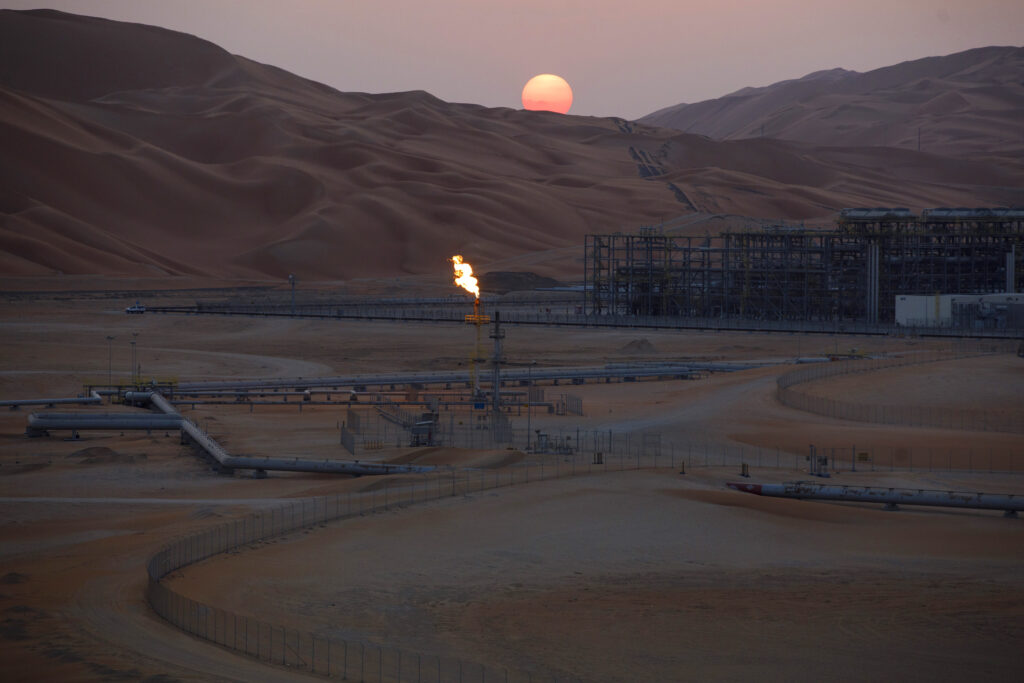
Winston Churchill, a man who knew a thing about war – including from his time in South Africa – warned about the “malignant Fortune, ugly surprises, [and] awful miscalculations” that always accompany military adventurism.
Perhaps US and Israeli leaders have forgotten this as their war with Iran enters its third week. Investors’ hopes for a speedy resolution, similar to last year’s Twelve-Day War, have evaporated.
Iran’s leadership has shown little sign of giving up the fight.
It has scant hope of defeating the US militarily but can win the political battle if high fuel prices weigh on the minds of American voters leading up to the November mid-term elections.
Read/listen:
South Africa seeks new fuel suppliers
Eskom’s 8.8% tariff hike kicks in on 1 April as fuel price shock looms
Middle East war has ‘sapped’ confidence – SBG’s Goolam Ballim
The new supreme leader, son of the slain Ayatollah Ali Khamenei, said that Iran must continue to throttle maritime traffic through the Strait of Hormuz. This means as much as 20% of global oil and gas supplies are trapped.
The International Energy Agency, set up to coordinate the response of Western nations to the 1970s oil shocks, called it the “largest disruption in history to oil supplies”.
It arranged a release from strategic oil reserves across several countries, but the price of Brent crude still ended at around $100 a barrel last week.
This will hit some countries harder than others, and the longer the war drags out, the bigger the impact will be.
Russia is a big winner, especially now that sanctions on its oil sales have been temporarily eased, making Ukraine a big loser. China has been stockpiling oil for months and can ride out the storm. India, however, is far more vulnerable, being particularly dependent on natural gas.
Most European nations are net energy importers, but the US is an exporter. This week, we’ll focus on South Africa, an importer of crude oil and refined petroleum products.
Pain at the pump
South African motorists are in for a rude shock on 1 April, and it won’t be an April Fool’s joke.
Retail fuel prices in South Africa are adjusted on the first Wednesday of each month, and data from the Central Energy Fund points to a likely increase of around R4 per litre for petrol and nearly R7 per litre for diesel. These would be the largest monthly increases this century in both cases.
In a country where most people drive to work in their own cars or minibus taxis, this will erode disposable incomes.
Similarly, most goods are transported by road rather than rail, and this will eat into the margins of both large and small businesses.
Read:
JSE slides below 115 000 points amid Middle East oil shock
Oil swings after report IEA proposing record reserves release
Over R2trn JSE wipeout
However, it should be noted that incomes generally rise over time. Paying R24 per litre today is more affordable compared than it would have been five or 10 years ago. The chart below shows that the real (inflation-adjusted) petrol price with the expected April increase will be high, but not extreme by historical standards.
The worst period was the three years following Russia’s invasion of Ukraine in February 2022. Not only did the oil price surge, but the rand was particularly weak, falling from R14.55 per US dollar to R19.85 at its lowest in April 2025.
South Africa inflation-adjusted petrol price with expected April increase
ADVERTISEMENT
CONTINUE READING BELOW
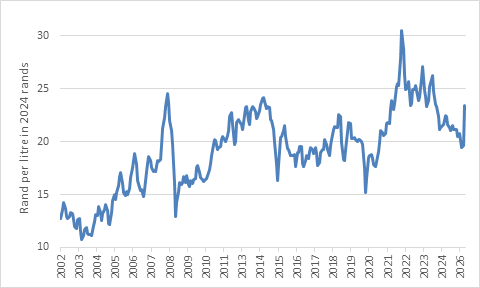
Source: Central Energy Fund, Stats SA, author’s calculations
The rand’s weakness over this period was partly due to domestic dysfunction, as severe load shedding crippled the economy, and partly because the US dollar surged as the Federal Reserve increased interest rates.
These two compounding factors are absent, for the time being. The local economy is performing better (more on that below), and there is no indication of the Fed raising rates.
This is because there was a general rise in US inflation across goods and services between 2021 and 2023, not just higher energy prices. Housing inflation peaked at 8% in early 2023, as did non-housing service inflation. These two categories, accounting for 60% of the inflation basket, are currently running around 3% and are declining.
The increase in energy inflation will complicate matters for the Fed, nonetheless, and it will postpone or prevent expected interest rate reductions.
The situation is similar for the South African Reserve Bank (Sarb), which always notes that it doesn’t respond to the first-round effects of oil price movements, but instead focuses on the second round.
This means monitoring “core” inflation, which excludes food and fuel, to look for signs of passthrough from petrol and diesel into other prices.
Read:
Interest rate uncertainty persists
Inflation falls, but the story is far from over
Unlike the Fed, the Sarb must also take exchange rate movements into account. A weaker rand will not only exacerbate higher dollar-denominated oil prices but also put upward pressure on a range of imported items and threaten inflation expectations.
So far, however, the rand has been reasonably well behaved given how it usually reacts to negative global shocks.
Part of the support comes from elevated precious metals prices, and in recent days, iron ore and coal prices have also risen.
South Africa’s interest rates
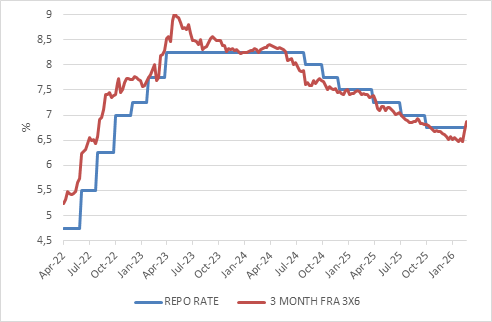
Source: LSEG Datastream
Nonetheless, the rand has been on the back foot, and fixed-income markets have scaled back expectations of lower interest rates. In fact, the volatile forward rate agreement market is now pricing in the possibility of a rate increase, though this is still very premature.
A lot would have to go wrong before the Sarb considers raising interest rates, but it is highly unlikely to cut them in the current environment.
Even if oil prices rise further, a real possibility, they will stabilise at some point.
Read:
Oil at $100 a barrel promises boon for Africa’s largest country
Middle East shipping attacks ignite fresh oil price spike above $100
Even if oil hits $150 per barrel and stays there, its inflation rate will fall to zero after 12 months.
It would be a mistake for central banks to overreact given that high energy costs tend to reduce spending on non-energy items, leading to some downward pressure on their prices.
Of interest
ADVERTISEMENT:
CONTINUE READING BELOW
Interest rates, both the Sarb’s policy rate and yields in the bond market, have already declined notably since peaking in early 2024. This contributed to solid gains in consumer spending before the war broke out.
Last week’s fourth-quarter gross domestic product data showed household final expenditure grew by almost 4% year on year. From this high base, it was always going to moderate, but the looming increase in the cost of living will accelerate the decline.
South Africa’s economic growth
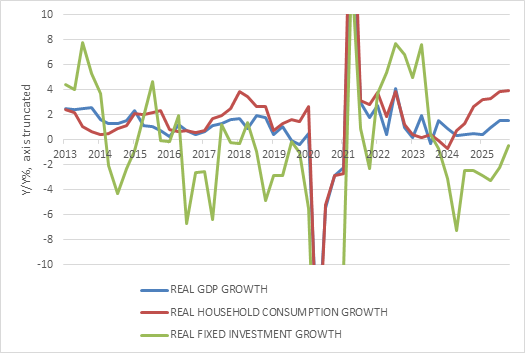
Source: Stats SA
For the overall economic growth rate to increase from 1.5% year on year in the fourth quarter (1.1% for the full 2025 calendar year), growth in fixed investment spending must accelerate from a contraction last year to sustained growth.
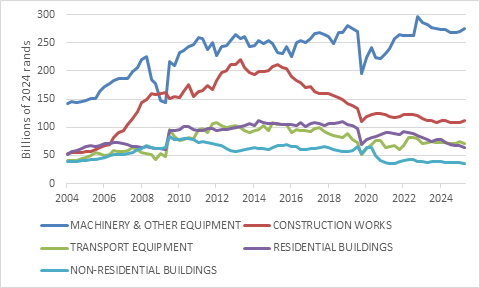
The chart further down breaks down the components of fixed investment (formally known as gross fixed capital formation). About two-thirds of this comes from the private sector, with machinery representing the largest segment by far.
This includes machines used in factories and mines, as well as computers and, more recently, equipment linked to the renewable energy build-out. This has shown a general uptrend over the years, and a tentative recovery over the past two quarters.
The same cannot be said for the other categories.
Spending on construction works has almost halved over the past decade, partly due to the completion of Kusile and Medupi, Eskom’s two long-delayed mega coal-fired power stations.
This category also includes roads, bridges, dams and other forms of infrastructure, and illustrates the decline of public sector capex amid budgetary pressures.
Together with the decline in spending on both residential and non-residential buildings, this has decimated the construction industry, one of the most labour-intensive sectors.
Looking ahead, spending on transport equipment should rise as private freight train operators start implementing their concessions on Transnet’s rail network.
The residential property sector is interest rate-sensitive and will even need lower rates to get going after a decade of stagnation.
Improvements in local government delivery are also necessary.
The non-residential building sector is somewhat less rate-sensitive but has been held back by an oversupply of shopping malls and office buildings. The latter seems to be easing as more workers return to offices (though a good way of saving on fuel costs would be for CEOs to allow staff work at home over the next few months).
Read:
Traxtion kickstarts private SA rail boom with R3.4bn investment
Creecy announces breakthrough in SA rail reform: 11 TOCs approved
Help us build a 21st Century transport system – Creecy to private sector
It is the construction works category that has the biggest hope of recovering over the next few years, given the concerted effort by policymakers to foster partnerships with the private sector to rebuild the country’s infrastructure.
This includes last week’s announcement that the World Bank will back a new credit-guarantee vehicle to derisk infrastructure projects for private investors, aiming to unlock as much as $10 billion in total spending.
Optimism versus pessimism
ADVERTISEMENT:
CONTINUE READING BELOW
Across all components, boards of directors will only approve capital outlays if projects can deliver an expected return above a required hurdle rate. The decline in interest rates means the hurdle rates will also be lower.
The more interest rates decline – unlikely in the short term but realistic over the medium term – the more projects are likely to receive the green light, but only if company directors are confident about the future.
As much as these decisions are guided by spreadsheets, the final call comes down to psychology. Ultimately, success depends on whether the people who make the decisions feel optimistic or pessimistic about the economic outlook.
Components of real fixed investment spending
Source: Stats SA
The sense of optimism will be dented by the crisis in Iran, but ultimately it will be determined by expectations for the domestic economy.
Therefore, this geopolitical episode is an urgent reminder to South African policymakers to accelerate the reforms needed to make the country a more attractive destination for investment and business.
Listen/read: Government’s plans for SA infrastructure development
As if on cue, a new analysis from the International Monetary Fund highlighted that running a business in South Africa – particularly navigating the regulatory environment – is “significantly more burdensome, fragmented, and costly than in peer economies”.
The country must get its own house in order to reduce exposure to global market sentiment and geopolitical risks.
For ordinary investors, psychology also plays a critical role in long-term investment success. Those who can sit through market turbulence and stick to a strategy usually outperform those who repeatedly change course.
These are unsettling times, and markets are likely to be volatile for some time to come.
Indeed, things may even get worse before they get better, in the sense that US President Donald Trump may only back down if oil prices are high enough to hurt him and the Republican Party politically.
Similarly, Iran may only capitulate if its own oil exports are blocked, further tightening global supply.
Read: Trump and Iran strike defiant tone as oil markets see little relief
At the same time, change could come much sooner. After all, psychology also plays a big role in politicians’ decision-making.
The slightest hint of good news will see markets quickly recovering. This is why trying to time the market is so fiendishly difficult, while “time in the market” is far more effective.
Since we began with a Churchill quote, it is fitting to end with another: “You will never reach your destination if you stop and throw stones at every dog that barks.”
Izak Odendaal is an investment strategist at Old Mutual Wealth.
#Life #barrel