
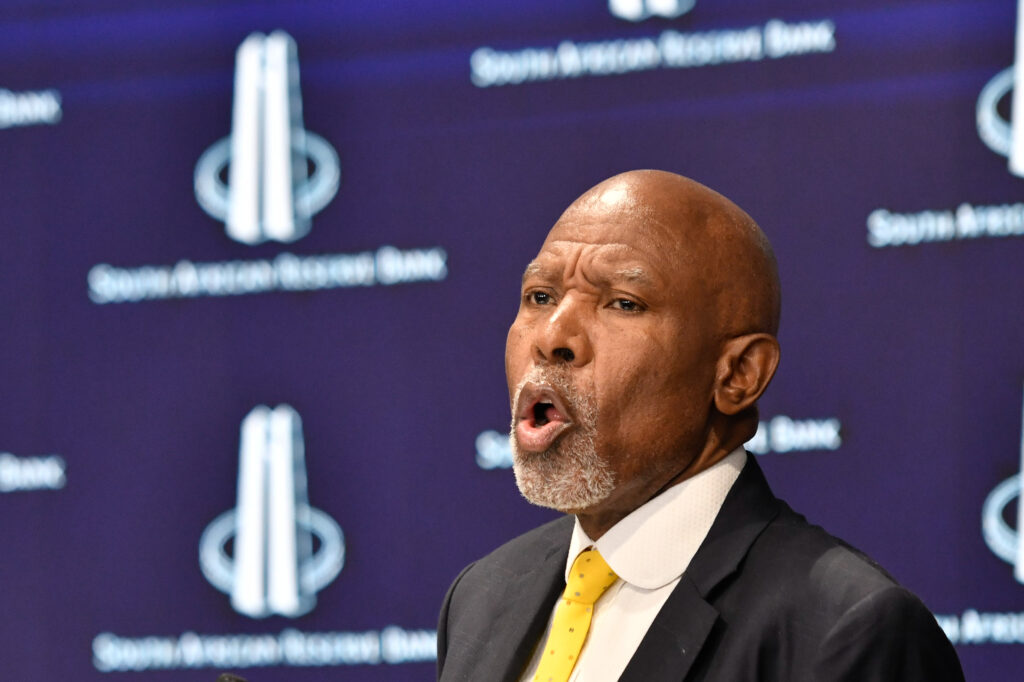
The South African Reserve Bank (Sarb) has left its benchmark repo rate unchanged at 6.75% following its latest Monetary Policy Committee (MPC) meeting, governor Lesetja Kganyago announced on Thursday.
Kganyago said it was a unanimous decision.
It took a cautious and steady approach, as widely expected, in the wake of the world being rocked by the Iran war in the Middle East since the start of the month, which has seen Brent oil prices spiral to over $100 a barrel.
Listen/read:
Sarb expected to sit tight as oil spike reshapes inflation outlook
How SA will feel the Iranian conflict
April fuel prices set to rocket
The spike in oil prices have raised concerns about global inflation and the risk of a recession.
In SA, fuel prices are expected to rocket in April by between R5 and R9 a litre for petrol and diesel, respectively, unless government announces any mitigation measures in the next few days.
The Sarb’s repo rate decision means SA’s prime lending rate for commercial banks remains steady at 10.25%.
Kganyago said in his MPC statement that the world is only a few weeks into the “shock” and that conditions remain “extremely uncertain”.
“At this stage, it is obvious that global inflation will be higher in the near term, while growth will probably suffer from supply-chain disruptions and rising costs. But the longer-term outlook is less clear.”
ADVERTISEMENT
CONTINUE READING BELOW
Inflation for February was exactly in line with our target but conflict in the Middle East is creating new price pressures. #SARBMPCMAR26 #SARBPolicyRate pic.twitter.com/ibdAbKR6xL
— SA Reserve Bank (@SAReserveBank) March 26, 2026
Growth projections unchanged
The governor added that the central bank’s growth projections for South Africa remains “largely unchanged”.
“There have been data revisions which lowered 2025 growth, making 2026 look a bit stronger in comparison. This offsets some of the impact from the current shock. We still have growth rising to around 2% over the next few years, but we now see downside risks to the outlook.”
Kganyago said higher energy prices will soon lead to higher inflation, with headline inflation accelerating to 4%. Fuel inflation will however be over 18% for the second quarter.
“Our baseline forecast then has a gradual unwinding of the shock, taking inflation back to 3% late next year,” he said.
The Sarb’s latest projections point to a more prolonged period of unchanged interest rates, delaying the easing cycle previously anticipated, Kganyago said.
“The latest forecasts from our Quarterly Projection Model show rates unchanged for a longer period, postponing the cuts from the January projections.” He added that the policy stance is treated as “moderately restrictive”, which helps bring inflation back to the 3% target.
“Our decisions will continue to be taken on a meeting-by-meeting basis, with careful attention to the outlook, data outcomes, and the balance of risks to the forecast.”
ADVERTISEMENT:
CONTINUE READING BELOW
Two other scenarios
Against a backdrop of heightened global uncertainty, Kganyago outlined two alternative scenarios with more adverse assumptions than the baseline.
“The first assumes the conflict persists for around two months, with oil prices averaging close to $100 a barrel and the rand about 5% weaker against the dollar. The second, more severe scenario assumes the war lasts more than a year, with oil prices remaining above $100 and the rand weakening by 10%.
In both cases, inflation is higher, exceeding 4% in the first version and 5% in the second, Kganyago said. This would require tighter monetary policy, “with one hike in the first scenario and several more in the other”.
Over time, inflation would ease as oil prices moderate and policy tightening takes effect.
“In the first scenario we are back to target during 2027. In the second scenario, this only happens in 2028.”
Kganyago reiterated the central bank’s commitment to the new 3% inflation target, acknowledging that the timeline may have shifted. “While earlier conditions suggested a faster adjustment, now there has been a negative shock, and it could take a bit longer.”
Read: Iran war oil shock threatens to disrupt Africa’s easing cycle
#Sarb #holds #rate #steady