
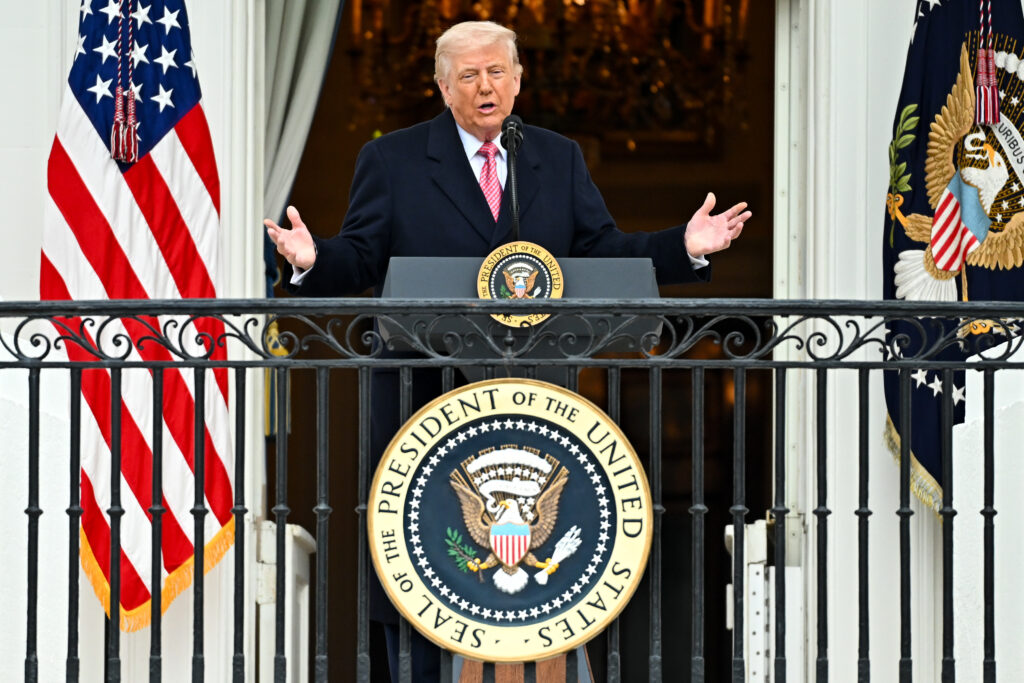
US President Donald Trump’s public comments about the Iran war reflect a growing frustration he has communicated privately to those around him, as the disruptive conflict stretches into a second month without a clean exit strategy.
Trump has told associates that he is angry with North Atlantic Treaty Organisation (Nato) members and other allies, said people familiar with his thinking.
With the war dragging on, Trump sees some partners as unwilling to do enough to help achieve a decisive end to the conflict.
Read:
Trump claims Iran gave in to US demands, considers seizing oil
Trump warns Iran of escalation as US troops arrive in region
Oil turns lower on report US may end war without Hormuz opening
Iran attacks Kuwaiti oil tanker as Trump expands US threats
The president has aired some of those grievances in public, exhorting allies on Tuesday to “go get your own oil” despite Iranian threats effectively closing the vital Strait of Hormuz, which has sent global fuel prices soaring.
“You’ll have to start learning how to fight for yourself, the U.S.A. won’t be there to help you anymore, just like you weren’t there for us,” he posted on social media.
Trump has vacillated between claiming progress in diplomatic talks with Tehran and threatening to escalate strikes as he becomes increasingly insistent about obtaining a ceasefire.
The president realises that the current situation is untenable, according to another person familiar with his thinking who requested anonymity to discuss private deliberations.
Recently, the president’s team has suggested that reopening Hormuz – which carries roughly 20% of seaborne oil supplies – may not be a necessary condition to end the war.
Such an outcome might soothe anxious investors who want to see the war’s constant disruptions fade away.
ADVERTISEMENT
CONTINUE READING BELOW
The S&P 500 Index extended gains following a report from Iran’s official news agency that said the country’s president was willing to end the war, rising as much as 2.7% for its biggest intraday advance since May.
But leaving the status of the strait undetermined – especially with Tehran demanding sovereignty over the waterway as part of a deal – would do little to prevent future volatility in the global economy.
Brent has surged around 60% in March, since the war began, and US gasoline topped $4 a gallon for the first time since 2022.
Taken together, the developments suggest that the war Trump started with Israel is no longer solely in his control.
That also poses a political risk for the president, who campaigned on not starting any new wars and whose Republican Party faces the prospect of losing control of Congress in the November midterm elections.
Even so, it’s the economic pain caused by the war that is the primary concern weighing on the White House as top officials are increasingly worried about the peril that it poses for GOP lawmakers running for re-election, one of the people said.
Election talk
“President Trump has always been clear about short-term disruptions as a result of Operation Epic Fury. America’s long-term economic trajectory, however, remains solid with the Administration focused on implementing the President’s proven economic agenda of tax cuts, deregulation, and energy abundance,” White House spokesman Kush Desai said in a statement.
“Once Operation Epic Fury’s objectives have been achieved and these short-term disruptions are behind us, Americans can rest assured that the President’s agenda will unleash the historic job, wage, and economic growth they saw during the first Trump administration.”
Critics have accused the US of underestimating the scale and length of disruption to energy flows stemming from the conflict.
ADVERTISEMENT:
CONTINUE READING BELOW
Trump and his team, however, have tried to separate the historic threat Iran and its proxy groups pose to the US and the region from the war’s impact on shipping.
With the US less reliant on Middle East oil and gas than Asia, he’s also tried to put the onus on others that are more dependent on energy from the region to help fix the problem.
Trump on Tuesday said the US helped drastically reduce the military threat posed by Iran, which he said could set the table for the strait closure to resolve itself.
“Well, I think it’ll automatically open, but my attitude is, I’ve obliterated the country. They have no strength left, and let the countries that are using the strait, let them go and open it,” the president told the New York Post.
That suggestion could alarm Gulf states, which were heartened by Trump’s claim made on Fox News last week that the US would continue to protect Gulf allies even “if we don’t stay” in Iran.
“They’d probably like us to stay,” he said. “If we don’t stay, we’re going to be protecting them. We know, you know, they’ve been very good.”
Leverage at risk
While the US could conceivably end military operations against Iran and leave Hormuz to a separate coalition task force, doing so would reduce the leverage Washington has over Tehran – particularly since European and Gulf allies are only interested in a narrower mission aimed at opening up the strait, rather than achieving broader strategic goals by bombing Iranian assets.
During the negotiations before the current war, Trump moved an unprecedented array of military assets – from warplanes to aircraft carrier strike groups – into the Middle East, but still failed at getting Iran to cave on certain US demands, such as abandoning its missile programme or support for proxy groups such as Hezbollah or Hamas.
The UAE is the only Gulf Arab country that that has said it will join a naval force to try to reopen Hormuz or provide escorts. Bahrain is working on a UN Security Council resolution to give a mandate to a naval task force.
ADVERTISEMENT:
CONTINUE READING BELOW
US Defence Secretary Pete Hegseth pointed to the president’s post on social media when asked during a briefing Tuesday morning if reopening the strait was an essential objective of Operation Epic Fury.
Hegseth said reopening the strait is “not just a United States of America problem” and “ultimately, I think other countries should pay attention when the president speaks”.
“He’s proven when he speaks, he means something. And he’s pointing out – [you] might want to start learning how to fight for yourself.”
White House Press Secretary Karoline Leavitt said during a press briefing on Monday that the US was “working towards” fully reopening the strait but did not list that as a core US military objective when asked if Trump would declare victory even if passage through the strait remained slow.
Leavitt reiterated that the core objectives are destroying Iran’s navy, destroying Iran’s ballistic missiles, dismantling Iran’s defence industrial infrastructure and preventing Iran from obtaining a nuclear weapon.
Speaking last Friday after meeting his G7 counterparts, Secretary of State Marco Rubio also drew a line between the war’s strategic goals and reopening the Strait of Hormuz.
It would be unacceptable if, after the operation ends, Iran continues dictating control of the strait and requiring payment to cross it, Rubio said.
“The whole world should be outraged by it. We’re impacted by it a little bit. But the rest of the world is impacted by it a lot more.”
© 2026 Bloomberg
#Trumps #exasperation #Iran #grows #signalling #hastened #exit