
Intel (INTC) reported April 1 that it will repurchase Apollo Global Management’s 49% stake in the joint venture tied to Fab 34 in Leixlip, Ireland, for $14.2 billion. The company plans to fund the deal with existing cash and about $6.5 billion of new debt, and it said the transaction should support profitability and its credit profile beginning in 2027.
The move reverses a financing deal Intel struck in June 2024, when Apollo agreed to invest about $11 billion for that same 49% stake as part of Intel’s Smart Capital strategy. Intel kept a 51% controlling interest and operational control of the site, which gave the company more flexibility while it continued spending heavily on manufacturing.
Why Fab 34 matters
Fab 34 is one of Intel’s most important manufacturing assets in Europe. Intel has said the facility supports Intel 4 and Intel 3 process technologies, while reporting on the new buyback noted that the site produces chips including Core Ultra and Xeon products. Intel also described Fab 34 as its first high-volume manufacturing site in Europe using EUV for Intel 4.
That gives the transaction more weight than a routine capital-structure move. Intel is not buying back a side asset. It is taking back full ownership of a leading-edge fab that sits close to the center of its manufacturing strategy.
Shutterstock/TheStreet
Why Intel’s stock moved
The market reaction was easy to understand. Intel is bringing a strategic fab fully back in-house at a time when investors have been looking for signs that the company is getting more comfortable carrying its manufacturing recovery on its own balance sheet. Shares rose sharply on the announcement, with intraday gains pushing higher than 9%.
The timing also fits the broader shift under CEO Lip-Bu Tan. A year ago, Intel was leaning on outside capital to help support this fab. Now it is paying more to unwind that arrangement, which gives investors a read on how management sees the value of tighter control.
The investor debate
Intel is buying back the stake at a meaningfully higher price than Apollo originally paid, and it is using both cash and new debt to do it. Investors still have to decide whether the strategic benefits are strong enough to justify the added cost and financing burden.
The bullish case is straightforward. Intel is regaining full ownership of a fab tied to some of its most important client and server products, and management says the deal should support EPS and its credit profile starting in 2027. If execution keeps improving, the move looks more like tighter strategic control than an expensive unwind.
What Intel’s stock chart says now
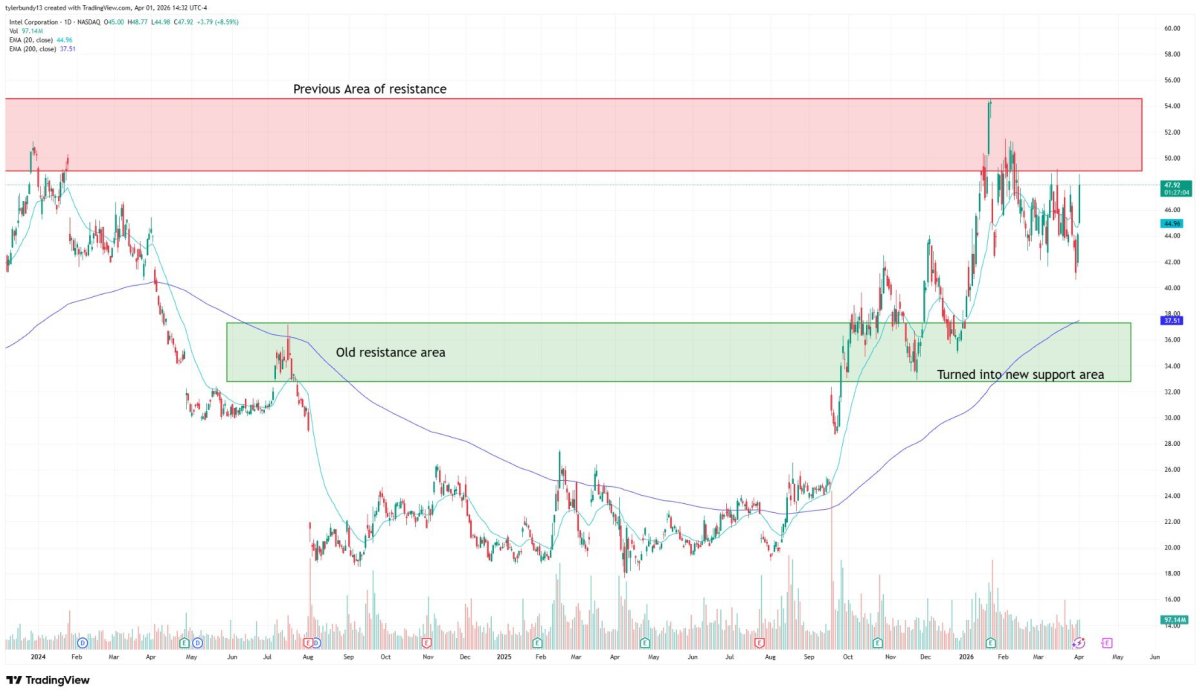
Intel’s technical picture has improved meaningfully, and Wednesday’s rally added to that shift. The stock opened at $45.00, traded as high as $48.77, dipped to $44.98, and is trading at $48.15 as of 2 pm April 1, up 9.11% on the day.
The stock remains above its exponential moving averages (EMA), a key indicator used by technical analysts. The 20-day EMA (light blue) sits at $44.99, while the 200-day EMA (dark blue) sits at $37.51. That keeps the short-term and longer-term trends pointed in the same direction.
More technicals
- Surging Chevron stock has more going for it than just higher oil prices
- Exxon stock jumps as today’s oil rally meets a bullish chart
- Are stocks oversold as Dow Jones, S&P 500 flash technical signal?
The support area underneath the price is still the cleaner level to watch. A zone between roughly $33 and $37 had acted as resistance before the breakout and now looks more like support. That band also lines up closely with the 200-day EMA, giving it added technical importance if the stock pulls back.
The next challenge is overhead. Intel is pushing into a prior resistance area between roughly $49 and $55, which means the stock is running into a zone where sellers showed up before. If buyers can keep control above the mid-$40s, the chart leaves room for a broader test of that range. If momentum cools, traders will likely look first to the 20-day EMA near $45, then to the broader $33 to $37 support zone.
Related: Bank of America resets Intel stock forecast
#Intel #major #fab #decision #uncertainty