
As the war on Iran enters its second month, reports from state media and residents in the Islamic Republic indicate mounting attacks on civilian infrastructure including homes, factories and electricity facilities.
Iran’s Red Crescent Society, part of the international humanitarian network, said on March 30 that US-Israeli airstrikes had damaged or destroyed more than 90 000 homes, about half of them in Tehran.
Some residents say they’re witness to increasing numbers of strikes on residential buildings. They include those on the capital’s north, a more affluent area where more secular Iranians live alongside regime elites. The pummeling of urban areas is also shifting the mood among some Iranians who might have supported the action, two people said.
“It’s not like they hit one block for one person, they hit three or five blocks expecting that the person will be in one of them,” a woman in her mid-50s who lives near the leafy Fereshteh neighbourhood said in voice notes sent on WhatsApp. On March 22, the strikes on her immediate surrounding area increased significantly, she said. “That’s how it’s been recently.”
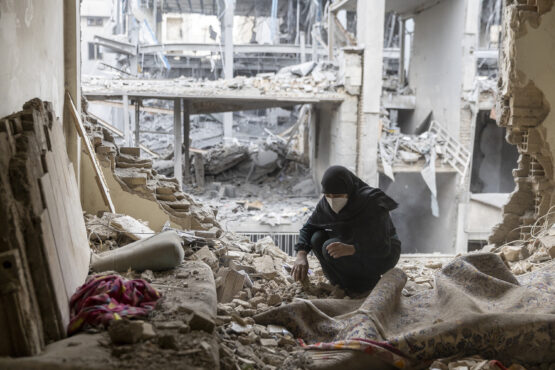
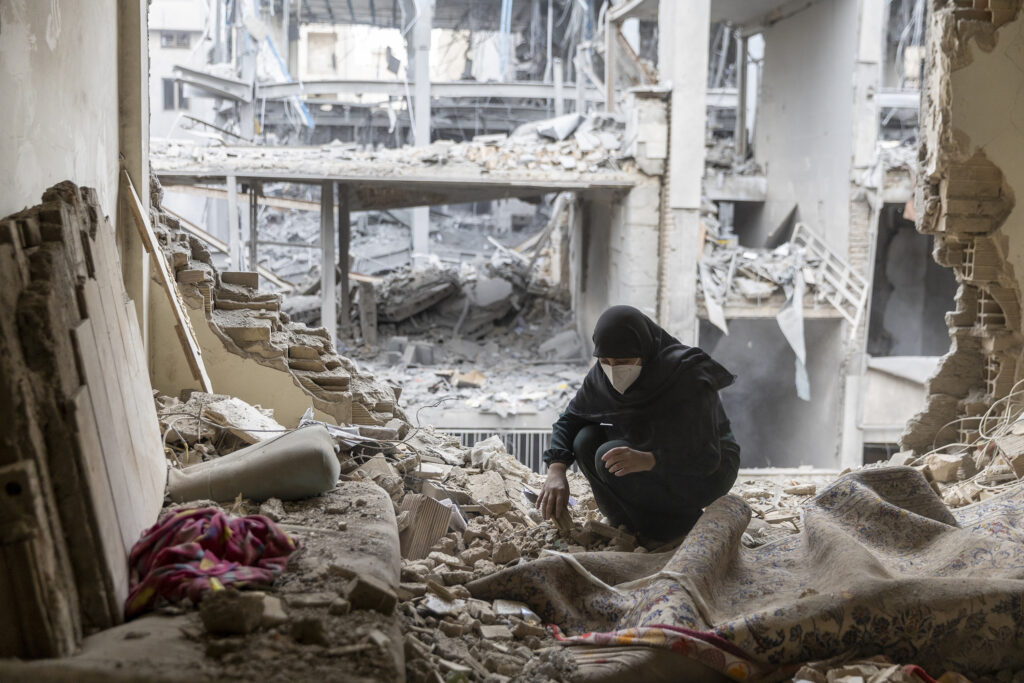
A woman sifts through the rubble of her home following an airstrike, in Tehran. Photographer: Majid Saeedi/Getty Images
While Donald Trump has signaled he’s preparing to end the conflict, the US and Israel have pressed on with their bombardment of Iran and the American president said on Wednesday he plans to hit the country “extremely hard” in coming weeks. The Islamic Republic, meanwhile, is firing missiles at Israel and Gulf states and is keeping the Strait of Hormuz largely closed to marine traffic.
The US and Israel say they are only hitting targets used for military purposes or by security services. Neither the US military nor Israel Defense Forces have published a list of what exactly what they’ve struck.
“The IDF conducts precise operational planning and takes feasible precautions in both the planning and execution of strikes in order to mitigate harm to civilians and civilian infrastructure to the greatest extent possible,” the forces said in a response to questions. A spokesperson for the US military wasn’t immediately available for comment on specific incidents.
Away from Tehran, Iranian state media reported that an airstrike on the town of Mahallat in central Markazi province killed 11 civilians, including two women and three children. Earlier the same day, strikes on electrical facilities in the provinces of Tehran and Alborz had caused temporary blackouts. Neither report could be independently verified.
ADVERTISEMENT
CONTINUE READING BELOW
Missiles also struck one of Iran’s biggest state-run pharmaceutical companies, Tofigh Darou, destroying its production and research and development units, state media said on Tuesday, blaming the strike on Israel. It’s a major producer of anti-cancer drugs and anesthetics in Iran, according to the Social Security Investment Co., whose subsidiary owns the company.
Assessing the impact on Iran is difficult. Following a deadly crackdown on protests in January, Iranians are facing continuing pressure through arrests and judicial executions as the regime battles to keep its grip on power after initial signs that some people supported the strikes.
State-imposed restrictions on internet access and telephones mean that only state media and accredited photographers are able to publish footage and photos. Unverified social media clips of apparent damage and attacks are also limited because of the government’s internet blackout.
The residents contacted by Bloomberg used patchy virtual proxy networks to communicate, often taking days at a time to respond. They asked not to be identified by name because of fear of reprisals from the authorities, which have deployed security forces to patrol streets and man checkpoints.
“Opinions are different and wide ranging but the thing that is very clear is that everyone is exhausted by the war situation,” a 35-year-old woman who lives in northern Tehran said by WhatsApp. “This is something that I can say I’m hearing and seeing a lot.”
A Tehran-based businessman said his own home was almost hit in an airstrike just north of the Velenjak neighborhood. He also said he sensed a change in mood among the people because of the extent and pace of the bombardment.
“Those who were begging for the attacks to start are now regretting it big time, seeing the devastation on civilian infrastructure and housing,” he said.
In Isfahan, the ancient capital of Iran that’s prized for its historic center, social media footage and a video released by state media showed extensive damage to the 17th century Palace of Chehel Sotoun, which is close to the Isfahan provincial governor’s office, another historic building, that was directly bombed. UNESCO has expressed concern over the protection of heritage sites.
The province of Isfahan is a major industrial hub, home of the steel sector as well several important nuclear facilities, including a uranium enrichment site that was bombed by Israel and the US in the 12-day war last year.
ADVERTISEMENT:
CONTINUE READING BELOW
Last week, Iranian state media said Israeli strikes caused significant damage to the Mobarakeh Steel Co., one of the Middle East’s biggest flat steel producers, and a major employer in the area. The US-Israel alliance also bombed a big steel maker in the southwestern city of Ahvaz, the Tasnim news agency reported.
On Sunday night, Trump posted a video on social media showing explosions engulfing an area in fireballs and thick plumes of orange and black smoke. The Wall Street Journal later reported, citing a US official, that it showed a 2 000-pound so-called bunker buster hitting an ammunition depot in Isfahan. Iranian state media hasn’t reported on the strike.
“They did that the other night — the entire city was shaking, like an earthquake,” said a businessman in Isfahan. “There’s no mercy or humanity in how they’re targeting.”
In a statement on March 8, US Central Command said it “takes every feasible precaution to minimize harm to civilians but cannot guarantee civilian safety in or near facilities used by the Iranian regime for military purposes.”
Yet Trump has often threatened to destroy civilian infrastructure. On March 30, Trump threatened to conclude the war by “blowing up and completely obliterating” all of Iran’s power stations, oil wells, the Kharg island oil terminal and “possibly” all desalination plants if the country doesn’t open the Strait of Hormuz.
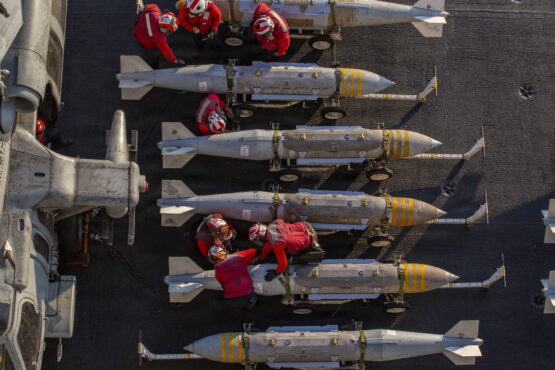
US sailors prepare ordnance on the flight deck of USS Abraham Lincoln, on February 28, the opening day of the War with Iran. Source: US Navy
Iranian state media hasn’t been consistently updating the civilian death toll. The US-based Human Rights Activists News Agency reported on March 29 that 1,574 civilians had been killed in airstrikes along with 1,211 military fatalities and more than 700 “unclassified” deaths.
Trump has said 13 000 military targets were struck, while the IDF said on Wednesday they had carried out 10,000 airstrikes on 4,000 “terrorist targets” using 16,000 different munitions so far. Israel has killed 2 000 Iranian military personnel and some 40 senior state officials, the statement added.
ADVERTISEMENT:
CONTINUE READING BELOW
An IDF illustration shows that attacks have been heavily concentrated in Iran’s western and northwestern provinces, Tehran and the center of the country, including Isfahan. Seven categories are used to define targets, including “nuclear program” and military sites. A large number of strikes are categorized as “regime targets” and “terror infrastructure” without being specific.
The capital Tehran is a sprawling, densely populated metropolis that’s surrounded by mountains. Offices and buildings that are used by the police and the Basij paramilitary forces are scattered throughout the city.
Long delays on satellite imaging imposed by US companies have also made it impossible to assess damage in real time. Ten days into the war, San Francisco-based Planet Labs PBC extended a four-day delay on commercial satellite imagery in the Middle East to two weeks, citing security concerns over their use by adversarial states.
The first days of war, which started on February 28, included some of the deadliest attacks on civilians. A strike on a school in Minab in southern Iran killed 168 people including 100 children, according to Iranian state media. Reuters has reported that US military investigators believed it was likely the US was responsible for the attack. The US has said it’s investigating.
In the early hours of Saturday morning, an Israeli airstrike on the Tehran suburb of Sa’adat Abad destroyed a residential building. One of the residents had fled to a town on Tehran’s outskirts with his wife and daughter during the second week of the war, returned in the aftermath to find his home partially destroyed and uninhabitable.
He had tried to retrieve documents and possessions before looters could get to them first, something he had heard was now commonplace at attack sites. He said an elderly lady who lived in an apartment on the building’s top floor had been killed after the strike caused the entire roof to collapse.
The businessman in Isfahan said one of his companies is surrounded by damage from airstrikes. The bombing of industrial facilities strikes at the heart of Iran’s economy as well as ordinary workers, he said.
Meanwhile, Iranians are dealing with the bombardment in different ways. “People here are going to bed on tranquilizers,” the businessman said. “Younger people seem to be completely detached and trying to get on with their lives, going to cafés while there’s a massive bomb crater 30 meters away.”
© 2026 Bloomberg
#Iranians #reel #USIsraeli #attacks #civilian #infrastructure