
The sharp increase in fuel prices – leading to expectations of higher inflation and the possibility of interest rates staying higher for longer – will force most households to relook their monthly budgets. This includes buying food, especially if higher transport costs reverse the slowing in food inflation in recent months.
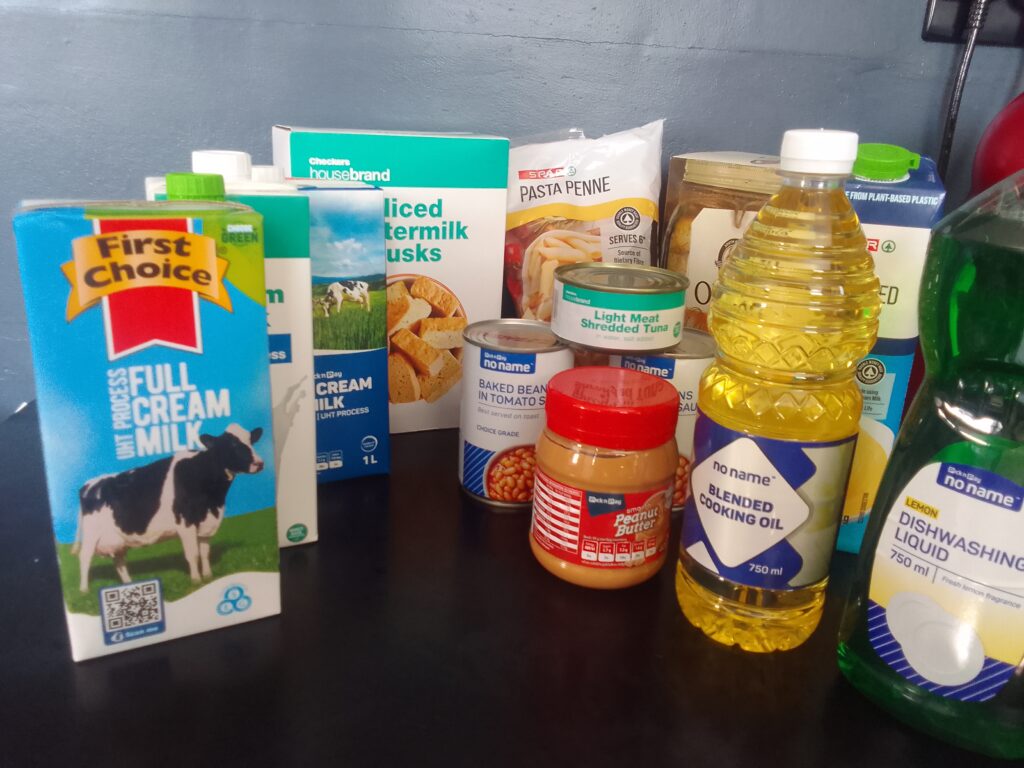
One way of taming the food bill is to look at retailers’ house brands, which sometimes offer significant savings compared to the usual branded products.
Read:
No April Fools’ joke: Diesel still rockets over R7/l, petrol over R3/l
The fuel price challenge
A quick look at a selection of house brands at the bigger supermarkets shows that a house brand is some 20% cheaper than a branded product. In some cases, they are as much as 50% cheaper.
A quick walk through four retailers is far from a proper survey, but it still highlighted a few basics – and delivered a few surprises.
The biggest surprise is that house brands are not always cheaper.
One tricky aspect is that each retail chain had special offers that made it difficult to compare the prices of different products in-store and between retailers.
The methodology for the limited comparison was simple. We collected the regular retail prices of some 20 house brand products at Checkers, Pick n Pay, Spar and Woolworths, as well as the prices of a popular branded product of each. The shops were situated within a 2km radius.
Shoprite, Usave and Boxer were not included as their stores were further away and situated in areas that could be seen to have a distinctively different target market. We also ignored the irritating pricing that endes in 99c, rounding these up to a rand.
ADVERTISEMENT
CONTINUE READING BELOW
Listen: Private label boom: More South Africans are ditching name brands [Apr 2025]
The outcome of the informal study suggests that Pick n Pay offers the widest range of products under its No Name brand, and that these products are generally cheaper than that of the other retailers. It is also starting to stock a new house brand under the Pick n Pay logo.
Premium
It is probably wrong to compare Woolworths premium products to Pick n Pay’s No Name brand or Checkers’s Housebrand.
Woolworths is not aimed at shoppers looking to save money. It is positioned as a quality brand for organic products, produce that adheres to fair trade agreements, and those that are produced under strict sustainable conditions.
A good example of this is a tray of 30 eggs selling at Checkers at R70, but R175 at Woolworths. However, the eggs at Woolworths are organic and free range.
The same goes for other products. Rooibos tea and tomato sauce are nearly twice the price at Woolworths, but both are certified to be organic.
The biggest difference was in the price of a packet of pasta – R50 at Woolworths and R16 to R20 for either a branded or a house brand product at the other retailers. Pick n Pay had a special offer of two packets pasta for R28.
|
Branded groceries vs house brands |
|||||
| Branded | Checkers | Spar | Pick n Pay | Woolworths | |
| Milk | 20 | 17 | 20 | 17 | 20 |
| Tuna | 24 | 22 | 24 | 22 | 29 |
| Baked beans | 16 | 13 | 15 | 12 | 17 |
| Rusks | 65 | 54 | 60 | 50 | 80 |
| Eggs (30) | 70 | 70 | 85 | 80 | 175 |
| Toilet paper | 58 | 74 | 95 | 70 | 80 |
| Dishwashing liquid | 35 | 30 | 40 | 27 | 50 |
| Tea | 40 | 29 | 30 | 27 | 50 |
| Tomato sauce | 43 | 28 | 39 | 25 | 50 |
| Cooking oil | 37 | 37 | 37 | 32 | 40 |
| Rice (2kg) | 43 | 30 | 30 | 44 | 42 |
| Tinned peaches | 43 | 24 | 25 | 26 | – |
| Oats (1kg) | 33 | 37 | – | 39 | 42 |
| Peanut butter | 50 | 40 | 47 | 40 | 52 |
| Fruit juice concentrate | 30 | 15 | 15 | 17 | 77 |
| Pasta | 20 | 16 | 19 | 14* | 50 |
| * Product on special: Two for R28 | |||||
Source: In-store survey
ADVERTISEMENT:
CONTINUE READING BELOW
Leader
Pick n Pay is the leader in house brands. The group introduced its recognisable blue-striped No Name brand in 1976 and offers more than 3 000 products in this range, according to its annual report.
The new Pick n Pay brand looks better, with more graphics on the packaging – similar to that of Spar.
It is interesting that a branded packet of toilet paper was 17% cheaper at Checkers than the cheapest house brand at the four retailers.
Jungle Oats was also cheaper at Checkers than any of the house brands, as was eggs. The price of cooking oil did not differ much.
The biggest price differences between branded products and house brands were for peanut butter (R50 for Black Cat compared to R40 for the Checkers and Pick n Pay brands) and tinned peaches (R44 for the branded product and R27 for Checkers Housebrand).
Spar house brand products were more expensive than those of Pick n Pay and Checkers (on the products that were compared).
Branded fruit juice concentrate is double the price of house brands, raising the question of whether the kids will be able to tell the difference.
The proof of the pudding …
ADVERTISEMENT:
CONTINUE READING BELOW
Opinions on the quality of house brands differ. Some shoppers will say that there is no difference between packets of rice and jars of milk.
There is a high probability that some of the products come from the same suppliers. If not the same producers, suppliers use the similar ingredients, methods and equipment to produce the different brands.
Other shoppers will be quick to criticise a no-name dish washing liquid as being watery or a cheaper tomato sauce as being inedible.
Packaging gives little away. The packaging on all the house brands state that the products were specially packed for the specific retailer. Some products have a supplier code, but many don’t.
The labels that disclose the ingredients and nutritional information shows little difference between many of the products, even if one’s taste buds beg to differ.
A closer look at Ouma buttermilk rusks and the same offered by Checkers Housebrand shows the same ingredients, except that the Checkers product also contain eggs, which are absent from the Ouma rusks. Woolworths’s more expensive rusks contains all kinds of fruits and nuts that more mundane rusks do not.
The biggest surprise of the flash survey was that Woolworths, home of the most expensive brands, was the busiest of all the shops visited on Friday morning. A reason might have been that it was raining on Good Friday and the more affluent among the hungry went shopping because they had little else to do.
Another reason might be that those shoppers prefer quality over price.
#Battle #house #brands