
The White House announced the US would hold direct talks with Iran even as continued fighting in the Middle East, punctuated by Israeli strikes in Lebanon, threatened to derail the fragile ceasefire in the six-week conflict.
Press Secretary Karoline Leavitt said Vice President JD Vance will lead a delegation to Islamabad, which would include special envoy Steve Witkoff and Jared Kushner. The first round of talks is set for Saturday morning local time, even as the Strait of Hormuz remained largely closed as of Thursday morning, falling short of a key US condition for the ceasefire.
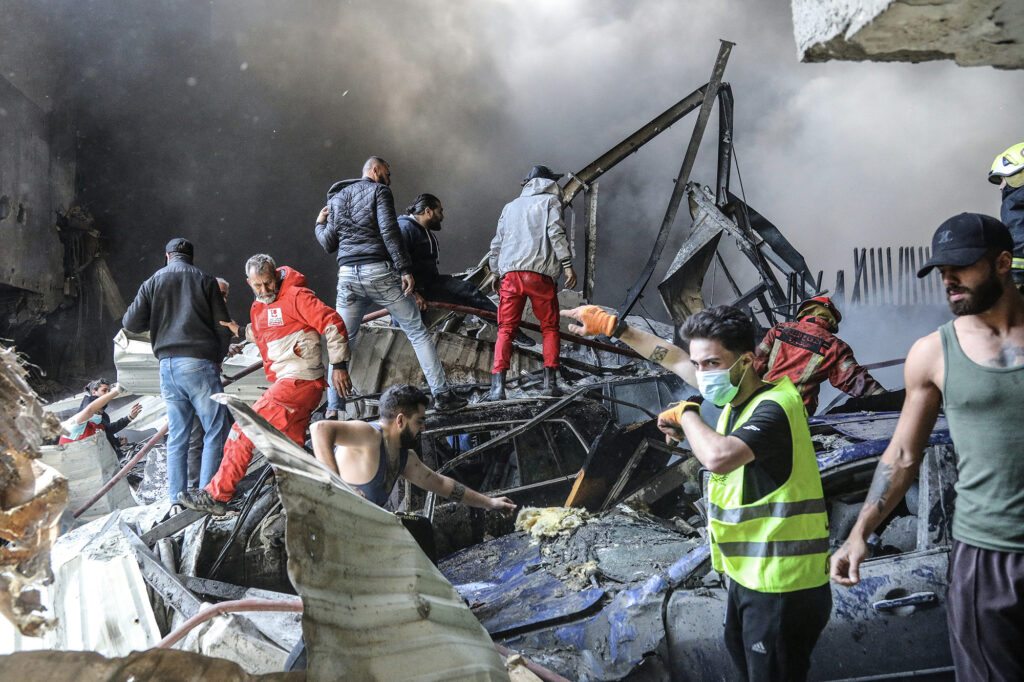
Sporadic fighting continued throughout the region, including in Lebanon, where Israel launched its largest assault on the country since the start of the latest conflict, escalating the campaign against Iran-backed Hezbollah. Iranian officials cast that as violating the terms of the day-old agreement.
“The Iran–U.S. Ceasefire terms are clear and explicit: the U.S. must choose—ceasefire or continued war via Israel. It cannot have both,” Iranian Foreign Minister Abbas Araghchi said in a social media post.
In a separate post, Iranian Parliament Speaker Mohammad-Bagher Ghalibaf cited fighting in Lebanon, an alleged drone incursion into Iranian airspace and the “denial of Iran’s right to enrichment,” saying that such conditions make a bilateral ceasefire or negotiations “unreasonable.”
Leavitt reiterated Wednesday that President Donald Trump expected the Strait of Hormuz to be “reopened immediately.”
Trump said in a social media post that US military personnel and weaponry would remain in place around Iran “until such time as the REAL AGREEMENT reached is fully complied with.” If Iran doesn’t comply, ‘the ‘Shootin’ Starts,’ bigger, and better, and stronger than anyone has ever seen before,” he said.
Iran’s semi-official Fars news agency reported that the passage of oil tankers through the strait was halted after Israeli strikes. Vance countered that assertion, saying “we are seeing signs that the straits are starting to reopen.”
ADVERTISEMENT
CONTINUE READING BELOW
Vance, who was traveling in Hungary, told reporters “we’re on the right track” in negotiations and said of Ghalibaf’s statement: “I actually wonder how good he is at understanding English” because some of his comments “didn’t make sense.”
The vice president added that Israel had agreed to “check themselves a little bit in Lebanon” to support negotiations. Hezbollah said it fired rockets toward Israel in response to a “violation of ceasefire,” Agence France-Presse reported.
More than 800 freighters are stuck inside the Persian Gulf, mostly waiting to leave, and shipowners and insurer groups have warned that more details will be needed to determine if safe transit is possible. Just three ships were observed leaving the region on Wednesday, according to ship-tracking data compiled by Bloomberg. In normal times about 135 ships cross daily.
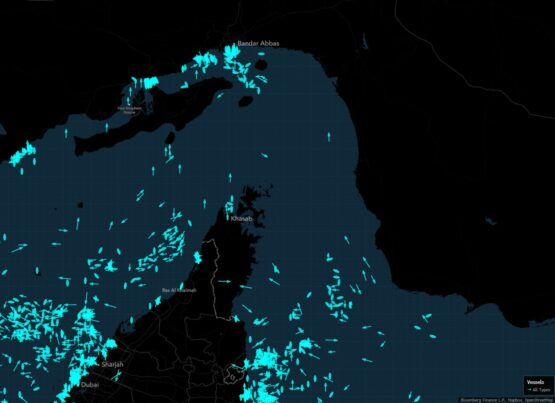
Ships of all types were seen on Wednesday morning clustered on either side of Hormuz, around Dubai in the Persian Gulf and Khor Fakkan in the Gulf of Oman.
The Israeli military said it struck more than 100 Hezbollah targets within 10 minutes. Prime Minister Benjamin Netanyahu said the campaign had set back Iran’s capabilities but that the war was not over.
Trump said earlier Wednesday that Lebanon was not part of the ceasefire but expressed confidence that the campaign would not undercut the broader agreement.
French President Emmanuel Macron, in a post on X Wednesday evening, condemned the Israeli strikes in Lebanon that he said caused heavy civilian casualties.
Trump lashed out at NATO following a meeting with Secretary-General Mark Rutte, underscoring tensions after allies declined to help protect shipping in the Strait of Hormuz or allow US bases to be used in strikes on Iran.
Trump’s ceasefire announcement Tuesday night in Washington marked a retreat from threats to unleash massive devastation on Iran, easing fears of a protracted global energy crisis. Oil prices plunged more than 17% on news of the agreement.
A surge in global equities fueled by the ceasefire lost momentum after Tehran said several terms had been breached, highlighting lingering uncertainty in markets. Oil climbed, with Brent up by about 2.5% as Asian markets opened on Thursday.
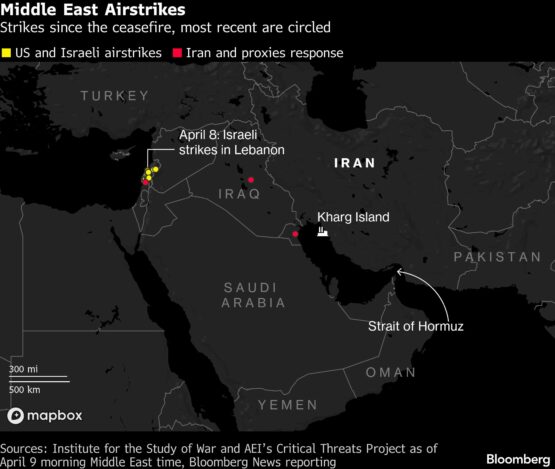
Trump made conflicting claims about the deal, including suggesting a joint US-Iran toll system for ships in Hormuz. Leavitt said that proposal had not been accepted.
“That’s not something we’ve said that we’ve definitively accepted,” Leavitt said. “The joint venture is something that was proposed by the president, but he was very clear in his statement last night — he wants to see the strait reopened, immediately, without limitation and that’s something we’re going to hold them to.”
ADVERTISEMENT:
CONTINUE READING BELOW
Trump also said Iran had undergone a “regime change,” even though there have been no signs this week that new leadership had taken hold. He indicated the US would use its 15-point plan as the basis of negotiations with Tehran, while remaining open to sanctions relief.
Leavitt said Iran’s earlier proposal was “unacceptable” but that a revised plan had been submitted.
Iran’s demands include its continued control of Hormuz, acceptance of its nuclear-enrichment activities, the lifting of all primary and secondary sanctions, and a withdrawal of US combat forces from the region, according to a statement by its Supreme National Security Council carried by state media.
Missile and drone attacks continued across the region, raising questions about enforcement. Saudi Arabia’s oil pipeline was hit by a drone strike, according to a person familiar with the matter.
Trump’s announcement represented a dramatic climb-down from a warning earlier Tuesday that “a whole civilization will die tonight, never to be brought back again” if Iran didn’t yield. His threatened attacks on Iran’s civilian infrastructure, including power plants, may have been considered war crimes if they were carried out. More than 5,300 people have died in the near six-week war.
Trump reiterated there would be no uranium enrichment, while Netanyahu said highly enriched uranium would be removed from Iran, one way or another.
Trump also proposed 50% tariffs on countries supplying weapons to Iran, It’s unclear how he would follow through on that threat, since the US Supreme Court curbed his authority to impose certain levies unilaterally.
© 2026 Bloomberg
#Vance #lead #Iran #talks #Tehran #ceasefire #violated