
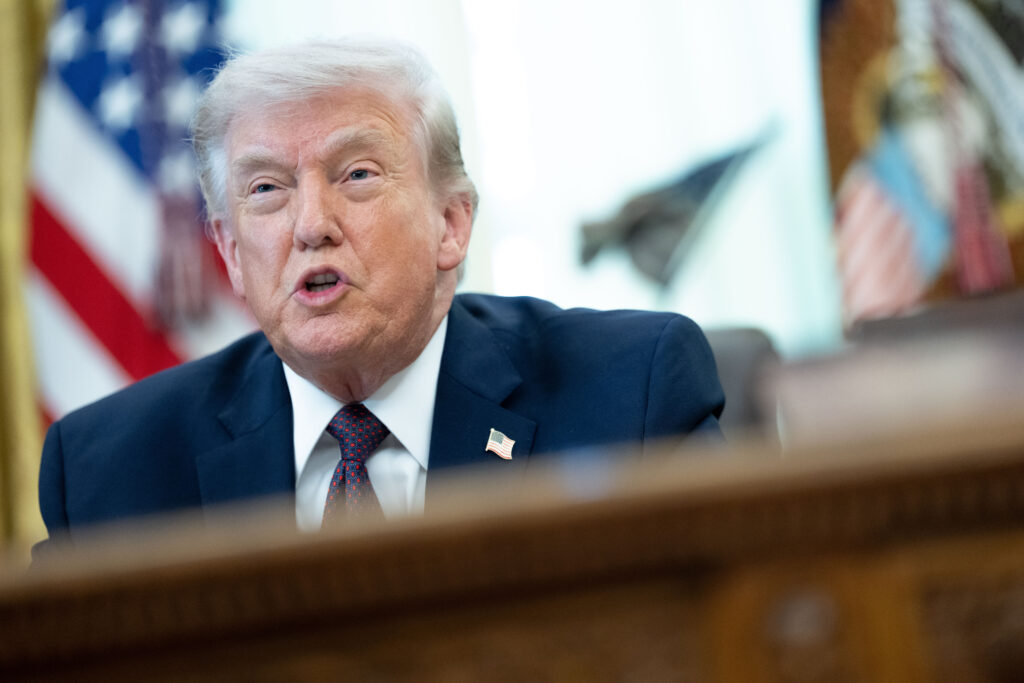
A year after launching his borderless economic war, US President Donald Trump now finds himself trapped in a physical war of attrition that has dragged the whole world into an economic quagmire …
Trump initiated the first international war of his second presidency from the lawns of the White House just over a year ago.
The Liberation Day tariffs announced that day represented the most perverse and pervasive execution of his long-stated grand plan of resetting the world’s economic order in favour of an America whose return to greatness defined his entire presidential approach.
Read:
Trade can be an ‘act of war’ – Warren Buffett
Trump boosts tariffs across world, reshaping global commerce
Strike-down of Trump’s tariffs offers no long-term clarity for anyone
In Trump’s view, trade deficits that resulted from the US buying more from a country than it sold to it represented a form of cheating that he had been appointed to address.
Lost in translation was the reality that America’s consumer market is much wealthier than that of many of its competitors, as well as the simple fact of the uneven distribution of natural and resource endowments across the globe.
The consequence of this natural imbalance is that US consumers will consistently and decisively outspend the citizens of Lesotho – any pursuit of trade parity between the two countries would therefore be a senseless exercise.
Tariffs as a weapon
Trump’s conflation of his ill-conceived economic rhetoric and his ill-advised political rhetoric meant that his fixation on punishing some nations and getting every other nation to fall in line undermined the essence of his tariff modelling.
When the reality of how arbitrary it all was became clear, retreats and carve-outs became the order of the day. When the dust settled, global markets had been rattled and then stabilised.
Various nations embarked on diplomatic projects aimed at securing a deal that both countries could at least read and make sense of – without the guarantee that the US would always honour the spirit.
ADVERTISEMENT
CONTINUE READING BELOW
Read:
Beyond Trump’s pointless pause
Between debt, aid and diplomatic surrender, Africa’s dependency problems run deep …
What became clear through the chaos was that the global economic system has over many years become disproportionately dependent on the US being a logical and trusted trade partner – and which had, for many years, turned out to be largely logical even if self-serving in its engagements with global trade partners.
These interdependencies – ranging from payment and settlement systems, trade currencies and trading protocols – meant few countries could wean themselves off the US system overnight.
Rather, the process ushered in a revival in deliberations around global trade systems and how they could be insulated from the impulsive instincts of one role-player whose behaviour and commitment to agreed rules has grown ever less predictable.
The immediate fallout from the tariff war was the reintroduction of anxiety into the global markets – something many central bankers had hoped was a thing of the past.
Having forced citizens to stomach the pain of the long process of correction from the disruptions of the Covid-19 pandemic, central banks across the globe had transitioned from a period of ‘higher-for-longer’ interest rates to some form of stability that was cut short by Trump’s antics, which reignited concerns over inflation and recession.
‘Trusted’ trade partner
As the reputation of the US as a trusted trade partner was decimated, long-delayed and difficult discussions about forging new trade alliances were suddenly accelerated.
South Africa – which had to deal with both the economic and political brunt of Trump’s hysteria – engaged in a process of being measured against the chaos and hoping that the merits of its deliberations would prevail.
The problem is that few issues can keep Trump’s mind engaged for long and surprisingly, he allowed the renewal of the African Growth and Opportunity Act (Agoa), with South Africa included.
The curious thing about Agoa is that it essentially is an instrument of Trump’s greatest grievance – allowing other countries to access the US markets favourably to improve their own trade outcomes.
ADVERTISEMENT:
CONTINUE READING BELOW
Listen/read:
Agoa extended – and SA is included
Trump’s tariffs have gutted Agoa’s duty‑free promise
In its design, it formed part of the US’s soft power regime, which regarded the minor economic concessions as negotiation instruments in the pursuit of stronger diplomatic ties or – as some might argue – extending dependencies so the countries would tread carefully in matters relating to the US.
As the first anniversary of the Liberation Day tariffs approached – with the actual achievements of the tariffs still dubious – Trump moved on to an actual war.
The US and Israel launched attacks on Iran, and much like the sparse logic underpinning the tariffs of 2025, the motivation for the war against Iran proved elusive, even to America’s longstanding allies.
The shift to Iran
The problem with the war against Iran is that it isn’t limited to the aggressors and their targets.
As a country that has the great fortune of being geographically located along the shipping routes where much of the world’s oil has to transit, Iran had the ability to invoke its control of the Strait of Hormuz to inflict acute pain on most nations on the globe through a squeeze in oil prices.
Read/listen:
Oil trading costs have surged since Iran war began
Iran deputy minister says ships need consent to pass Hormuz
Iran ceasefire offers short-term relief, long-term risks remain elevated
Unsurprisingly, it activated this – and as the war escalated, so did the oil price. Suddenly, a war between a few nations created immediate economic casualties everywhere.
The spike in oil prices forced countries to raid their reserves and treasuries in order to insulate citizens from the dramatic increases.
One can hardly find it surprising that Iran went for this option, as it essentially forced the US to explain itself to its allies and citizens and justify whether the pain was all worth it.
Trump’s reaction – threatening to bomb Iran “back to the Stone Age” – didn’t on its own swing the pendulum as no one really knew if he was serious about this threat.
ADVERTISEMENT:
CONTINUE READING BELOW
What was known is that even if Iran took him at his word and conceded on reopening the Strait, no deal is binding on Trump and none of the oft-invoked processes of de-escalating conflicts could be expected to be honoured by him.
Post-Trump expectations
The fragile truce that was eventually implemented does not provide long-term assurance of de-escalation. It instead provides a window of reflection.
For many countries, it is an opportunity to ponder how – within a period of less than a year – the global economic system has been exposed as fundamentally flawed and what needs to be done to address this.
One option – which is probably ill-advised – is to assume that the end of Trump’s term will usher in a return to the ways of yesteryear, and all we have to do is simply bide the time.
That option works on the premise that the Republican Party will have a political identity that is distinct from Trump.
However, given the popularity of his Maga (‘Make America Great Again’) movement that delivered him to the White House twice, the next Republican candidate may simply tap into the Maga pulse and continue the Trump doctrine.
Read:
Ceasefire and oil prices: Ongoing uncertainty vs what we know
Putin secures another strategic ally as Trump focuses on Iran
The second – and more pragmatic – option is for countries across the world to treat this moment as an opportunity to reduce their dependence on the US and formulate alliances capable of withstanding the whims of individuals whose political orientation runs counter to the globalist model that has defined the world of modern capitalism we all find ourselves beholden to.
Alternatively, we could all wait for Trump to find his next hobby – one that will hopefully be less destructive to the world than those he has pursued over the past year.
#Searching #Trumps #hobby