
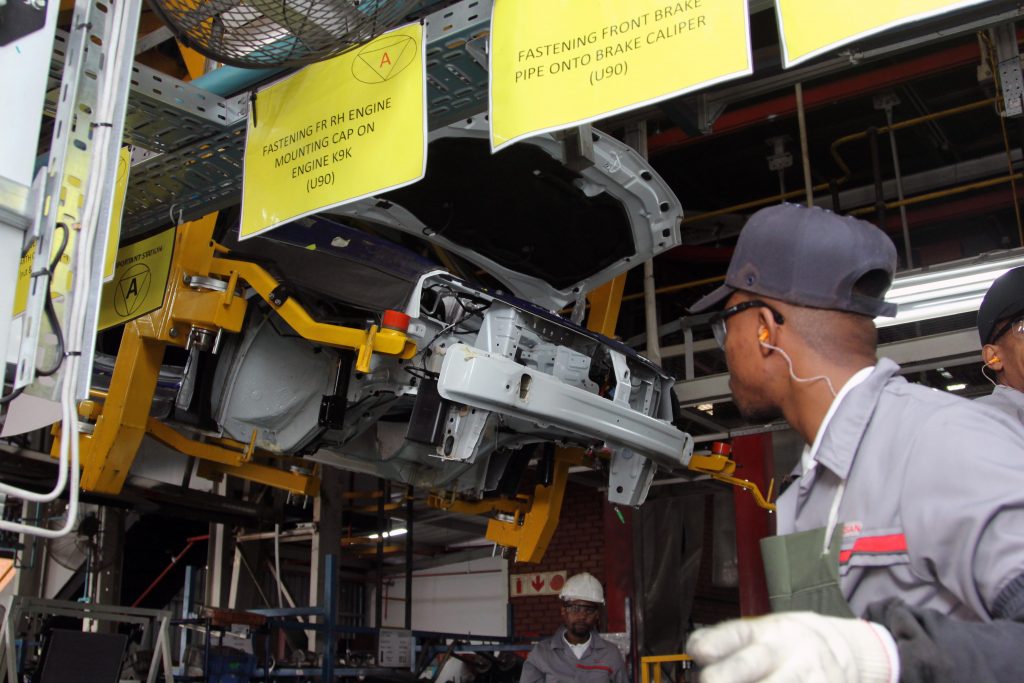
Leaders of some of South Africa’s long-standing automotive manufacturers are calling 2026 a “make-or-break year” for government to decide whether it really wants a long-term sustainable automotive manufacturing sector – or put up an alternative path that generates as much employment and economic value.
The vehicle and components manufacturing sectors contribute almost a quarter of SA’s manufacturing output (22.6%), while automotive manufacturing and retail together contribute approximately 5.2% to GDP.
Read:
Motor city Nelson Mandela Bay is buckling under a tide of Asian imports
Doubts emerge over Volkswagen’s future in South Africa
More than 115 000 people are directly employed in vehicle and component manufacturing, with 40% based in Nelson Mandela Bay, the country’s automotive hub. An estimated 500 000 people are employed across the sector’s broader value chain.
Around seven of every 10 locally-manufactured vehicles are exported, contributing almost 15% of SA’s total export value.
Original equipment manufacturers (OEMs) are under threat from a diverse set of global challenges – including protectionist tariffs by the US, the shift to new energy vehicles (NEVs) in key markets, rapid advancements in manufacturing technology, and the rise of cheap imports from Asia displacing local sales.
Deteriorating local business conditions – including infrastructure, electricity, water, basic service delivery, logistics, crime – increase the costs of doing business, as do the costs of electricity and fuel in particular.
This has eroded competitiveness, while government’s industrial policy has not kept pace with the global shifts.
Despite rising local sales and exports, actual automotive production, local content and employment are tracking significantly below the targets of the SA Automotive Masterplan 2035.
This highlights a widening gap between current industrial conditions and the vision set in 2021.
New investments, but what level of local value?
Recent months have seen announcements of new and forthcoming auto investments, primarily by Chinese manufacturers.
Chery has purchased the Nissan plant in Rosslyn and expects to roll its first locally made vehicles off the production line sometime in 2027, after plant retrofitting and upgrades. The facility is reportedly set to produce both NEVs and internal combustion engine vehicles, with speculation pointing to a pick-up model aimed at both SA and broader African markets.
Foton announced in March that its first overseas manufacturing base, located within the BAIC plant in the Coega Special Economic Zone (SEZ) in Nelson Mandela Bay, has begun completely knocked down (CKD) production of its Tunland bakkies.
Geely has re-entered the local market, signing up a raft of local dealerships and signing an agreement with China National Building Materials South Africa (CNBM SA) to support the coordinated development of NEVs, charging infrastructure and “localised supply chains”.
GWM is also reportedly weighing options for local manufacturing of a vehicle yet to be decided, either by sharing or acquiring an existing facility.
ADVERTISEMENT
CONTINUE READING BELOW
While it is encouraging that new investors are entering the market, it is vital that these are measured against actual local economic value addition and the creation of much-needed, sustainable local jobs in their operations (not only short-term construction jobs) and the surrounding components supplier ecosystem.
These investments should incorporate targeted plans to achieve the 60% local content goal of the SA Automotive Master Plan and a balance of supply of fully assembled vehicles to both domestic and export markets.
Imports taking hold … and taking jobs
Local manufacturers are rapidly losing ground to imports in the domestic market – from nine of the top 10 best-selling vehicles being made locally in 2015, down to just five in 2025.
Of the top 10 best-selling automakers in the domestic market, only four now represent investment in local manufacturing, the balance are importers mostly from Indian and Chinese manufacturing plants.
Read:
Can South Africa retain its industrial position on the continent?
SA auto sector faces perfect storm
Most concerning is the decline in CKD manufacturing – a key driver of local investment, employment, and deeply embedded supply chains – from a high of 56% to just 33% over the past two decades.
Thus, on the one hand, we have a local manufacturing sector under threat, even though domestic vehicle sales and exports hit record highs last year, and on the other hand, the country is welcoming new investments in the sector.
Warning bells of deindustrialisation being sounded by established auto manufacturers, industry bodies, economic commentators – and even labour unions that usually take an opposed position – may seem contradictory at a time when the country is attracting new foreign industrial investment.
New investments that bring competition on an equal footing to local manufacturing and give consumers greater choice and affordability are to be welcomed.
Read:
China’s Chery plans multi-billion-rand car plant at old Nissan Rosslyn site
Isuzu mulls manufacturing a SUV at its Gqeberha plant
Mahindra backs SKD production to attract major auto investment to SA
BMW SA plans to export the new X3 SUV to the US
Equally, new investments that convert previously fully-imported brands into locally-made vehicles, generating industrial employment, are on the face of it a positive development.
This has the potential to reverse the current situation where sales of cheaper imports have risen to outstrip sales of locally-built vehicles.
CKD vs SKD vs ‘WICKD’
However, there is a distinct difference between the type of manufacturing undertaken by incoming investors versus that of long-established OEMs such as BMW in Tshwane, Toyota in eThekwini, Volkswagen and Isuzu in Nelson Mandela Bay, and Mercedes-Benz in East London.
These OEMs operate full CKD manufacturing facilities, including on-site press and paint shops, and achieve high levels of local content – typically 30-40% – supported by a broad and highly developed supplier base.
This includes wheel and tyre production, metal pressing for chassis and body components, brake discs and pads, side-impact beams, seatbelts and other safety-critical parts, as well as plastics manufacturing for door panels, bumpers and dashboards. It also extends to wiring harnesses, windscreens, seats, and vehicle security and tracking technologies.
In order to meet localisation targets, the OEMs have actively supported local investments by these component manufacturers, which have generated additional employment in deepened value chains, and added economic value across diverse secondary and tertiary sectors.
ADVERTISEMENT:
CONTINUE READING BELOW
Sustaining CKD volumes is critical to preserving the local automotive industry, along with its value creation and socio-economic benefits.
CKD has high investment value and costs, but it is transformative in the economy.
Semi knocked-down (SKD) assembly, on the other hand, is a cheaper investment but its economic impact is shallow, involving vehicles imported in ‘kit form’ for local assembly.
Typically it involves minimal to no exports, low volumes, some low-tech employment creation in assembly, but minimal local content as most of the components are imported, and thus minimal impact in diversified, local value chains.
Some recent investments, such as Mahindra’s plant inaugurated last year in the Dube TradePort SEZ in KwaZulu-Natal, represent SKD assembly.
Of even greater concern than the rise of SKD assembly, which the current Automotive Production and Development Programme (APDP) actually incentivises, are the announcements by more recent investors that they are performing CKD manufacturing.
What is hidden, though, is that while they may be building vehicles from the ground up rather than importing them in kit form, they are using entirely imported components.
As a result, these investments bring little to no skills or technology transfer, and little to no localisation, so eroding the market for local component manufacturers.
Their volumes are small, mostly targeting the local market, and thus generating little export value for SA.
We are calling this WICKD – ‘wholly imported completely knocked-down’ production – and it is the most recent, and arguably most dangerous, threat to genuine local CKD manufacturing and its surrounding ecosystem.
These manufacturers own their entire supply chain and have excess capacity in their own markets, so they have no incentive to localise component manufacturing as the traditional OEMs do.
Contested terrain
This may seem like a contest between established brands and incomers, the old guard and the new, or West versus East (although Japanese brands count among SA’s ‘established’ OEMs), but it is really about what kind of investment the country wishes to attract – and crucially, the policy measures required to ensure that such investment creates sustainable jobs and delivers meaningful value to the local economy.
While automotive industry bodies such as Naamsa and Naacam, and business organisations including the Nelson Mandela Bay Business Chamber – located in South Africa’s automotive hub – are calling for greater protection and support for local vehicle manufacturing and employment, there is rising concern that the APDP, which supports domestic automotive production, comes at a significant cost to taxpayers and contributes to higher new vehicle prices.
Listen/read:
Chinese brands gain ground as affordability drives strongest car sales in a decade
Strength of the rand is ‘good news’ for new vehicle prices
The dtic considers ad valorem tax changes to lower car prices
However, the arguments against the APDP neglect to consider the complex ecosystem around automotive manufacturing, including component manufacturers, dealerships, service and fitment centres, and aftermarket parts wholesalers and retailers.
Added to that is the value chain of suppliers of logistics, commodities and services to these businesses – creating a substantial employment multiplier, and generating incomes that in turn support tertiary sectors such as transport, retail, tourism, financial services, healthcare and education.
ADVERTISEMENT:
CONTINUE READING BELOW
Either way, what automotive (and other) manufacturers urgently require is clarity and a firm direction from government on policy and the type of manufacturing SA wants to attract.
Ideally, the country should continue to push for increasing local content and for new manufacturing entrants to use local component suppliers, if we are retain to jobs in the auto manufacturing ecosystem.
Alongside this, these manufacturers should also bring access to export markets beyond SA, to enable growth beyond the domestic market and ensure that they are not just displacing domestic sales – cutting an existing cake into smaller slices.
Read:
Can South Africa retain its industrial position on the continent?
How SA auto manufacturers can take advantage of global shifts
However, if SA chooses to move towards SKD and WICKD models, allowing deep local manufacturing capacity to wither, then a clear plan is needed – we can’t simply pull the rug out from under a sector that accounts for almost a quarter of manufacturing output and half a million jobs.
Focus then needs to turn to reinventing manufacturing in new sectors, filling global gaps, pursuing low-carbon manufacturing, retaining skilled employment and industrial capacity, and incentivising innovation and high-tech production.
This will require a clear roadmap with defined actions and timelines, to avoid it being too late to prevent wider knock-on effects.
South Africa’s policymakers have hard choices to make.
It is clear that the APDP is no longer fit for purpose in the rapidly changing local and global landscape. It does not serve the needs of CKD manufacturers, while it has had the unintended consequence of supporting less desirable SKD manufacturing and cheap imports.
Simply increasing import tariffs on vehicles and components is not the solution, as this is a blunt instrument likely to harm consumers more than it benefits manufacturers.
Policy reform is urgent, and must clearly and unequivocally support South Africa’s desired industrial direction.
At the same time, industrial policy reform must be integrated with measures to unblock hurdles to competitiveness and the costs and ease of doing business – a competitive electricity market and reliable supply, logistics inefficiencies, crumbling municipal infrastructure and procurement blockages, corruption, and safety and security.
Read:
Major changes on the cards for SA’s automotive industry policy
First signs of SA auto industry deindustrialising, warns Toyota CEO
Whichever direction automotive and industrial policy reform takes, the change is urgent.
The alternative is losing the bedrock of South Africa’s manufacturing capacity, with no idea or plan on what to replace it with.
Denise van Huyssteen is CEO of the Nelson Mandela Bay Business Chamber.
#threat #SAs #waning #automotive #manufacturing #strength