
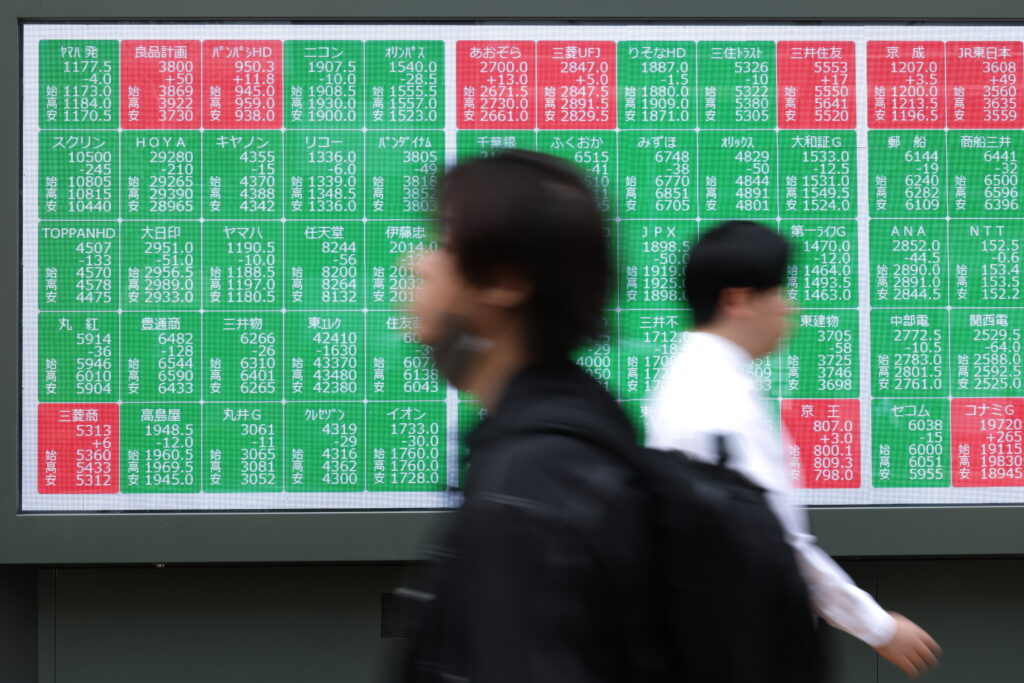
A record-breaking rally in global equities stalled in Asia as investors trimmed positions ahead of the weekend while awaiting progress on extending the US-Iran ceasefire.
The MSCI All Country World Index — the broadest barometer of global stocks — slipped 0.1% after a 10-day rally that drove it to a record high on Thursday. While Wall Street gauges also closed at all-time highs, momentum faded in Asia, with regional shares falling 0.9% as traders awaited signs of progress in talks aimed at sustaining a US-Iran truce set to expire next week.
Equity-index futures indicated European shares would also open lower. Netflix tumbled 9.6% in post-market trading after its second-quarter forecast fell short of analysts’ expectations.
Global crude benchmark Brent dropped 1.3% to $98.10 a barrel after President Donald Trump expressed optimism about securing a permanent ceasefire with Iran. Gold was a touch higher at about $4,800 an ounce, while Treasuries and a gauge of the dollar were little changed in a cautious end to the week.
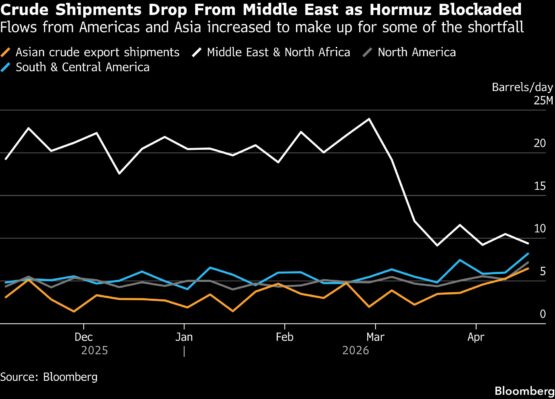
Investors are awaiting progress in talks that could reopen the Strait of Hormuz, easing crude flows and relieving pressure on economies after oil prices surged following the conflict’s onset in late February. While crude has pared its war-driven premium and stocks have climbed to record highs, policymakers are warning that markets may be underestimating the war’s economic toll.
“Markets head into the final session of the week sitting at key technical and psychological levels, with conviction still lacking as traders wait for clearer signals out of the Middle East,” Nick Twidale, chief market analyst at AT Global Markets, wrote in a note.
ADVERTISEMENT
CONTINUE READING BELOW
Trump claimed, without evidence, that Iran had agreed to terms it has long resisted, including giving up ambitions for a nuclear weapon and turning over nuclear material. The deal would also include “free oil” and an opening of the Strait of Hormuz, the President said. The prospects for a deal with Iran are “looking very good,” he said.
Tehran hasn’t confirmed it’s made those concessions.
Earlier, Trump announced a 10-day ceasefire between Israel and Lebanon. His comments on Thursday made no mention of Hezbollah. Israeli Prime Minister Benjamin Netanyahu confirmed in a video message that he’d agreed to the truce.
What Bloomberg’s Strategists Say..
“The US-Iran conflict has clearly calmed down, but there’s very little sign of that leading to a serious resumption in flows of materials out of the Strait of Hormuz. That signals strong potential for crude futures to climb back above $100 a barrel and for equities to retreat from this week’s advance to records.”
— Garfield Reynolds, MLIV Asia Team Leader.
Meanwhile, some Gulf Arab and European leaders believe that a US-Iran peace deal will take about six months to be agreed and that the warring sides should extend their ceasefire to cover that timeframe, according to officials from the regions familiar with the matter.
ADVERTISEMENT:
CONTINUE READING BELOW
Traders are also focused on the dollar, which has weakened after rallying on haven demand since the war began in late February. Deutsche Bank AG and Wells Fargo & Co. are among banks declaring the greenback’s war-driven haven rally is likely over as the fragile ceasefire between the US and Iran prompts investors to seek riskier assets.
Optimism over easing Middle East tensions has helped several equity markets unwind war-driven risk premiums. Benchmarks in Singapore and Taiwan, and China’s CSI 300 Index had all reversed losses that came after the US and Israel attacked Iran in late February.
On Thursday, Japan’s Nikkei 225 Stock Average ended the day at a new record high, erasing its losses from the Iran war on optimism the new peace talks may hasten the end to the conflict. The gauge dropped 1% Friday.
“Asian markets are pricing in a ceasefire extension that does not yet exist,” said Oriano Lizza, a sales trader at CMC Markets in Singapore. “The Nikkei has soared past its February record, while Brent crude has steadied above $94 per barrel after whipsawing at the start of the week. These moves have relied on diplomatic signals rather than a signed deal. That sets up real risk in current market positions.”
Corporate News:
- Netflix Inc. slid in after-hours trading after issuing a second-quarter forecast that missed analysts’ expectations.
- Ericsson AB earnings missed analysts’ forecasts in the first quarter, as the Swedish company struggled in a weak market for telecommunications equipment and rising chip costs.
- Apple Inc.’s marketing executive in charge of the Apple Watch, AirPods, health and smart home initiatives said he’s retiring, marking a changing of the guard for a series of key product lines.
- TSMC’s Taipei-listed shares fell as much as 1.9% on Friday, due in part to investor unease over the chipmaker’s heavy reliance on a small number of hyperscaler customers.
Some of the main moves in markets:
Stocks
- S&P 500 futures were little changed as of 6:50 a.m. London time
- Nasdaq 100 futures were little changed
- The MSCI Asia Pacific Index fell 0.9%
- Japan’s Topix fell 1%
- Australia’s S&P/ASX 200 fell 0.2%
- Hong Kong’s Hang Seng fell 1.2%
- The Shanghai Composite was little changed
- Euro Stoxx 50 futures fell 0.1%
Currencies
- The Bloomberg Dollar Spot Index was little changed
- The euro was little changed at $1.1782
- The Japanese yen fell 0.2% to 159.47 per dollar
- The offshore yuan was little changed at 6.8247 per dollar
- The British pound was little changed at $1.3520
Cryptocurrencies
- Bitcoin fell 0.7% to $74,689.81
- Ether fell 1.2% to $2,321.29
Bonds
- The yield on 10-year Treasuries was little changed at 4.32%
- Japan’s 10-year yield advanced 1.5 basis points to 2.415%
- Australia’s 10-year yield advanced four basis points to 5.00%
Commodities
- Spot gold rose 0.2% to $4 797.55 an ounce
- West Texas Intermediate crude fell 1.6% to $93.14 a barrel
This story was produced with the assistance of Bloomberg Automation.
© 2026 Bloomberg
#Record #stock #rally #stalls #peace #deal #awaited #Markets #wrap