
An influential former Federal Reserve official says the legal protections barring members of the Fed Board of Governors from removal by the president except for cause should be overturned.
Former Federal Reserve Vice Chair for Supervision Randal Quarles said April 10 as reported by American Banker that he objects to the idea of regulatory independence as a general matter.
But he added that the central bank’s decentralized structure would ensure that the White House would still not be able to dictate monetary policy if such an outcome became a reality.
“I wish we stopped using the word independence — independence about the Fed, independence about executive agencies generally,” Quarles said.
“There is no such thing as an independent agency in our constitutional system, and as a matter of general political first principles, there should not be. We don’t want — and can’t have — an independent Fed,” he added.
Quarles said that despite that constitutional restriction, the central bank’s structure can still keep monetary policy from being dictated by the White House or any other faction.
“What we can have is a system that assures that the monetary policy decisions of the central bank are insulated from short term political direction,” Quarles said. “No one should be able to direct the outcome of the process.”
Warsh Senate hearings stalled over “politicized” subpoenas against Powell
Congress returns to Washington this week with still no word as to when Fed Chair nominee Kevin Warsh will appear before the Senate Banking Committee as President Donald Trump’s pick to replace his nemesis Jerome Powell.
The hearings, originally expected to begin in March, have been left off the committee’s calendar once again as of April 13.
More Federal Reserve:
- Global central banks signal shocking shift on interest-rate bets
But when that day finally arrives, Warsh, a former Fed governor once known for his hawkish views on monetary policy, can expect a slew of questions (and some pretty harsh ones from both parties) in his attempt to succeed Powell when his term as leader concludes in May.
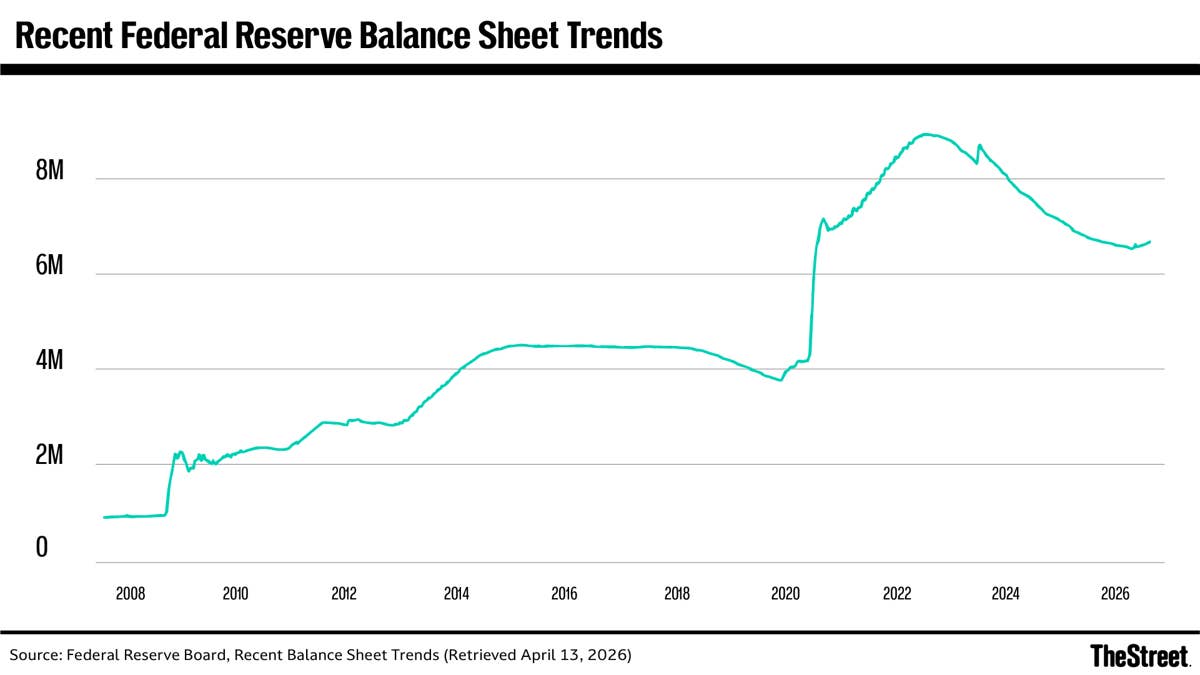
Questions will arise about the Federal Reserve’s role, how it functions, and its impact on the economy, prices, the $6.63 trillion balance sheet and the American workforce.
Trump attacks Powell over interest-rate cuts
Trump, who has repeatedly criticized Powell personally (“a moron’’) and professionally (“Too Late’’) for not slashing interest rates to 1% or lower over the last 14 months.
The president has unsuccessfully demanded Powell resign.
During the months that took place for a search for Powell’s successor, the president vowed he would only nominate a candidate who agreed with his economic agenda including dovish rate cuts.
After Warsh’s name was made public, Trump said he did not approach interest-rate cuts with the nominee.
DOJ criminal probe of Powell stuns global economy
There has been little formal movement to get Warsh in place to take over from Powell, which means as Reuters reported March 7, that the time for a seamless transition is running out.
The process is further complicated by a widely criticized criminal investigation the Department of Justice led by Trump ally Jeanine Pirro has launched against Powell for allegedly lying to Congress about the $2.5 billion cost of the Fed headquarters renovations.
Powell has said the probe is a pretext to pressure him to lower interest rates.
The unprecedented probe has prompted one Republican member of the banking committee, without whose vote the nomination can’t be passed to the full Senate, to delay the process until the Powell investigation is shut down permanently.
Global economists rally around Powell, Fed independence
Powell announced the unprecedented subpoenas in a rare Sunday evening video earlier this year. ”This is about whether the Fed will be able to…set interest rates…or whether…policy will be directed by political pressure or intimidation,’’ the Fed chair said.
A coalition of central bankers and top economists including Janet Yellen, Ben Bernanke and Alan Greenspan immediately issued a joint warning, saying the probe was an “unprecedented attempt to use prosecutorial attacks to undermine (the Fed’s) independence.”
Related: Supreme Court signals Fed independence in Cook firing lawsuit
They went further, explicitly tying the episode to global risk, saying: “This is how monetary policy is made in emerging markets with weak institutions.”
The experts were warning, in the highest economic and legal terms, that the United States risks sliding toward politicized monetary policy, something typically seen in less than stable economies such as, and these are my words, banana republics and Hungary.
Even some Republican and financial leaders warned the politicization of the Fed could:
- Push inflation higher
- Undermine investor trust
- Destabilize bond markets
- These negative outcomes would ripple through the global economy
Federal judge halts Powell probe pending appeal
As of April 13, a federal judge has forcefully pushed back against the subpoenas and has kept them blocked.
Chief U.S. District Judge James Boasberg has:
- Quashed, or tossed out, both DOJ subpoenas targeting Powell.
- Rejected the DOJ request headed by Pirro to reinstate them.
- Effectively halted the investigation for the time being, pending appeal which PIrro has vowed to do.
Quarles takes on role of independent regulators
Quarles also expressed concern about the outcome of two forthcoming Supreme Court decisions, one concerning whether independent regulators are constitutional and another concerning whether Trump’s purported dismissal of Fed Gov. Lisa Cook, which I reported, was lawful.
A Supreme Court ruling is expected this spring on Cook’s case.
Both cases could overturn Humphrey’s Executor v. United States, a 1935 Supreme Court opinion that upheld the constitutionality of independent regulators.
Quarles said he was afraid that the court would strike down independent agencies but make an exception for the Fed, which he said would be regrettable because the exception would undermine the rule and isn’t required to ensure that monetary policy decisions remain sound.
“I think that’s both wrong and unnecessary,” Quarles said. “It’s wrong because it will not be sustainable. If the Supreme Court says, ‘Here’s how the system is supposed to operate: The president has to be able to dismiss entities that execute executive power.
But the Fed, we’ll just magically say, is different,’ then that is an unsustainable solution that will ultimately result in the withdrawal of the necessary insulation from short-term political direction, because that’s just not a good answer,” he said.
Quarles cites roles of regional bank presidents in monetary policy
He concluded that Senate confirmation would also be an impediment to the president undertaking wholesale firings of Fed board members.
Trump himself attempted to move less-conventionalpicks onto the Fed board during his first term, only to have them withdraw for lack of political support.
And if a president were successful in a total Fed overhaul, Quarles said, it must be because there is a strong political desire for a change of policy or approach.
“It is not a slam dunk that the president will be able to get nominees through the Senate,” Quarles said. “For most of my time on the board we did not have six confirmed governors…the board was outvoted on monetary policy decisions, if it came down to it, by the reserve bank presidents, which is how the system is supposed to operate.
Related: Warsh nomination stirs Fed independence fears on Wall Street
#Extop #Fed #official #drops #shocking #message #independence