
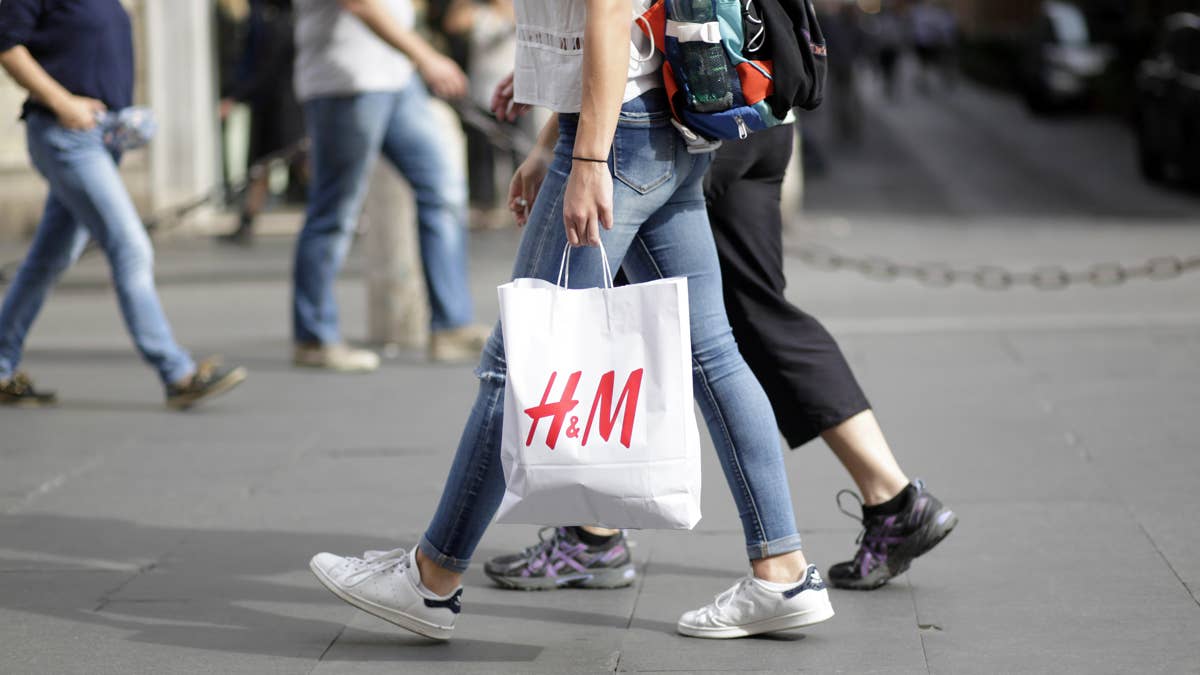
Purchasing clothing has become increasingly more expensive, with apparel prices rising 3.4% year over year in March 2026, outpacing overall inflation, according to data from the U.S. Bureau of Labor Statistics.
As consumers grow more price-conscious, brands are being forced to rethink both value and relevance.
H&M has long been recognized for bridging the gap between luxury and affordability through high-profile designer collaborations. By partnering with some of fashion’s most influential names, the company has aimed to democratize luxury while boosting brand visibility.
Since its first designer collaboration with Karl Lagerfeld in 2004, H&M has launched multiple successful collaborations, including Versace in 2011, Balmain in 2015, Giambista Valli in 2019, and Paco Rabanne in 2023, to name a few.
However, the rapid cycle of trend-driven releases has also drawn criticism. H&M has been cited among the least sustainable apparel companies due to its fast fashion model, which encourages high-volume consumption and short product lifecycles, an issue highlighted in a 2022 lawsuit reported by The Fashion Law.
Now, two decades after one of its most talked-about partnerships, H&M is revisiting the collaboration model with a renewed focus on sustainability and long-term strategy.
H&M reunites with Stella McCartney after 20 years
In May 2026, H&M (HNNMY) will relaunch its collaboration with high-end British designer Stella McCartney, 20 years after their first collection debuted in 2005. The initial partnership was both commercially successful and culturally significant, selling out within days and generating widespread media attention.
At the time, McCartney in a Vogue interview described the collaboration as a “risk,” noting that luxury designers rarely worked with fast fashion retailers. Known for her strong stance on ethical and cruelty-free fashion, McCartney built her brand around sustainability well before it became an industry trend.
After serving as Creative Director of Chloé in 1997, she founded her own label in 2001, positioning it as a luxury brand rooted in eco-conscious and vegetarian principles.
The H&M x Stella McCartney collection’s different approach to fast fashion
The 2026 H&M x Stella McCartney collection aims to revisit iconic designs from McCartney’s archives while making them accessible at lower price points. However, unlike previous collaborations, this collection emphasizes responsible production.
“I’m not an elitist designer, and I’ve always really struggled with the fact that the majority of people who love my stuff can’t get my stuff because of the price point,” said McCartney in the Vogue interview.
To align with her values, both H&M and McCartney have committed to ensuring that each piece is produced using more sustainable methods. This includes a focus on responsibly sourced materials and ethical manufacturing processes, an approach that stands out at a time when some brands have scaled back sustainability commitments.
As part of this initiative, H&M is also launching an Insights Board in collaboration with McCartney to guide future sustainability decisions. The company has reaffirmed its goal of using 100% recycled or sustainably sourced materials by 2030.
This suggests the collaboration is not just a creative initiative, but part of a broader effort to reposition the brand amid mounting sustainability scrutiny and slowing growth.
Shutterstock
H&M’s broader sustainability strategy
H&M has acknowledged its environmental impact and has taken steps to improve transparency and accountability. Over the past decade, the company has introduced several initiatives designed to promote circular fashion and reduce waste.
Programs such as “The Garment Collection,” launched in 2013, allow customers to donate their pre-loved clothing at H&M stores. Meanwhile, its “Take Care” initiative offers repair services, rentals, and second-hand options to extend product lifecycles.
The company also collaborates with external partners and organizations to strengthen its sustainability efforts.
According to its 2025 H&M Group Annual & Sustainability Report, the company now uses 91% recycled or sustainably sourced materials in its products, including 32% recycled inputs.
“We are strengthening our offering and showing that growth, profitability and reduced emissions can go hand in hand,” said H&M CEO Daniel Ervér in a letter.
By 2030, H&M aims to fully transition to recycled or sustainably sourced materials and reduce emissions by 56%.
H&M financial pressures and operational challenges
Despite these strategic shifts, H&M continues to face significant business challenges.
In the first quarter of fiscal 2026, the company reported a 1% year-over-year decline in net sales (in local currencies), with North America sales dropping 3%.
The company has also been scaling back its physical footprint, reducing its store count by 4%, a net decrease of 163 locations, as closures continue to outpace openings.
To address the pressures, H&M is focusing on improving inventory management, streamlining its supply chain, and reducing reliance on markdowns.
Industry-wide headwinds and the role of collaborations
H&M’s challenges reflect broader trends across the global fashion industry.
According to McKinsey & Company’s State of Fashion 2026 Report, the sector is expected to grow at a low single-digit rate this year. Macroeconomic uncertainty, tariff pressures, and conscious consumer sentiment, particularly in the U.S., continue to shape purchasing behavior.
More coverage on retail brand collaborations:
- Bad Bunny’s bargain outfit breaks Super Bowl fashion tradition
- Affordable apparel brand makes viral move to win back customers
- Aritzia brings back iconic fashion brand after shutdown
In this environment, brand recognition alone is no longer enough. Consumer expectations are evolving rapidly, and companies must continuously adapt their products, pricing strategies, and overall experience to remain competitive.
The dynamic helps explain the growing trend of collaborations between fast fashion retailers and high-end designers. These partnerships allow brands to generate excitement, attract new audiences, and reposition themselves in a crowded and shifting marketplace.
Recent examples include Zara’s collaboration with high-fashion designers like John Galliano and cultural figures such as Bad Bunny. Others include Gap’s appointment of Zac Posen as creative director and Target’s partnerships with brands such as Diane Von Furstenberg, Lilly Pulitzer, Levi’s, and Kendra Scott.
Hypebae industry expert Sylvia Shoshan says luxury is losing the cultural conversation, and these collaborations are an attempt to re-enter it.
“The H&M archive proves it’s possible to do this thoughtfully,” said Shoshan. “The Margiela collaboration held its conceptual integrity, while the Balmain drop fully committed to the house’s maximalist identity. The pieces that endure and appreciate are those where the designer’s vision was genuinely present, not just their name on the label.”
As fast fashion faces mounting scrutiny and slowing growth, the success of collaborations like this may determine whether legacy players like H&M remain relevant in a rapidly shifting market.
Related: Justin Bieber turns Coachella 2026 into a $5M merch empire
#HampM #revives #major #designer #collab #years