
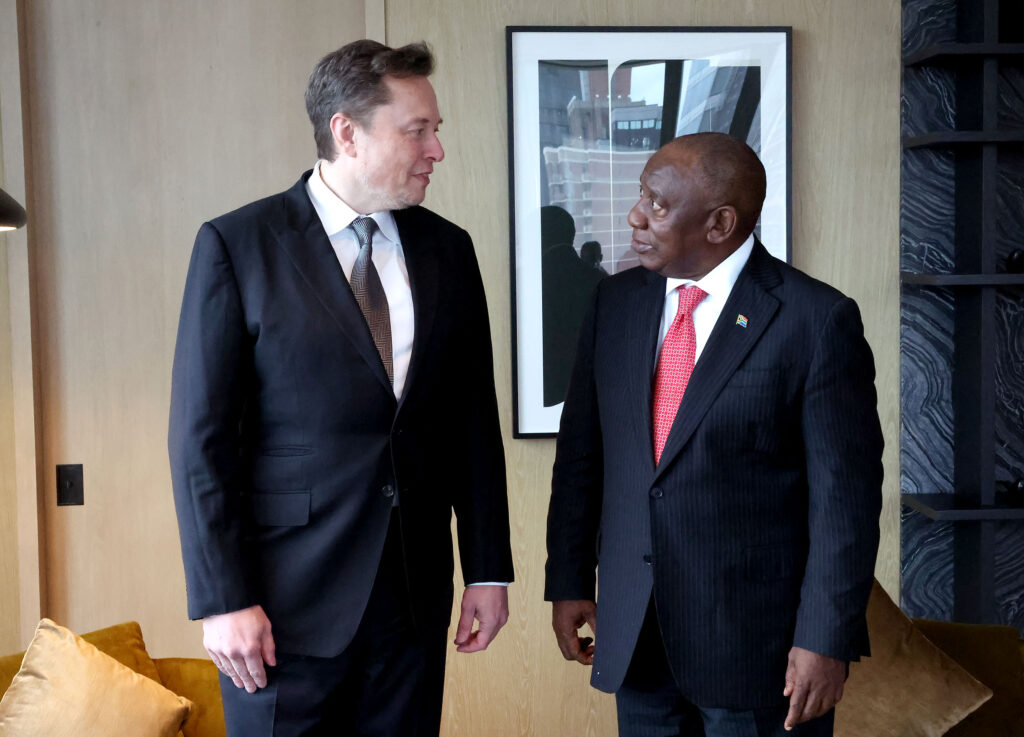
President Cyril Ramaphosa said billionaire Elon Musk could use equity-equivalence programmes to meet South Africa’s racial-equity rules and roll out his Starlink internet service locally, pointing to US firms that comply through alternative investments rather than ownership.
Mines and telecommunications operators such as Musk’s Starlink are, however, subject to licensing regulations that require 30% ownership by Black citizens, limiting the use of such alternatives.
Read: Scrap BEE laws to unlock ‘billions of dollars’ – US ambassador
Was Starlink offered empowerment pathway to get into SA?
Communications Minister Solly Malatsi of the Democratic Alliance party has proposed extending equity-equivalence structures to the sector, but some lawmakers overseeing the industry in December called for him to withdraw the policy, with Ramaphosa’s African National Congress “deeply concerned” with the plan.
Read: SA lawmakers slam Starlink plan over ‘back door’ entry
International companies “are given an opportunity through the equity-equivalence process where they can do other things that are empowering”, Ramaphosa told reporters Wednesday.
ADVERTISEMENT
CONTINUE READING BELOW
Singling out so-called Black-economic empowerment (BEE) laws “is, to me, quite dishonest, because if you look at our laws, you’ll find that they are empowering”, he said.
Musk on 12 April wrote on his X social-media platform that the country of his birth won’t license his satellite internet service “simply because I am not Black”.
South Africa won’t allow Starlink to be licensed, even though I was BORN THERE, simply because I am not Black!
We were offered many times the opportunity to bribe our way to a license by pretending that a Black guy runs Starlink SA, but I have refused to do so on principle.… https://t.co/m6G1ZQcC1C
— Elon Musk (@elonmusk) April 12, 2026
Satellite technologies that rely on a constellation of low-Earth orbit satellites would be a potential game-changer for South African users who’ve historically faced expensive or unreliable internet options. Only 1.7% of rural households have access, according to a 2023 survey compiled by the nation’s statistics agency.
ADVERTISEMENT:
CONTINUE READING BELOW
Read: Was Starlink offered empowerment pathway to get into SA?
South Africa introduced empowerment policies after the end of apartheid, compelling companies in industries including banking, mining and telecommunications to sell stakes to Black people who were systematically excluded from the economy during White-minority rule.
A change to the industry rules would allow telecoms companies to invest in projects such as infrastructure, digital-inclusion initiatives or research that benefits previously disadvantaged communities.
The exemption is already standard for a number of industries, including the nation’s auto sector. In 2019, car manufacturers – including BMW AG, Ford Motor Co and Toyota Motor Corp – established a fund that would bring disenfranchised groups into the sector.
More than half of South Africans want the policy scrapped and hiring and promotions to be merit-based, according to the Institute for Justice and Reconciliation.
#Musk #row #shows #gap #Ramaphosa #equity #rules