
You can also listen to this podcast on iono.fm here.
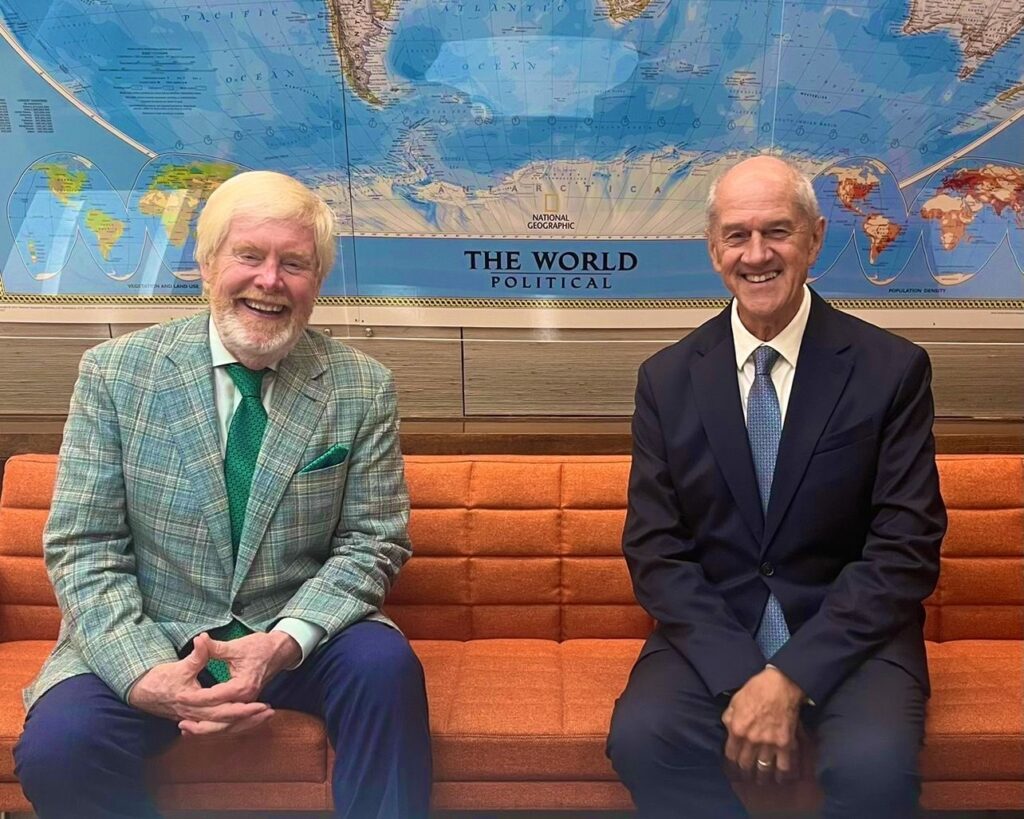
JIMMY MOYAHA: It has been made official. The next South African ambassador to the United States is a gentleman by the name of Roelf Meyer.
Read: Ramaphosa names Roelf Meyer as next SA ambassador to the US
For those who don’t know that name or who might recognise that name, but not know why they recognise it, this gentleman was formerly part of the National Party, back in the day, and has served in the cabinet in the past – among many of his other accolades.
We’re going to be reflecting on this appointment by the president and trying to make sense of whether or not this is finally the right appointment for the United States conversation.
I’m joined on the line by director at Political Futures Consulting, Daniel Silke, to look at this and see what to make of it. Dan, lovely having you on the show. Thanks so much for taking the time.
Your initial thoughts on the appointment? Is this something you had expected the president to kind of dig into his wheelhouse for this particular situation?
DANIEL SILKE: It took long to get to this particular position after the debacle with the previous designate, Ebrahim Rasool.
Now I would certainly say that finally President [Cyril] Ramaphosa has read the room right, in a sense – which he didn’t do with the previous designated ambassador.
And in this case, I think Roelf Meyer is indeed a much more able and capable representative of South Africa. I also think he’s someone who can perhaps relate in better terms to the current Republican administration [in the US] in particular.
So my overall first reaction is one that is more positive, and I think that Meyer brings a whole host of talents – and remember he’s the designate ambassador, so his credentials still have to be accepted by Washington.
One would expect those to be approved, given that South Africa approved the new US ambassador in South Africa.
So I would certainly argue that this is a better choice and he is someone who has the potential of, I think, engaging the [US President Donald] Trump administration with a greater sense of urgency and perhaps also nuanced compromise going forward.
ADVERTISEMENT
CONTINUE READING BELOW
JIMMY MOYAHA: Dan, what do we know about the ambassador-designate? We obviously know a bit about his past, given that he has been a public figure. We know the basics around his legal qualifications, and you’ve alluded to the fact that he has been involved in a lot of other activities over the course of his career.
What makes this particular candidate so special?
DANIEL SILKE: Well, ‘special’, of course, is a difficult word, I think.
This candidate in particular has gone through the transition in South Africa, having understood, I think, the complexities – and [being ] controversial at times in the shift between white minority rule towards a democratic dispensation in South Africa.
Ultimately, Roelf Meyer was at the coalface of negotiating that negotiated settlement. He was, I think, a negotiator who could be trusted, in a sense, by all sides.
Yes, indeed, there are elements, certainly, in the more conservative Afrikaans community in South Africa, who would argue that he did not protect the interests of white Afrikaners, but I think that is a minority view.
In general he is seen as someone who can take two difficult sides and at least bring them together in some more peaceful fashion.
He’s been involved in conflict resolution – more broadly speaking on an international scale.
And I think given this depth of tension between South Africa and the United States, he does offer a bridge-building capacity.
That’s really what he’s been known for. And again, whether you like him or not, politically, I do think that he has those particular skills that can take sort of extreme positions and perhaps mould them into something more acceptable and workable for all.
JIMMY MOYAHA: Dan, speaking of workable, let’s look at what Roelf’s first touch points would need to be if he is accepted as the next ambassador. We know that the tensions between the United States and South Africa continue to be strained, and we keep seeing that strain could be widening by the day.
Where does the ambassador start from day one to build that bridge, understanding that some of the conversations are constantly moving conversations, and prioritising them might be even more important?
DANIEL SILKE: Well, look, I think the ambassador or the ambassador-designate has to sell to the ANC, in particular, the fact that the United States remains a very important trading partner – and there is no benefit to South Africa in continuing to alienate the United States.
And I think we’ve seen South Africa over the course of the last few years move closer to China, perhaps even closer to Russia, and look very much more towards a friendship with Iran.
ADVERTISEMENT:
CONTINUE READING BELOW
All those big geopolitical foreign policy moves by South Africa have ultimately distanced South Africa from the United States.
So for me this is not so much about Roelf Meyer in Washington. It’s also about Roelf Meyer in reporting back to the ANC and to the president here in South Africa.
And reiterating the point that, despite the fact that there will be disagreements between Washington and Pretoria on a vast range of issues – and acute differences at that – the United States needs to ultimately be treated with respect and needs to be part and parcel of our broader global trading links.
I think if that can be accomplished domestically in South Africa, it will then be augmented by him networking in Washington and conveying the reality of South Africa rather than some of the strange false narratives that have been peddled in Washington about South Africa.
JIMMY MOYAHA: Dan, does this latest appointment of Roelf resolve some of the serious issues and the core issues that Washington has had with South Africa?
Understandably, things like South Africa’s BEE [black economic empowerment] policy have been at the centre of the disagreements with Washington. Does this appointment address those?
DANIEL SILKE: In the short term clearly the beef that Washington has with Pretoria, whether it’s over BEE, whether it’s over the radicalisation of South African politics, that Kill the Boer song – even over South Africa’s foreign policy orientation towards Iran and anti-Israel – those issues remain at the forefront of the tensions that exist.
And I’m not convinced that the new ambassador-designate will be able to smooth over those cracks in the short term.
The best I think that one could hope for is that he understands and gains a better understanding of those particular issues that are presented to him in Washington by the Trump administration – and perhaps takes them again back into the fold here in South Africa and discusses them with his principals here, including the president, so that perhaps a conversation can be started at least around some of these issues and that an accommodation can be achieved.
And I think that also might be a strength, but don’t expect these issues to go away. They are certainly the disruptive issues in the relationship currently between the two countries.
But we must remember that the United States is open for business. They want business with all countries across the African continent.
They’ve changed the orientation towards Africa as well in looking for contracts, increasing trade.
And if South Africa also can open markets to United States goods coming into South Africa, then I think this can offset some of those major disagreements and issues that we’ve just highlighted.
ADVERTISEMENT:
CONTINUE READING BELOW
JIMMY MOYAHA: Dan, before I let you go, I want to get your thoughts on perhaps the rest of the South African conversation as it relates to these ongoing tensions. Is this appointment the right appointment for the coalition government [government of national unity, GNU] that we have somehow been able to hold together as long as we have?
You touched on very important points regarding the relationship between South Africa and the United States, and the fact that South Africa has its own internal relationships to manage.
Does this kind of appointment strike that perfect balance to be able to get us back on track, both domestically and on the global stage?
DANIEL SILKE: Look, I don’t think there’s ever going to be a perfect balance in relation to our government of national unity. It’s a fractious, difficult governing arrangement, but I certainly think that in terms of the broader ANC and in terms perhaps of the DA, this appointment will be largely welcomed.
I think Roelf Meyer brings that sort of sense of realism, a realism that is not rooted in any kind of ideology. And that realism I think will find resonance, certainly from perhaps the DA side and also from the mainstream ANC side.
So again, from a GNU perspective we are probably looking, broadly speaking, at the news being supportive. There will be some exceptions to the rule, possibly the Freedom Front Plus, who have their beef, of course, with Roelf Meyer because of the [democratic] negotiation process.
But otherwise I think that this is a better appointment than the previous one that, of course, ended in disaster.
And I think it’s an appointment that can work both domestically and within the Washington circles as well. To me that’s the important issue here.
Roelf Meyer carries a certain gravitas, whether you like his politics or not, and he carries a gravitas and understanding of the world, a world in which compromises need to be reached.
On that basis, and given the need for compromises in the GNU, Roelf Meyer carries a certain gravitas, and I think that is a positive attribute to have.
JIMMY MOYAHA: The South African ambassador-designate to the United States was officially announced by the president today, and that announcement carries through with it a lot of expectation around repairing the damage and fractured relationships between South Africa and the United States,
We’ll see how this unfolds and whether or not this decision is received in a different light.
For now we’ll leave this conversation on that note. Thanks so much to Daniel Silke for joining us to take a look at the announcement by The Presidency of our latest ambassador to the United States.
#Roelf #carries #gravitas #politics