
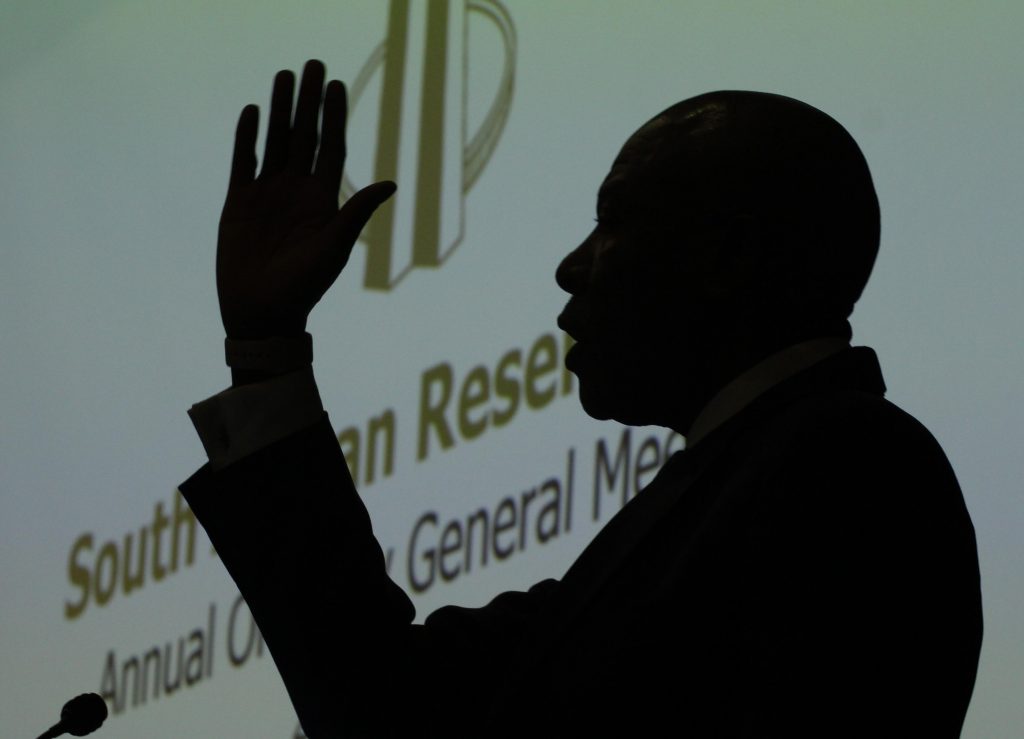
The South African Reserve Bank (Sarb) will respond to inflationary pressures triggered by the US-Israeli war on Iran if they prove persistent, Governor Lesetja Kganyago said.
“We do not know how long this conflict is going to last,” Kganyago told an audience on Wednesday at the Soweto Theatre, southwest of Johannesburg. When shocks like this arise, the central bank treats them as temporary, he said.
Read:
Inflation edges up before Iran oil shock registers
Kganyago says war inflation risks are playing out
ADVERTISEMENT
CONTINUE READING BELOW
“If it is temporary, there is nothing for us to respond to, but if it becomes persistent, we end up having to respond to that shock,” the governor said.
Kganyago and the Sarb’s monetary policy committee retained the benchmark rate at 6.75% last month, warning that an oil-price surge and rand weakness caused by the conflict in the Persian Gulf pose risks to the inflation outlook.
The central bank’s quarterly projection model sees inflation peaking at 4.3% this month, after edging up to 3.1% in March, 0.1 percentage point above its target.
The data was collected before South Africa hiked petrol and diesel prices on April 1 by the steepest margin in almost two decades.
“The jump in fuel price inflation is the largest in the history of inflation targeting,” David Fowkes, a member of the MPC, said at the forum.
Countries around the world are grappling with inflation shocks triggered by the US-Israeli attacks on Iran that began on 28 February, rolling out measures from fuel rationing to tax cuts and price controls.
Brent crude has surged more than 40% as flows through the Strait of Hormuz – a critical chokepoint for about a fifth of global oil and liquefied natural gas – have been constrained.
© 2026 Bloomberg
#Sarb #act #war #inflation #shock #persists