

When Cameron Weston-Edwards failed to land an internship at a historical tour company in rural England, he knew something had to change. “If I’m getting rejected for that, the chance of getting a grad job are slim,” the 22-year-old politics student says. “I clearly need a more impressive CV.”
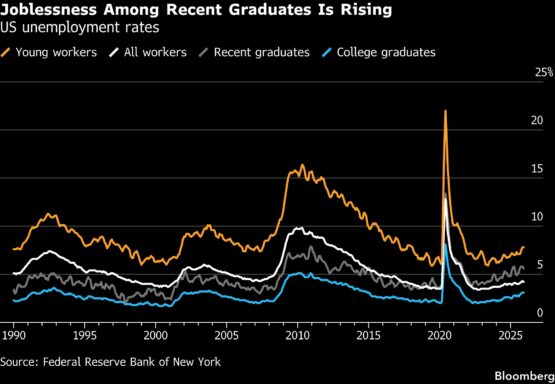
Weston-Edwards is among thousands of young people across Europe and the US hoping a master’s degree can help them beat the toughest jobs market in decades, with employers slashing vacancies due to global economic turbulence and the expanding promise of artificial intelligence.

University of Leeds student Cameron Weston-Edwards outside the university’s Parkinson Building. Image: Lorna Mackay/Bloomberg
US law school applications have soared 32% this year to date, compared with the past four-year average, according to official data. In continental Europe, three in four business master’s programmes attracted more applicants in 2025 than in the prior year, up from about half in 2023, a survey from the Graduate Management Admission Council showed.
Read:
UK stands to lose 8m jobs from AI, analysis warns
Google to invest £5bn to boost AI development in UK
Trade shocks could wipe out 90 000 green jobs in UK, study finds
In Britain, class sizes are expanding, as are universities’ teaching ranks: ‘lecturer’ is this year’s third fastest-growing job on LinkedIn, ahead of roles such as machine learning researcher or investment broker. The phenomenon has echoes of the global financial crisis, after which many young people went back to school to ride out the jobs drought.
The UK is grappling with a particularly acute jobs crisis. Higher payroll taxes and a rising minimum wage have discouraged businesses from hiring school-leavers, while university graduates are up against a service-sector that’s delving into the possibilities of AI.
ADVERTISEMENT
CONTINUE READING BELOW
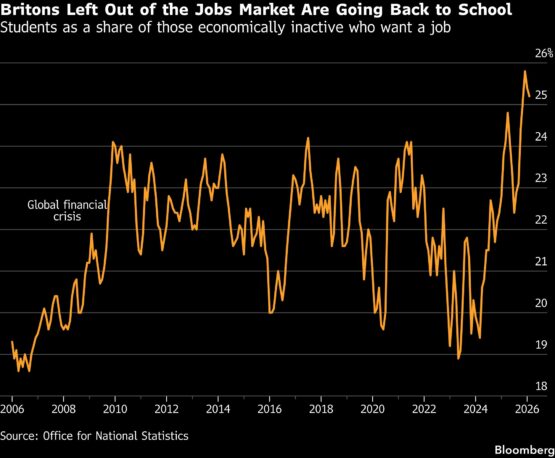
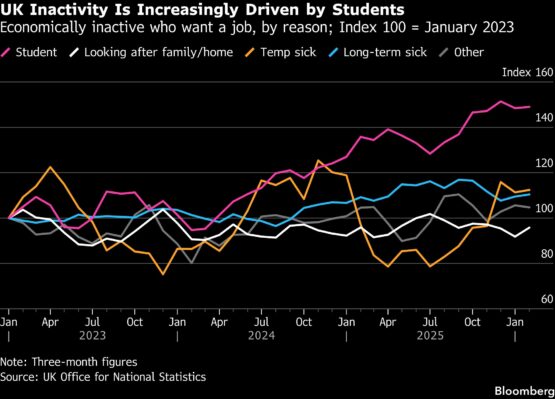
The UK youth jobless rate is at its highest since 2015, and a growing share of youngsters have struggled to find work for at least a year. More than half a million Brits who want a job have left the labour market to study, according to official figures, and students now account for over a quarter of those who are not working but want a job.
For Weston-Edwards, a postgraduate qualification is essential. The internship that turned him down was given to someone with an MA in history. This pushed him to accept an offer to start a master’s in political communications later this year.
Read: The new economics of people in a world of closing doors
Enrollments for taught postgraduate courses in the UK rose 8% in the year to 2024/25, after years of declines, according to the latest official figures. Practical degrees with routes to traditionally strong industries, such as the financial sector, are especially popular.
Postgraduate applications to Bayes Business School in London rose almost 10% for the 2025/26 cohort, accelerating from previous years. Staff say the current admissions cycle is even stronger.
Across the English Channel, students in mainland Europe are reporting similar experiences. Lauren Amdor, 23, is about to start an international governance and diplomacy master’s at Paris’ Sciences Po in August. The programme’s six-month internship and the promise of career mentorship from instructors, many of whom are working professionals, were major draws.
“The career support available for current students feels much easier to access than for those not in education,” she says.
ADVERTISEMENT:
CONTINUE READING BELOW
Graduates are emerging from their multi-year degrees into a different world to the one they imagined as their studies began, when the AI revolution was just getting started. A postgraduate degree is a chance to quickly gain new skills after being “locked into a degree for three years,” according to Cormac Bryce, associate dean for MSc programmes at London’s Bayes Business School.
Read: Graduated, now what?
In the US, law degrees are at risk of losing their status as guarantees of job security. Even college deans acknowledge that by the time graduation rolls around for the class of 2029 – who will begin law school this fall – the entry-level job market may look very different.
That raises questions about whether they should admit fewer students. While administrators say it’s unlikely that law schools will radically reduce class sizes anytime soon, they see danger in over-promising to candidates.
“Nothing leads to student unhappiness faster than feeling misled,” said James Leipold, senior advisor to the Law School Admission Council, in a recent article about law schools’ enrollment strategies.
Read: The consequences of a disillusioned youth
Sean Fitzpatrick, CEO of AI research platform LexisNexis’s global legal business, is warning the US has reached “peak legal” when it comes to hiring. “I don’t think we’re going to see an expansion in the number of jobs in law firms for the next couple of years,” he added.
ADVERTISEMENT:
CONTINUE READING BELOW
Indeed, recruitment at large US law firms for full-time roles already appears to be slowing down, according to data from the National Association for Law Placement.
At a recent dinner with half a dozen managing partners, Fitzpatrick said this year’s first-year associate class would be the same size or smaller than in past years. Though the partners expect business to grow, they believe AI would allow the existing staff to handle the additional work.
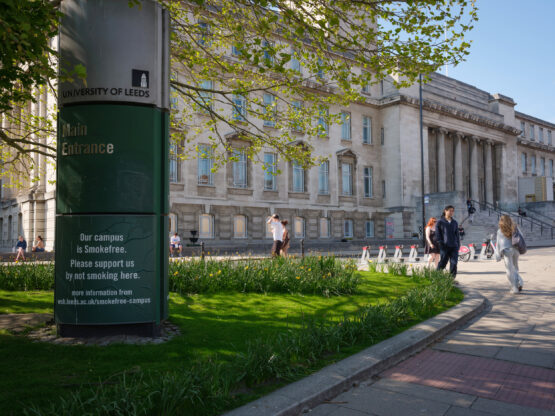
The University of Leeds where Weston-Edwards will remain for a postgraduate qualification. Image: Lorna Mackay/Bloomberg
Unlike in the jobs market, Weston-Edwards found himself spoiled for choice when it came to postgraduate study. He applied to two programmes and was accepted to both. When it was time to decide, he quickly moved past discussions about course content and structure, focusing instead on one key question: would it lead to a job?
Read: Unemployment problem becoming too big to solve
“Employability was definitely the number one factor,” he said. “A lot of people who do a master’s now do it because of the state of jobs market rather than a personal desire to further their education.”
© 2026 Bloomberg
#graduates #turn #emergency #degrees #ride #jobs #crisis