
Chinese exporters are beginning to lift prices on everything from swimsuits to air conditioners as the Iran war drives up oil-linked input costs, signaling that global consumer inflation is likely to accelerate.
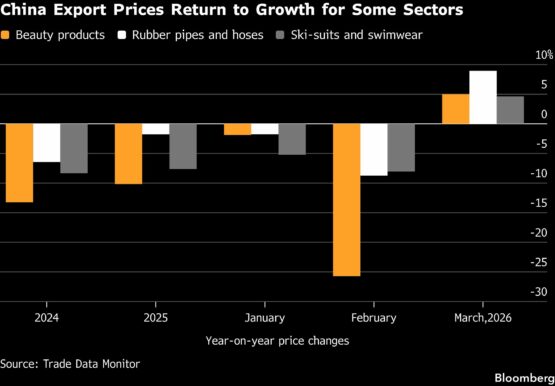
More than a dozen categories of household goods saw sharp year-on-year price increases in March, customs data compiled by Trade Data Monitor and analysed by Bloomberg showed — snapping a sustained decline over the past few years that had helped restrain global inflation.
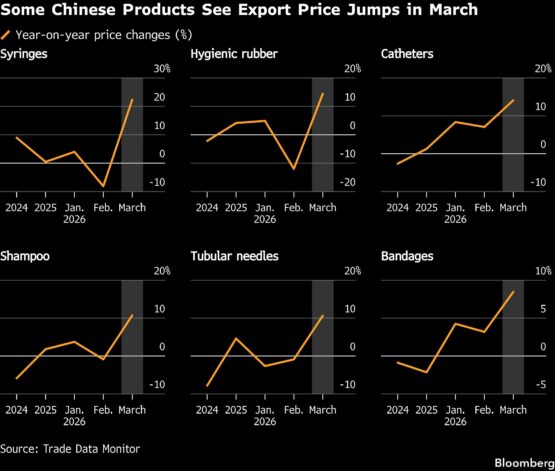
“I held off raising prices for as long as I could in March, but in the end I had no choice,” said Pang Ling, a sales manager at a Shanghai-based medical catheter maker. “I panicked watching plastic costs climb almost every singe day,” she said.
That stress is rippling across a raft of sectors, with exporters also raising prices on swimsuits, ski-suits and women’s trousers — all reliant on synthetic fibers such as polyester — by low- to mid-single digit percentages in March. Their suppliers hiked fiber prices as frequently as daily during the month.
Other products reliant on rubber, plastic and oil-derived chemicals also saw spikes. Syringes were one of the hardest hit products, with prices up as much as 20% in March. Meanwhile, home appliance prices are getting squeezed on two fronts as manufacturers also face higher metal and semiconductor costs.
The detailed breakdown provides one of the first snapshots of how the Iran-war induced energy shock is rippling through the world’s No. 2 economy and on to retailers around the world.
ADVERTISEMENT
CONTINUE READING BELOW
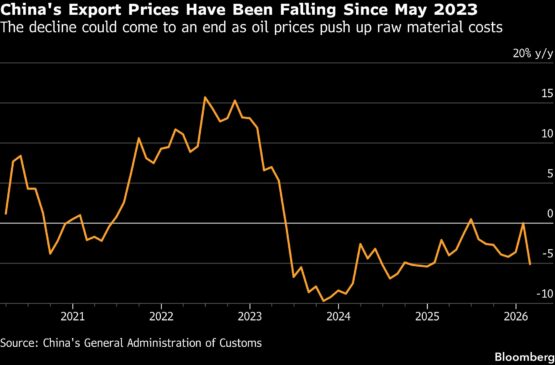
For almost three years, China’s export prices had been falling due to overcapacity and intense competition, helping to contain inflation in economies from the US to Europe. Those declines shaved an estimated 0.3%-0.5% off headline inflation in advanced economies in recent years, according to Capital Economics.
As recently as February, cheaper Chinese goods acted as a restraint on price pressures in economies such as the UK.
Now, as Chinese manufacturers begin passing on higher costs, that disinflationary buffer is weakening.
Bloomberg Economics estimates above-3% inflation in 2026 is “back in play” across the euro area, the US and the UK as a result of the energy cost spike. This is a huge reversal from before the Iran war, when price growth in major economies was headed back toward target.
That cost pressure has already seen Chinese producer prices return to growth for the first time in more than three years and Goldman Sachs Group Inc. expects overall export prices to turn positive as soon as in March. Official data to be released around April 25 will confirm whether that’s the case.
So far, the full brunt of higher export prices hasn’t reached consumers and, in most economies, inflation has only ticked up modestly. Many goods shipped last month were likely ordered weeks or even months earlier, meaning they also won’t reflect rising input costs. And exporters in some sectors like toys, even cut prices in March due to fierce competition and weak demand.
ADVERTISEMENT:
CONTINUE READING BELOW
This suggests that export-price inflation is set to accelerate in the coming months, especially in the absence of a resolution to the Iran conflict.
A 10% increase in the cost of oil typically lifts Chinese export prices by an average 50 basis points over the first year, with a peak four to five months from the initial shock, according to Goldman Sachs estimates.
Even so, Standard Chartered Plc’s Ding Shuang noted that China’s export prices will probably rise less than those of other major exporters, meaning the country could absorb part of the global inflation shock.
That’s because weak domestic consumer spending will put a lid on overall inflation and wage growth in China, while competition will continue to limit how much companies can raise their prices, according to Ding.
But the rest of the world is bracing for a price shock. Pang, who has already increased prices 7% on new orders from US-based clients, is set to travel there this week to negotiate further hikes. Prices of polyvinyl chloride (PVC), her company’s main input, surged as much as 80% in March from pre-war levels and remain about 50% higher even after a modest pullback in the past two weeks.
“I’m so tired of not knowing what tomorrow will bring,” Pang said. “The whole situation has put me on an emotional rollercoaster every day.”
© 2026 Bloomberg
#World #inflation #scare #coming #Chinese #exporters #lift #prices