
You can also listen to this podcast on iono.fm here.
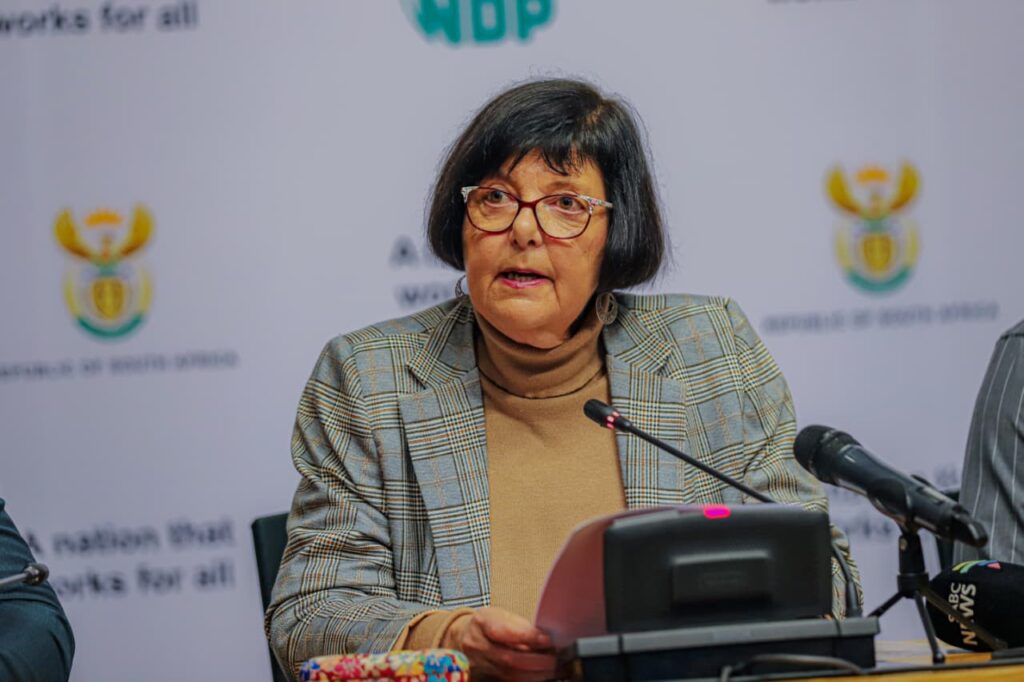
JEREMY MAGGS: Transport Minister Barbara Creecy has told parliament that logistics and mobility reform must sit at the heart of South Africa’s growth plan.
In her department’s R102 billion budget vote, she has placed major emphasis on opening freight rail to private operators, improving port capacity, restoring passenger rail, stabilising road funding, reforming public transport, and also strengthening oversight of troubled entities.
It’s a long list, but with ageing infrastructure, fiscal pressure and commuters and businesses still demanding more tangible improvement, the central question, I think, is whether the transport plan is now moving from promise to delivery.
Minister Creecy joins me on the programme now. Minister, very warm welcome, you’ve told parliament that this budget is designed to turn transport from a constraint into “an enabler of prosperity”.
Maybe let me ask you what the single delivery target is by which you should be judged over the next 12 months.
BARBARA CREECY: Greetings, Jeremy, to you and your listeners. I don’t think in a big ecosystem like transport, you can have one single deliverable.
I have six numbers that I’m working towards: 250 million tonnes of freight, 600 million passenger journeys, 35 gross crane moves per hour, a 50% reduction in road fatalities, 42 million passengers through the Acsa (Airports Company South Africa) network and 1.2 million tonnes of air freight.
My intention is to achieve all of this by 2030. That is how I measure myself and how I measure all of the entities and officials in the Department of Transport.
JEREMY MAGGS: Let’s pick up on Transnet, if we can. You say in the speech that the first 11 private train operating companies could move up to 24 million tonnes of freight a year from April 2027, if I read the speech correctly.
Read:
Creecy announces breakthrough in SA rail reform: 11 TOCs approved
Help us build a 21st Century transport system – Creecy to private sector
Minister, what guarantee, though, is there that Transnet’s infrastructure is going to be reliable enough for them to deliver on a very ambitious volume?
BARBARA CREECY: Jeremy, that is a fundamentally important question and that is why we have applications to the budget facility for infrastructure of R34 billion in this financial year and why we are very glad that we have already received the first R23 billion, which we are using to improve the coal and the iron ore lines.
That is in process.
What we are also doing is that we are developing concessions, which we will put out to market for the manganese line and the general freight corridor for this year.
Listen/read:
Can SA finally deliver a credible rail recovery?
Transnet signals turnaround as private operators enter rail and ports
Transnet receives R16.1bn to improve the state of its network
That would be because we believe that the upgrades that are required on these lines probably would exceed this envelope. Nevertheless, they are critically important transport corridors, and they do need upgrading.
JEREMY MAGGS: Minister, business groups, though, say that freight logistics reform has been delayed, that private participation has not moved fast enough. I’ve got to ask you the question why exporters believe the breakthrough is finally real this time around.
ADVERTISEMENT
CONTINUE READING BELOW
BARBARA CREECY: Well, I think that we did last week name the 11 private operators. This is a huge step forward.
It’s the first time we’ve ever had private operators on the freight rail network. Obviously, we’ve always had private operators in the ports.
Recent figures indicate that last year was the best year to date for our ports. In fact, we have exceeded last year the high point in Transnet history of the 2009/2010 financial year in terms of volumes exported.
You would also know that we have now concessioned out Pier 2 in Durban, and the intention is to increase the volumes we carry there from two million to 2.8 million TEUs (twenty-foot equivalent unit) per annum.
Read:
Rail master plan will cost almost R2trn over 30 years
Transnet bottlenecks spur fresh private rail investment push
Grindrod, Minrail secure access to Transnet’s rail lines
So I think that the ports have been doing quite well. There aren’t these long queues anymore outside of our ports.
What we now need to do is to shift a lot of the freight off the road network back onto the rail network, which is not to say there wouldn’t always be a role for trucking – first mile, last mile, and those other miles in between.
JEREMY MAGGS: Let me pick you up on Pier 2, if I can. You say in the speech that it’s a bankable model, but exporters would want to know when they will see reduced delays and lower logistic costs, rather than just new agreements and new announcements. Is this closer than we think?
BARBARA CREECY: I think that part of why having private operators on rail and in ports is important is because it introduces that element of competition that has to reduce cost.
I think that it’s also why we have introduced the Transport Economic Regulator, so that going forward, there must be a level playing field for all operators and that level playing field must also be related to market affordability and market demand.
JEREMY MAGGS: Let me pick you up on that regulator, if I can. How are you going to ensure that Transnet is not still effectively both a player and a referee in a system that you’ve just told me is now open to competitors?
BARBARA CREECY: Well, that’s exactly why the regulator is going to be determining the tariffs going forward, because you can’t have Transnet that is an operator determining tariffs that would be in its favour, as opposed to creating this level playing field, where Transnet itself will also have to move freight at the same fees as private operators would need to do.
Read:
Treasury wants more private sector help around fixed investment
Transnet signals turnaround as private operators enter rail and ports
JEREMY MAGGS: Your department also says the National Ports Authority should be separated from Transnet. If I’m not mistaken, at least 20 years of delay. Again, why has such basic reform taken so long, and when can you tell us it’s actually going to happen? Can you pinpoint a date?
BARBARA CREECY: I don’t want to get into why these reforms have been delayed, I think almost for 20 years, I guess there’s been a lot of policy squabbling. The key issue that we are addressing currently is the balance sheet implications of separating out Transnet Ports Authority.
Transnet Ports Authority really has been cross-subsidising rail for the longest time. We think this entity must be separate because ports themselves need infrastructure investment and infrastructure development.
You can’t have the fact that ports are operating more effectively but are not reinvesting that profit because then in the long term, you’re going to have the same problem in the ports that you have in the rail system.
I am busy working with a team of Transnet and National Treasury.
We do expect to make an announcement on the time frames, and I would want to be sure that I’ve dotted all the i’s and crossed all the t’s before I give you a date. But we will give a date.
ADVERTISEMENT:
CONTINUE READING BELOW
JEREMY MAGGS: Minister, let’s move from Transnet to passenger rail, journeys have risen above 100 million a year, I think. But for many commuters, you will concede the network remains limited. It’s either unavailable or it is irregular.
Maybe this is the question: how many priority corridors are still not fully restored? And again, let me push you on a time frame, by when will they be operating?
BARBARA CREECY: Five are not fully restored, and of the 35 of the 40 priority corridors that are restored, we have to fix the signalling in order that we can up the numbers.
So the big constraint on the numbers at the moment is the signalling because if you are operating on a manual system, you can’t safely increase the train numbers.
I do have a team of international experts from the UK out here at the moment looking at how, with the existing technology, we could safely increase the number of trains that we run in an hour.
I think this is something that commuters want. The delays on the other five lines are budget related. We do have financial constraints because of the limitations of National Treasury.
But I am hoping that we will manage to get all of these lines operational by 2028.
JEREMY MAGGS: Minister, let’s move from trains to automobiles. Let me talk to you about the taxi industry. Again, you said it’s got to be formalised and better regulated.
Read: Fuel price surges reach taxi fares
Maybe just explain to me what that means in practice for operators and commuters. And are you prepared to confront associations that resist safety standards and financial transparency?
BARBARA CREECY: Well, we are confronting those issues together with the associations. We have an annual meeting with the Minister of Police.
On the one hand, we are trying to ensure that there is more oversight over reported cases of taxi violence that impact heavily on the industry. The industry itself would accept that there are criminal elements that are operating and require the police in this regard.
On the other side, we are also working with the industry to say that you have to reduce the number of illegal operators, because when there is conflict between legal and illegal operators on routes, that’s when violence occurs.
But we are also monitoring the industry with regard to bullying of private citizens who are accused of running lift clubs and that sort of thing, which I think is totally unacceptable.
Read:
Cape Town commuters brace for looming taxi fare hike
Fixing rail could ease Cape Town’s congestion problem
So this is a work in progress. It’s not easy because I would venture to say that perhaps the number of illegal vehicle operators on the roads is probably equal to the number of legal operators.
We are working with provinces on upgrading the vehicle licensing system. I think that this kind of digital improvement is going to be fundamental. It seems to have been excessively slow, and the provincial regulatory authorities seem to have been very under capacitated.
But this is a very important activity that we’ve got to get to grips with so that we can have better certainty about who is and who isn’t officially licensed to operate.
ADVERTISEMENT:
CONTINUE READING BELOW
JEREMY MAGGS: Minister, I want to touch on two other issues very quickly. One is Sanral (South African National Roads Agency), and again, you’ll correct me if I’ve got the number wrong. I think you said 13 000km of provincial roads. Your own speech, though, warns this could ultimately force widespread tolling.
Essentially what you’re saying is that motorists are going to pay again because provincial governments have failed to maintain their roads.
BARBARA CREECY: Look, we have two portfolios in Sanral. So there’s the toll portfolio, which is the national roads, and then there is the non-toll portfolio, which is the provincial roads and certain national roads which we don’t think are viable for tolling.
One of the questions that I’m working on with provincial departments is how do we deal with their maintenance and road development backlogs.
You would understand that some of our rural provinces, like the Eastern Cape and Limpopo, are still operating primarily with gravel roads, although now you would find that there would be mines and other forms of economic activity that would require a better road network.
This is where we are exploring with National Treasury opportunities to front-load provincial grants so that we can deal with maintenance and upgrades sooner rather than later.
JEREMY MAGGS: Minister, just finally, your budget speech described SAA (South African Airways) as a key national asset that must “remain a going concern”. I just want your reaction to this.
You would have read at the weekend, the two SAA flights reportedly encountered serious landing incidents in Cape Town on 11 May. One was only reported eight days later. I have to ask you how a safety critical incident involving a national airline can go unreported for so long?
BARBARA CREECY: That’s an important matter which I have to pursue with the Civil Aviation Authority. I obviously would want to understand that.
I myself flew on 11 May on one of our domestic airlines, and it was a terrible day for the airlines. In fact, I actually received a letter of congratulation from FlySafair on the extent to which Air Traffic and Navigation Services managed that day in the context of very heavy rainstorms.
Read: FlySafair to be prosecuted for overbooking flights
But safety is absolutely paramount. We have a very proud record of air safety, and it is critical that we understand why, if there was a weather related incident, we only found out about it eight days later.
JEREMY MAGGS: I understand you’ve got to talk to the Civil Aviation Authority, but you will also surely be demanding an explanation from SAA. And will you make public exactly who knew what and when?
BARBARA CREECY: Well, I want to start with the Civil Aviation Authority because they are the independent safety regulator. They would obviously have to indicate to me whether these allegations are true, and obviously we will then take it from there.
At law, there are built in sanctions if safety incidents are not reported timeously and those sanctions must be implemented.
JEREMY MAGGS: Minister Barbara Creecy, thank you very much.
#Creecy #pushes #private #rail #revive #SAs #logistics #network