
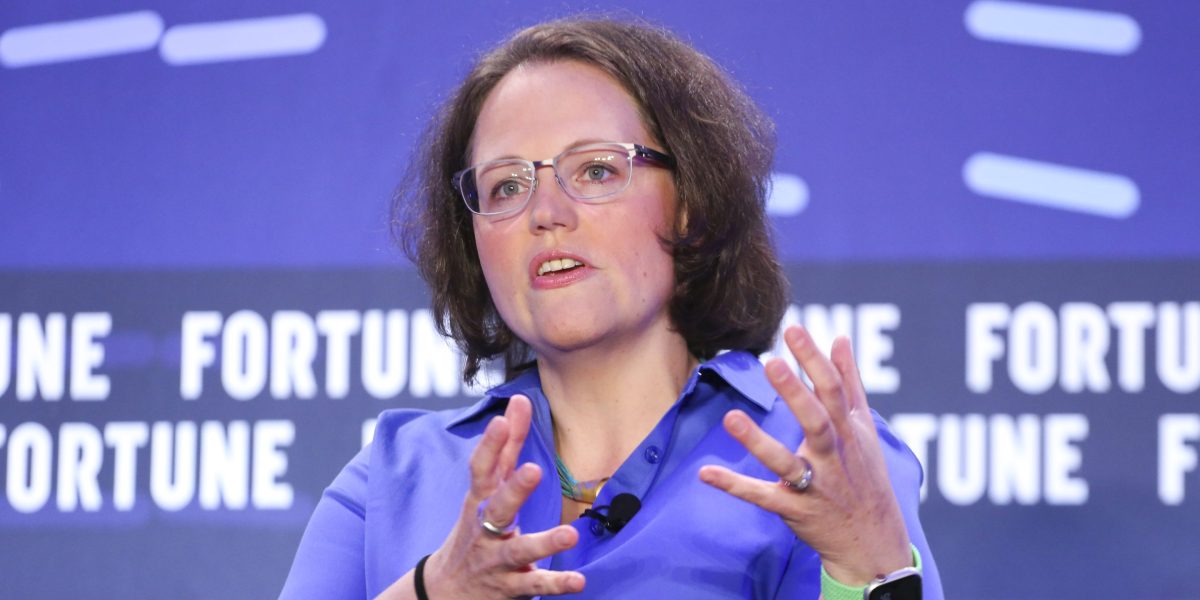

Leaders and researchers have predicted that a whole slew of industries will be radically upended by AI, from financial services to computer programming. But just because these human jobs will be changed, doesn’t mean they’ll be wiped from company headcounts. In fact, Indeed’s chief economist, Svenja Gudell, believes those who are most exposed could stand to benefit from tech disruption.
“The sectors that are most exposed to AI right now are seeing the most growth in terms of demand for those jobs,” Gudell recently said onstage at Fortune’s Workplace Innovation Summit.
The executive at the hiring platform uses software developers as an example. As advanced tools have evolved to write code, traditional developers are having a harder time finding jobs—yet within that same industry, AI-fluent developers are experiencing a renaissance. Software development job postings on Indeed increased 14% year-over-year in April 2026, and more than 47% of those postings now mention AI, suggesting the growth is concentrated in roles that require working alongside the technology rather than competing with it. Employers, Gudell says, are also willing to splurge on professionals trained to thrive in the AI era.
That premium is emerging against an otherwise sluggish backdrop. The U.S. unemployment rate sits at 4.3%, with fewer than one job opening per unemployed worker, and overall job postings are barely above their pre-pandemic baseline. Yet postings mentioning AI have surged more than 130% over the same stretch—a divergence that has effectively split the labor market into AI-adjacent winners and everyone else.
“AI is creating a whole bunch of new jobs, and interestingly enough, if you are an AI software developer, things are looking quite good for you,” Gudell continued. “There’s a wage premium on your skills right now.”
Meanwhile, Gudell is also honest about the flip side. Workplaces won’t be the same in the AI era, and many employees are handwringing over the fate of their careers as mundane work tasks are automated, organizational charts are reimagined, and hiring slows. Roles such as sales representatives, historians, data scientists, and personal financial advisors are among the most affected by generative AI, according to Microsoft. And some employers, like Block and Cisco, have cited AI as the reason for their headcount reductions. The information sector’s layoff rate has doubled over the past year to 2.4%—the sharpest increase of any industry, which Indeed attributes in part to AI.
Gudell has crunched the numbers, and the verdict is in: all roles across all industries will be affected by advanced tech. However, AI still isn’t capable of taking over every job just yet—and humans working in AI-exposed fields may actually be the best off in the shift. Indeed’s 2025 AI at Work report found that while 26% of jobs could be “highly” transformed by generative AI and another 54% “moderately” transformed, fewer than 1% of work skills can currently be performed by AI without human involvement.
“Our own research actually shows that AI will touch every single job out there,” the chief economist explained. “Every job will be touched by AI—some more so than others—but at least currently, with today’s technology, not a single job can be completely done by AI. You still need the human in the loop.”
#chief #economist #sectors #exposed #big #growth #job #demand