

Bill Winters has run Standard Chartered for over a decade. He has survived oil price crashes, geopolitical shocks, regulatory overhauls, and a pandemic. He is not known for dramatic language.
What he said at the bank’s investor day in Hong Kong on May 19 was dramatic. And the employees who were listening know exactly what it means for them.
What Winters said and why the language matters
Standard Chartered will cut more than 15% of its corporate function roles by 2030, approximately 7,800 positions from a support services workforce of roughly 51,000, according to HCAmag. The bank’s total global workforce stands at approximately 80,000.
Winters did not use the standard corporate language of “workforce optimization” or “operational efficiency.”
He was direct.
“It’s not cost-cutting; it’s replacing, in some cases, lower-value human capital with the financial capital and the investment capital we’re putting in,” Winters said at the briefing.
More Layoffs:
- E-commerce giant shuts down office as layoffs rise
- Oracle signals massive AI opportunity as layoffs hit
- AI won’t trigger mass layoffs yet, Fed says
He added a second formulation that may land harder for affected staff.
“We don’t have job losses, but we do have job role reductions in favor of the machines, and that will accelerate as we go forward into AI,” Winters said, Tech Times confirmed.
The functions targeted first are human resources, risk, and compliance, the corporate support roles Standard Chartered describes as absorbing the most cost relative to the value they generate.
Why this announcement stands out from other AI layoff announcements
An American Banker survey published in April found that only 3% of bank executives said AI had led to workforce reductions at their firms, according to Tech Times.
Standard Chartered’s announcement complicates that figure, made from a position of record earnings rather than financial pressure.
The bank posted a return on tangible equity of 11.9% in 2025 and hit its 2026 medium-term financial targets a year ahead of schedule, including a $1.5 billion annualized cost savings goal. It recorded $18 billion in net new wealth management inflows in Q1 2026 alone, according to Outlook Business.
These are not the numbers of a bank cutting to survive. They are the numbers of a bank cutting to reposition. That distinction matters, because it suggests the AI-driven headcount reduction trend in banking has moved from distressed balance sheets to healthy ones.
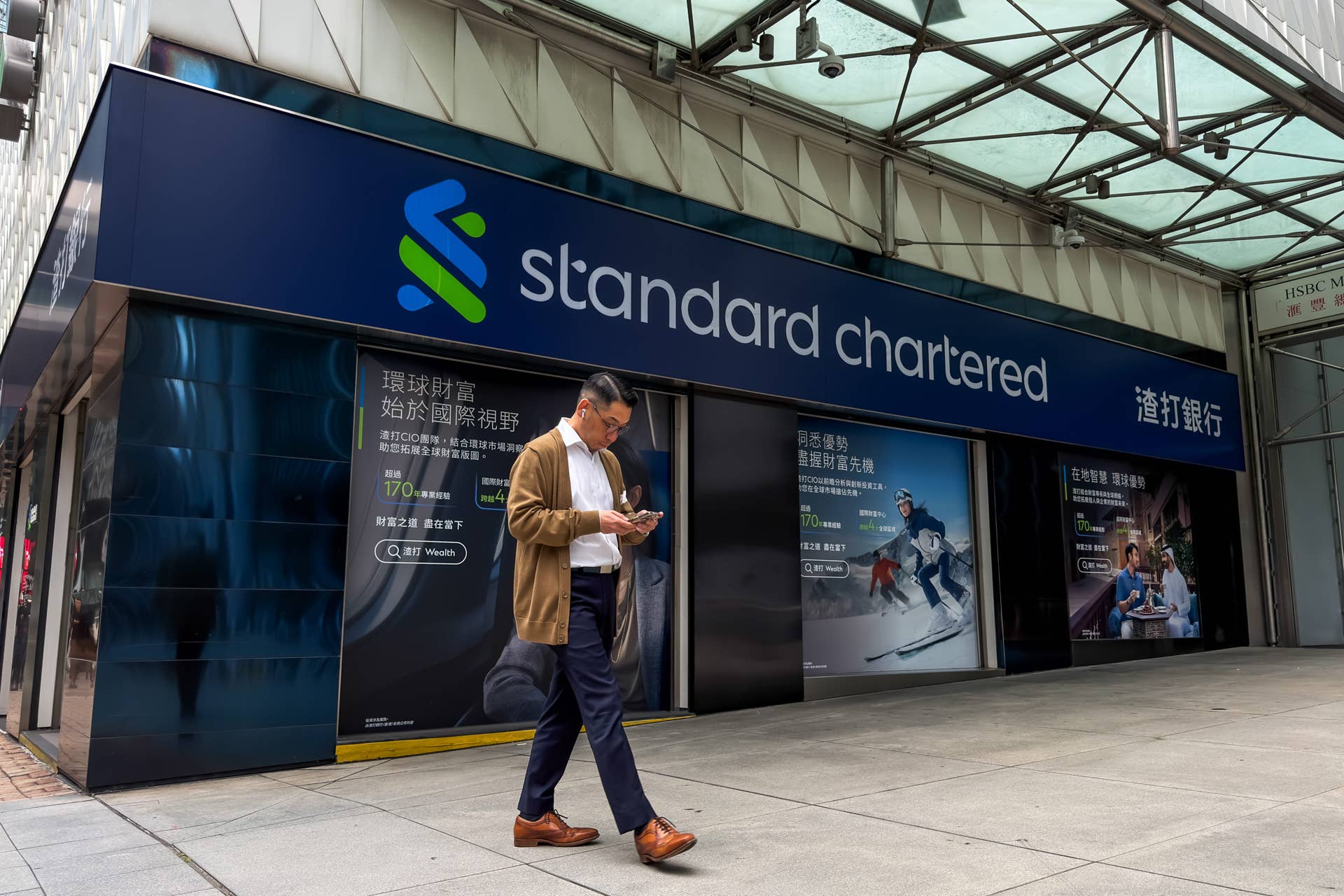
Xin/Getty Images
Standard Chartered’s new financial targets and what they demand
The job cuts arrived alongside a significantly upgraded profitability outlook. Standard Chartered now targets a return on tangible equity above 15% by 2028, more than 3 percentage points above its 2025 level, and around 18% by 2030. The cost-to-income ratio target is 57% by 2028.
Income per employee is targeted to rise 20% by 2028. The dividend payout ratio has been raised to 30%.
Those targets require a leaner operating model. The bank says natural attrition, running at approximately 3% annually, will absorb part of the reduction, with some affected employees moving into other roles within the business.
Standard Chartered’s strategy is explicit: redirect the cost of lower-value support functions into technology and higher-return businesses, particularly wealth management, where the bank is already seeing strong momentum.
Key figures from Standard Chartered’s May 19 investor day:
- Job cuts: approximately 7,800 roles, more than 15% of corporate functions, phased by 2030; functions include HR, risk and compliance, according to HCAmag
- Workforce: approximately 80,000 globally; support services approximately 51,000 as of mid-2025, HCAmag confirmed
- ROTE targets: above 15% by 2028, around 18% by 2030; cost-to-income ratio 57% by 2028, according to BeinCrypto
- Income per employee: targeted to rise 20% by 2028; dividend payout ratio raised to 30%, BeinCrypto confirmed
- Prior targets hit: $1.5 billion annualized cost savings achieved one year early; 2026 medium-term financial targets met ahead of schedule, according to Outlook Business
- Q1 2026 performance: record $18 billion in net new wealth management inflows; 2025 ROTE 11.9%, Outlook Business confirmed
- Standard Chartered shares: up 65% over the past 12 months, according to Business Standard
What Standard Chartered’s move signals for banking and for employees
Standard Chartered is not the first bank to announce AI-related headcount reductions in 2026. But it may be the first to frame them this explicitly, from a position of strength, with a specific job count, and with language directly connecting AI to the replacement of human roles.
That framing matters beyond Standard Chartered itself. Deutsche Bank analysts wrote in January that “AI redundancy washing” would be a significant feature of 2026, with companies attributing cuts to AI whether or not the technology was actually the driver. Winters is doing something different: he is not using AI as cover. He is presenting it as the rationale.
For the bank’s employees in HR, risk, and compliance functions across Bengaluru, Tianjin, Warsaw, and other hubs, the message from the investor day is precise. The bank’s next phase of growth is being funded partly by eliminating the roles they currently hold. That is a hard message to soften, and Standard Chartered has not tried to.
Related: Mark Zuckerberg sends startling message to Meta employees
#Standard #Chartered #CEO #sends #shocking #message #bank #employees