
You can also listen to this podcast on iono.fm here.
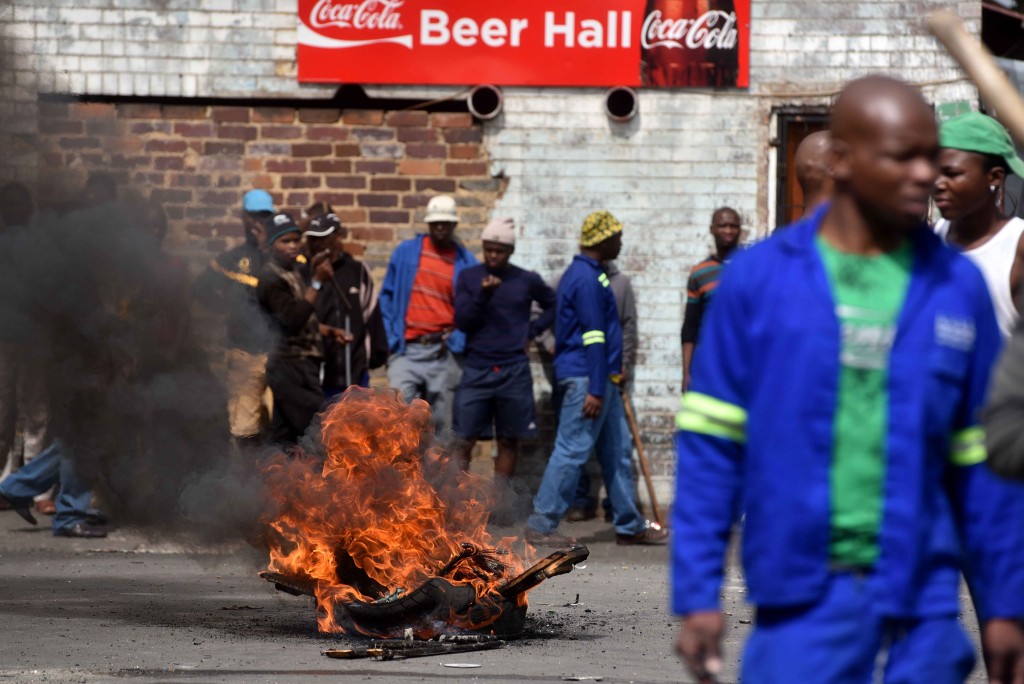
JEREMY MAGGS: Now this has become a big problem not only in Johannesburg but around the country – xenophobic tension is not only a threat to lives and communities, it’s also a threat to jobs, informal trade and investor confidence and the stability of local economies.
With fears of further anti-immigrant mobilisation, questions are growing about who benefits when economic frustration is redirected towards foreign nationals instead of unemployment, weak service delivery and failing governance.
It is a front and centre issue in South Africa right now, and joining me is Sandile Swana, who is a respected political commentator and also a principal consultant at the Centre for Strategic Leadership.
Sandile, first of all, what damage do you think anti-immigrant intimidation – and we’re seeing a lot of it right now – is doing to township businesses, jobs and local economies? How serious has it become?
SANDILE SWANA: As you know, Jeremy, we’ve experienced violence, I’m taking [about] Gauteng now, we’ve experienced violence before, and the unease, the [uncertainty] that it creates makes the average citizen work less, because you’re rushing to get home to a place that you think is safer.
So it has an automatic, depressing effect.
It reminds me of one of the chief economists at Eskom one time being asked, what does load shedding do to the economy? He said there is no amount of load shedding that is good for the economy.
So I will say to you, there is no amount of instability, no amount of threats and violence and damage to property that is beneficial to the economy at all.
ADVERTISEMENT
CONTINUE READING BELOW
Research has shown us that when this becomes a major focus of any nation, certainly since 1960 here in Africa, there is no nation that has benefited economically, socially or politically from this focus on chasing immigrants.
JEREMY MAGGS: As you observe the current situation, do you think that this is genuine public frustration? Or do you think that it is being driven by deliberate mobilisation?
SANDILE SWANA: This is deliberate mobilisation, and there are forces – we may not be able to identify them accurately – but there are those who have identified themselves with this movement, being ActionSA, uMkhonto weSizwe Party (MKP), Patriotic Alliance (PA) and so on — political entities.
But this is my question, Jeremy, if you look at 1994, Nelson Mandela is the president of the country. He takes over in the elections in April.
Now, one of the things that Nelson Mandela did with [FW] de Klerk, he said — after they killed Chris Hani – he said, De Klerk, let’s not delay the elections because when we continue to delay the elections, all sorts of people start their own agendas, including this one of killing Chris Hani, because now the right wing and other people want to derail this process. So let’s have this election.
De Klerk said, look man, we [don’t have] the proper population register. And Mandela said, people must come with whatever paper they can bring to identify themselves. So the elections took place.
In that whole group of people who were there, there were many South Africans who didn’t have proper IDs. There had been a system, the Wenela (Witwatersrand Native Labour Association) system, the Teba (The Employment Bureau of Africa) system, for recruiting ( …) people into the mines and the industries at fixed prices and so on.
So these foreigners were here. Now, in December of the same year, six or seven months after the elections, groups of youths are energised, mobilised, equipped to start killing foreigners in Alexandra township.
There was no new census that had happened. Nobody had verified what the level of unemployment was, it was much lower. Some of the provinces, like Western Cape had full employment, by the way, in 1994.
Nobody had published any statistics about unemployment. Nobody had done a census. These youths, if you are a youngster in Alex, you know nothing about the level of unemployment in the country or the census, you know nothing.
ADVERTISEMENT:
CONTINUE READING BELOW
So somebody took the steps to energise these youths, organised them into killing units, and the killing started and it ran until about March the following year.
So I am saying this has happened repeatedly over time. There are certain episodes of it and there are political actors who have been behind this.
JEREMY MAGGS: Let me ask you a question about current consequence and fallout. Do you think we’re at a point now where this kind of unrest or violence has the potential to make investors and employers even more reluctant to put money into vulnerable communities?
SANDILE SWANA: I’ll put it – that’s a narrow question – into the vulnerable communities. But there was strong violence in the July 2021 insurrection, that [Cyril] Ramaphosa identified as an insurrection, where shops were damaged.
The supermarkets, the retailers continue to reinvest in the townships. So it comes and goes. I don’t think that is the problem.
Number two, our Moody’s rating has gone up. So big business and investors are not worried that the GNU (government of national unity) will not be able to handle this from a business continuity and business security perspective.
JEREMY MAGGS: So how do you believe the GNU should be approaching this then?
SANDILE SWANA: I think the GNU should approach this as a GNU. In other words, what I’m saying to you is that my view of what they’ve done this week is that the ANC (African National Congress) is trying to be the James Bond of this whole thing, the star that comes out glorious.
And thus, I don’t think that is fair, I don’t think that is reasonable.
I think the Minister of Home Affairs (Leon Schreiber), of which I think we have a very competent minister of Home Affairs, should have been given an opportunity to engage the stakeholders and clarify the successful programmes that it’s already engaged in in reformulating our immigration policies, practices and also population registration.
ADVERTISEMENT:
CONTINUE READING BELOW
I think Home Affairs is becoming successful, and give channels for everybody who wants to make an input to give that input.
Those concerned with unemployment need to be given their own platform under the trade and industry, and to address those things in detail.
There are certain details that I think are being overlooked in all of these things. For instance, when people say they want to monopolise spaza shops.
JEREMY MAGGS: Sandile, that’s one side of the equation. But again, ahead of the planned 30 June action that we’re hearing about, there’s also the question about where police and intelligence services are when threats of violence such as this one are being made openly.
SANDILE SWANA: Yes, that is the biggest question right now, even perhaps more important than what I’ve said now, because mine is the medium to long-term solution.
The immediate solution to that, and it worked before when the EFF (Economic Freedom Fighters) threatened to do a shutdown in South Africa, the police had plans. We may not say the plans were perfect, but they neutralised that shutdown.
So I’m hoping that the meeting that was [held], and I could hear from the tone of [Fikile] Mbalula speaking, obviously they are trying to claim the glory as the ANC.
I think our security services are ready, and they know where the hotspots are and they should be fully able to pre-empt completely this whole thing.
JEREMY MAGGS: Sandile Swana, thank you very much indeed for that analysis. He is a political commentator, also principal consultant at the Centre for Strategic Leadership. Thank you very much.
#Xenophobic #violence #contained